Kirjojen hintavertailu. Mukana 12 390 323 kirjaa ja 12 kauppaa.

Kirjailija

Dustin Voss

Kirjat ja teokset yhdessä paikassa: 3 kirjaa, julkaisuja vuosilta 2019-2025, suosituimpien joukossa Money. Vertaile teosten hintoja ja tarkista saatavuus suomalaisista kirjakaupoista.

3 kirjaa

Kirjojen julkaisuhaarukka 2019-2025.

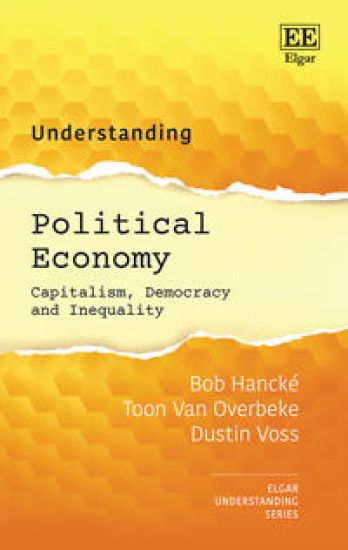
Understanding Political Economy

Understanding Political Economy

Bob Hancké; Toon Van Overbeke; Dustin Voss

EDWARD ELGAR PUBLISHING LTD
2025
sidottu
This book unpacks what political economy is and does through an investigation of its main questions and approaches. Bob Hancké, Toon Van Overbeke and Dustin Voss offer a historical and thematic review of the evolution of political-economic thought, centred on the relation between capitalism and democracy.Chapters discuss how interests, ideas and institutions are the methodological and conceptual building blocks of political economy. The authors use these concepts to understand how markets work and why they fail, the problems facing the welfare state, the political economy of voting and democracy, and the problems of cooperation in a world of interdependent democracies. Covering the main analytical approaches that political economists have developed to tackle the complexities of this social world, the book expands on some of the most important questions confronting the field.Understanding Political Economy is an invaluable resource for academics and students of political science, economics, and international relations. Its insights on capitalism, democracy and inequality are vital for policymakers in the field.

Money

Money

Nico Stehr; Dustin Voss

Routledge
2019
nidottu
Since the publication of Georg Simmel’s Philosophy of Money more than a century ago, social science has primarily considered money a medium of exchange. This new book treats money as a more inclusive social concept that has profoundly influenced the emergence of modern society. Money is also a moral and political category. It communicates prices and thus embodies innumerable evaluations and judgments of objects and services, of social relationships and associations.At the same time, modern societies are undergoing fundamental transformations in which money assumes an ever-important role, while banking and financial services constitute the new primary sector of modern service economies. In this book, the authors trace the transformational scope of monetarization and financialization along the four classical productive forces—land, capital, labor, and knowledge—and evaluate the consequences of an irrepressible urge to quantify and monetarize almost everything social. What happens to a society in which the tangible products of the real economy lose their preeminent status, and everything is judged purely according to its economic value? The authors identify an increasing disconnect between market prices and social values with serious social, political, economic, and environmental consequences.
Money

Money

Nico Stehr; Dustin Voss

Routledge
2019
sidottu
Since the publication of Georg Simmel’s Philosophy of Money more than a century ago, social science has primarily considered money a medium of exchange. This new book treats money as a more inclusive social concept that has profoundly influenced the emergence of modern society. Money is also a moral and political category. It communicates prices and thus embodies innumerable evaluations and judgments of objects and services, of social relationships and associations.At the same time, modern societies are undergoing fundamental transformations in which money assumes an ever-important role, while banking and financial services constitute the new primary sector of modern service economies. In this book, the authors trace the transformational scope of monetarization and financialization along the four classical productive forces—land, capital, labor, and knowledge—and evaluate the consequences of an irrepressible urge to quantify and monetarize almost everything social. What happens to a society in which the tangible products of the real economy lose their preeminent status, and everything is judged purely according to its economic value? The authors identify an increasing disconnect between market prices and social values with serious social, political, economic, and environmental consequences.