Kirjojen hintavertailu. Mukana 12 152 606 kirjaa ja 12 kauppaa.

Kirjailija

Dwight H. Perkins

Kirjat ja teokset yhdessä paikassa: 10 kirjaa, julkaisuja vuosilta 1966-2015, suosituimpien joukossa Under New Ownership. Vertaile teosten hintoja ja tarkista saatavuus suomalaisista kirjakaupoista.

10 kirjaa

Kirjojen julkaisuhaarukka 1966-2015.

Under New Ownership

Under New Ownership

Shahid Yusuf; Kaoru Nabeshima; Dwight H. Perkins

World Bank Publications
2005
nidottu
Although China's centrally planned economy is a little more than a shadow of its former self, the closely inter-linked reforms of the enterprise and banking sectors are still incomplete. The relative size of the state-owned enterprise sector has been much reduced, however, the sector remains the dominant borrower from the banking system and is responsible for the majority of bank non-performing assets. Thus in the interests of financial stability it is crucial to implement the remaining reform agenda. The accession to the WTO has also made it more urgent for China's most-dynamic state-owned enterprises and her banking industry to compete through innovation, continuing process upgrades, and active pursuit of strategies aimed at succeeding in global markets. In order to do so, not only do large state-owned industrial enterprises need to be privatized, but the government also needs to create the conditions that will result in market determined consolidation of small and medium size firms into entities with a core strength. Under New Ownership explores the effects of ownership reform in China on the performance of reformed industrial state-owned enterprises, and proposes privatization as a course of action to truly transform these enterprises into world class firms which compete on the basis of sound strategy, effective organization, and innovation. It draws upon newly collected firm level survey data to assess changes in the ownership structure of state enterprises on management, governance, innovation, and performance relative to other types of firms in China. This title provides researchers, students, and policymakers interested in the Chinese economy with in depth information and analysis on key issues related to the reform of state-owned enterprises.
Under New Ownership

Under New Ownership

Shahid Yusuf; Dwight H. Perkins; Kaoru Nabeshima

Stanford University Press
2005
sidottu
Drawing upon new firm-level survey data, this volume assesses how changes in the ownership structure of SOEs affect management, governance, innovation, and performance, comparing these SOEs to other types of firms in China.
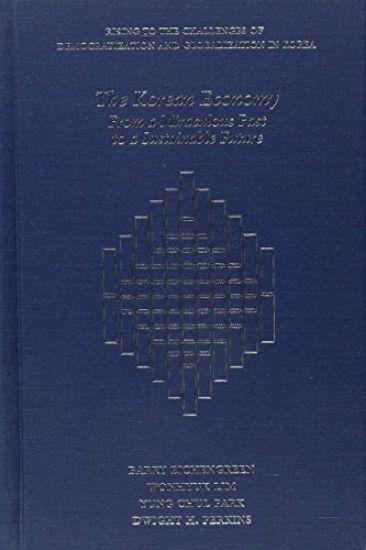
The Korean Economy

The Korean Economy

Barry Eichengreen; Wonhyuk Lim; Yung Chul Park; Dwight H. Perkins

Harvard University, Asia Center
2015
sidottu
South Korea has been held out as an economic miracle—as a country that successfully completed the transition from underdeveloped to developed country status—and as an example of how a middle-income country can continue to move up the technology ladder into the production and export of more sophisticated goods and services. But with these successes have come challenges, among them poverty, inequality, long work hours, financial instability, and complaints about the economic and political power of the country’s large corporate conglomerates, or chaebol.The Korean Economy provides an overview of Korean economic experience since the 1950s, with a focus on the period since democratization in 1987. Successive chapters analyze the Korean experience from the perspectives of political economy, the growth record, industrial organization and corporate governance, financial development and instability, labor and employment, inequality and social policy, and Korea’s place in the world economy. A concluding chapter describes the country’s economic challenges going forward and how they can best be met. The volume also serves to summarize the findings of companion volumes in the Harvard–Korean Development Institute series on the Korean economy, also published by the Harvard University Asia Center.
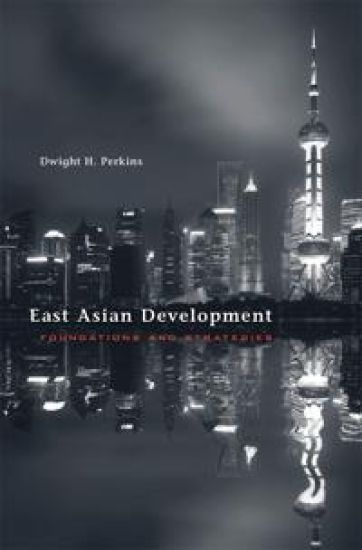
East Asian Development

East Asian Development

Dwight H. Perkins

Harvard University Press
2013
sidottu
In the early 1960s, fewer than five percent of Japanese owned automobiles, China’s per capita income was among the lowest in Asia, and living standards in South Korea’s rural areas were on par with some of the world’s poorest countries. Today, these are three of the most powerful economies on earth. Dwight Perkins grapples with both the contemporary and historical causes and consequences of the turnaround, drawing on firsthand experience in the region to explain how Asian countries sustained such rapid economic growth in the second half of the twentieth century.East Asian Development offers a comprehensive view of the region, from Japan and the “Asian Tigers” (Hong Kong, Singapore, Taiwan, South Korea) to Indonesia, Vietnam, Thailand, Malaysia, and China—a behemoth larger than all the other economies combined. While the overall picture of Asian growth is positive, no single economic policy has been effective regionwide. Interventionist policies that worked well in some countries failed elsewhere. Perkins analyzes income distribution, to uncover why initially egalitarian societies have ended up in very different places, with Japan, for example, maintaining a modest gap between rich and poor while China has become one of Asia’s most unequal economies.Today, the once-dynamic Japanese and Korean economies are sluggish, and even China shows signs of losing steam. Perkins investigates whether this is a regional phenomenon or typical of all economies at this stage of development. His inquiry reminds us that the uncharted waters of China’s vast economy make predictions of its future performance speculative at best.
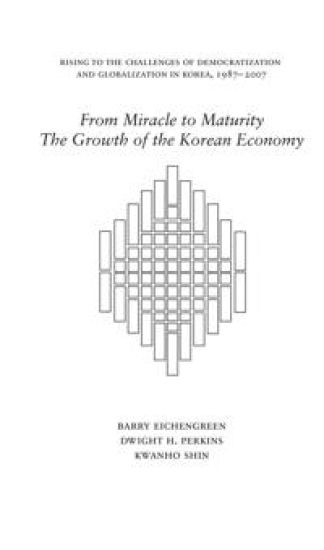
From Miracle to Maturity

From Miracle to Maturity

Barry Eichengreen; Dwight H. Perkins; Kwanho Shin

Harvard University, Asia Center
2012
sidottu
The economic growth of South Korea has been a remarkable success story. After the Korean War, the country was one of the poorest economies on the planet; by the twenty-first century, it had become a middle-income country, a member of the Organization of Economic Cooperation and Development (the club of advanced economies), and home to some of the world’s leading industrial corporations. And yet, many Koreans are less than satisfied with their country’s economic performance, given the continuing financial volatility and sluggish growth since the Korean economic crisis of 1997–1998.From Miracle to Maturity offers a comprehensive qualitative and quantitative analysis of the growth of the Korean economy, starting with the aggregate sources of growth (growth of the labor force, the stock of capital, and productivity) and then delving deeper into the roles played by structural change, exports, foreign investment, and financial development. The authors provide a detailed examination of the question of whether the Korean economy is now underperforming and ask, if so, what can be done to solve the problem.
The Challenges of China's Growth

The Challenges of China's Growth

Dwight H. Perkins

AEI Press
2007
pokkari
China's economic growth since 1978 has transformed the country. People are richer, freer, and healthier than they have ever been, and if current growth rates are sustained, poverty will be eliminated in China by 2025. But China's economic growth has also created its own challe...
Under New Ownership

Under New Ownership

Shahid Yusuf; Dwight H. Perkins; Kaoru Nabeshima

Stanford University Press
2005
pokkari
Although the relative size of the public sector has been much reduced worldwide since the early 1980s, it remains the dominant borrower from the banking system and responsible for the majority of the non-performing assets of banks. Drawing upon new firm-level survey data, this volume assesses how changes in the ownership structure of SOEs affect management, governance, innovation, and performance, comparing these SOEs to other types of firms in China. It also considers China's reform efforts against the experiences of other transition economies. The research reveals that the medium- and longer-term gains from privatization far outweigh costs of adjustment and that the precise mechanics of privatization have little effect on outcomes. The volume argues that privatization of large industrial SOEs and market-based consolidation of small- and medium-sized enterprises will be necessary to transform them into competitive and innovative world-class firms. Chapters include: China's Industrial System: Where is it, Where it Should be Headed, and Why; Reform in China, 1978-1997; The Accelerated Change in Enterprise Ownership, 1997-2003; Chinese Ownership Reform in the East European Mirror; Empirical Evidence on the Effect of SOE Reform in China; and Making Privatization Work.
Market Control and Planning in Communist China

Market Control and Planning in Communist China

Dwight H. Perkins

Harvard University Press
1966
sidottu
In the first study in depth of this subject by an economist, the author focuses on a major problem—common to all planned economies—that has confronted the Chinese Communists: whether to centralize all controls in the hands of the planners, or to allow factory and farm managers some degree of autonomy regulated only by the indirect pressures of the market. Because the finding of a satisfactory solution has been of highest importance to Peking, this study of the issue throws light on the shifts and turns of Chinese economic policy in general and on the underlying nature and significance of the broad trends in China's economy and society since 1949.