Kirjojen hintavertailu. Mukana 12 585 195 kirjaa ja 12 kauppaa.

Kirjailija

E.G. Frankel

Kirjat ja teokset yhdessä paikassa: 12 kirjaa, julkaisuja vuosilta 1988-2012, suosituimpien joukossa Challenging American Leadership. Vertaile teosten hintoja ja tarkista saatavuus suomalaisista kirjakaupoista.

Mukana myös kirjoitusasut: E G Frankel

12 kirjaa

Kirjojen julkaisuhaarukka 1988-2012.

Systems Reliability and Risk Analysis
Ernst G. Frankel This book has its origin in lecture notes developed over several years for use in a course in Systems Reliability f~r engineers concerned with the design of physical systems such as civil structures, power plants, and transport systems of all types. Increasing public concern with the reliability of systems for reasons of human safety, environmental protection, and acceptable investment risk limitations has resulted in an increasing interest by engineers in the formal application of reliability theory to engineering design. At the same time there is a demand for more effective approaches to the design of procedures for the operation and use of man­ made systems, more meaningful assessment of the risks introduced, and use such a system poses both when operating as designed and when operating at below design performance. The purpose of the book is to provide a sound, yet practical, introduction to reliability analysis and risk assessment which can be used by professionals in engineering, planning, management, and economics to improve the design, operation, and risk assessment of systems of interest. The text should be useful for students in many disciplines and is designed for fourth-year undergraduates or first-year graduate students. I would like to acknowledge the help of many of my graduate students who contributed to the development of this book by offering comments and criticism. Similarly, I would like to thank Mrs. Sheila McNary who typed untold drafts of the manuscript, and Mr.
Systems Reliability and Risk Analysis
Ernst G. Frankel This book has its origin in lecture notes developed over several years for use in a course in Systems Reliability for engineers concerned with the design of physical systems such as civil structures, power plants, and transport vehicles of all types. Increasing public concern with the reliability o~ systems for reasons of human safety, environmental protection, and acceptable ir. vestment risk limitations has resulted in an increasing interest by engineers in the formal applica~i0n of reliability theory to e~gineering desian. At the same time there is a demand for more effective approaches to the des~gn of procedures for the operation and use of man-made syste~s and more meaningful assessment of the risks intr)duction and use of such a system poses both when operating as designed and when operating at below design performance. The purpose of the book is to provide a sound, yet practical, introduction to reliability analysis and risk assessment which can be used by professionals in engineering, planning, management, and economics to improve the design, operation, and risk assessment of systems of interest. The text should be useful for students in many disciplines and is designed for fourth~year undergraduates or first-year graduate students. I would like to acknowledge the help of many of my graduate students who contributed to the development of this book by offering comments and criticism. Similarly I would like to thank Mrs.
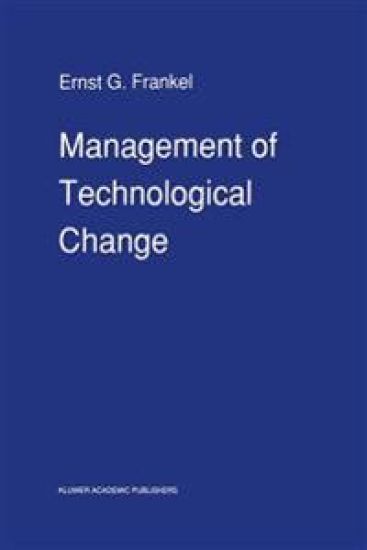
Management of Technological Change
Technological change has been recognized as the major contributor to economic growth and has become one of the most important challenges to policy makers and managers. Many excellent books and papers have been written on the subject. Most of these deal with the macro or micro economic impact of technological change or the technological change process from invention and discovery to innovation, development, and final maturity as well as ultimate obsolescence of technology. This book is designed to present technological change as a decision process and explain the use of recently developed methods for the effective management of technological change. In particular, techniques for the effective choice among technological alternatives, timing of the introduction of new technology both in terms of its own status and that of the technology to be replaced if any, and the rate and method of introduction of new technology are presented. Management of technology is a complex decision process which is affected by both internal and external factors. The purpose of this book is to instruct the reader in effective technology deciSion making which involves the evaluation of the status of technology in use if any, the problem to be solved or output to be obtained, determination of environmental and internal constraints, and the competitive environment or market conditions which affect the technology decisions.
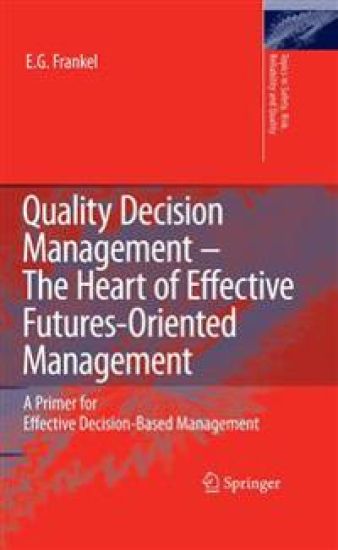
Quality Decision Management -The Heart of Effective Futures-Oriented Management
Over the years I have worked with or consulted for many managers throughout the world at all levels of industry and government. I have seen who succeeded, achieved goals, and made progress, and who failed or crashed. I have studied their methods of operation and their decision-making approach, as well as the range of people involved in the decision-making. I similarly personally managed large industrial and service organizations and their operations, and found that to succeed and have a content team of collaborators, decision-making had to be joint and delegated to the lowest competent and informed level. Using this approach not only improved the performance of the organization or firm, but also resulted in a more content, professional, cooperative, happy, and competent workforce. In general, people like to assume responsibility, particularly of functions with which they are intimately familiar. They enjoy the role of de- sion-maker and the use of their knowledge and experience in guiding their and related work. Delegation of decision-making not only infuses pride and conte- ment but also assures more informed, timely, and effective implementation of de- sions. It also adds to worker training and education as workers inquire, develop information and use of their own experience in improving their decision-making. Worker pride and feeling of control and involvement lead to contentment and s- isfaction which, in return, pays dividends in worker productivity, morale, retention, and resulting low turnover.
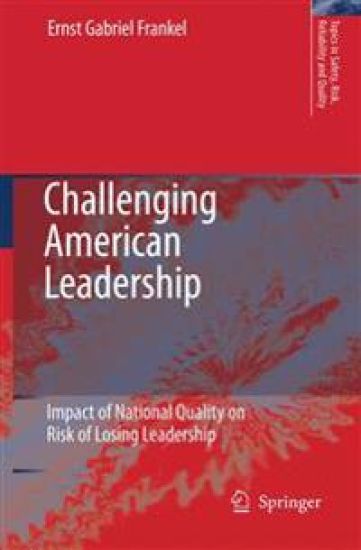
Challenging American Leadership

Challenging American Leadership

E.G. Frankel

Springer
2010
nidottu
After leading the world during most of the 20th century in economic, political, technological, military, and even social terms, America’s role is now being challenged. Its values questioned, and its methods often disparaged, America had become the clear example to be followed or even copied, yet its more recent strategic and political decisions gained little international support and a lot of outright opposition. The quality of its national planning and decision making has been severely compromised, and risk management appears to be largely absent. India and China are now emerging as new economic powers, with advancing technological prowess. Their focus is on socioeconomic development, but their capabilities and potentials are much broader and may challenge America's leadership before long, unless it recognizes the changing demands of the new wide open globalized world.
Oil and Security

Oil and Security

E.G. Frankel

Springer
2010
nidottu
This book examines the economic impact of changes in the global demand and supply for fossil fuels both on the major producers in Middle Eastern countries around the Persian Gulf, other producers, as well as the world at large. The economic, social and political life of most countries is not only intimately linked to and influenced by the energy market but also affected by historical developments. Among other issues, it shows how the economic, social and political development of societies in Arabia, the peoples of the Arab Peninsula are influenced by their historic and cultural environment, and what the future may bring to this region when their principal economic assets, petroleum and gas, start to lose markets as alternative sources of fossil fuel, alternative, and renewable energy supply the bulk of global energy needs. It also describes how changing fossil fuel costs, access, security of supply, and environmental impacts may affect future economic, social, and political developments as well as technological advances and changes in priorities.
Quality Decision Management -The Heart of Effective Futures-Oriented Management
Over the years I have worked with or consulted for many managers throughout the world at all levels of industry and government. I have seen who succeeded, achieved goals, and made progress, and who failed or crashed. I have studied their methods of operation and their decision-making approach, as well as the range of people involved in the decision-making. I similarly personally managed large industrial and service organizations and their operations, and found that to succeed and have a content team of collaborators, decision-making had to be joint and delegated to the lowest competent and informed level. Using this approach not only improved the performance of the organization or firm, but also resulted in a more content, professional, cooperative, happy, and competent workforce. In general, people like to assume responsibility, particularly of functions with which they are intimately familiar. They enjoy the role of de- sion-maker and the use of their knowledge and experience in guiding their and related work. Delegation of decision-making not only infuses pride and conte- ment but also assures more informed, timely, and effective implementation of de- sions. It also adds to worker training and education as workers inquire, develop information and use of their own experience in improving their decision-making. Worker pride and feeling of control and involvement lead to contentment and s- isfaction which, in return, pays dividends in worker productivity, morale, retention, and resulting low turnover.
Oil and Security

Oil and Security

E.G. Frankel

Springer-Verlag New York Inc.
2007
sidottu
This book examines the economic impact of changes in the global demand and supply for fossil fuels both on the major producers in Middle Eastern countries around the Persian Gulf, other producers, as well as the world at large. The economic, social and political life of most countries is not only intimately linked to and influenced by the energy market but also affected by historical developments. Among other issues, it shows how the economic, social and political development of societies in Arabia, the peoples of the Arab Peninsula are influenced by their historic and cultural environment, and what the future may bring to this region when their principal economic assets, petroleum and gas, start to lose markets as alternative sources of fossil fuel, alternative, and renewable energy supply the bulk of global energy needs. It also describes how changing fossil fuel costs, access, security of supply, and environmental impacts may affect future economic, social, and political developments as well as technological advances and changes in priorities.
Challenging American Leadership

Challenging American Leadership

E.G. Frankel

Springer-Verlag New York Inc.
2006
sidottu
After leading the world during most of the 20th century in economic, political, technological, military, and even social terms, America’s role is now being challenged. Its values questioned, and its methods often disparaged, America had become the clear example to be followed or even copied, yet its more recent strategic and political decisions gained little international support and a lot of outright opposition. The quality of its national planning and decision making has been severely compromised, and risk management appears to be largely absent. India and China are now emerging as new economic powers, with advancing technological prowess. Their focus is on socioeconomic development, but their capabilities and potentials are much broader and may challenge America's leadership before long, unless it recognizes the changing demands of the new wide open globalized world.
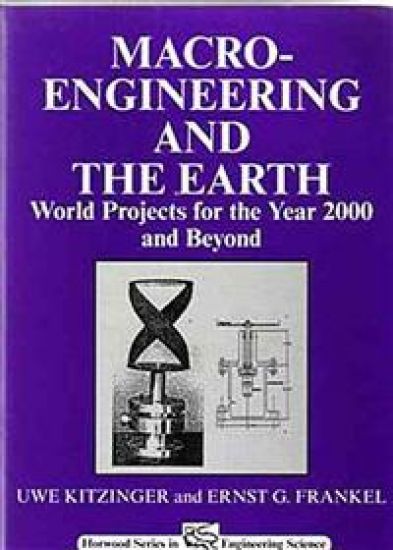
Macro-Engineering and the Earth

Macro-Engineering and the Earth

U W Kitzinger; E G Frankel

Horwood Publishing Ltd
1998
sidottu
This work delivers ideas, comments and projects on energy, communications, transport, management, human resources, and financial and legal issues which macroengineering can contribute towards the solution of the Earth's environmental problems. Some 20 engineers and scholars identify problems in the next century whose solutions call for international policy planning and a more collaborative, peaceful and prosperous world order. Imaginative concepts employ forward thinking for applying technology in revolutionary projects. The book presents results of research on a triple helical turbine capable of extracting vast amounts of energy from slow-moving water, an invention which could harness rivers and ocean currents, rendering high dams (with their political, social and ecological implications) redundant. These turbines are already in mass production in the USA for use in the Gulf Stream to produce energy and hydrogen fuel, and can also be used to harness power from the wind. Another project, for which the technology is already available, will harvest solar energy by satellites stationed beyond our atmosphere and beam it to the Earth; and yet another calls for planetary defence of Earth against asteroid collisions. The environmental section discusses large projects for changing our climate, planning and costing for a sub-Mediterranean aqueduct connecting the River Rhone in France with Algeria, and plans for intensive fish farming of the oceans. The role of satellites includes telemedicine, and there are Swiss plans for further tunnelling through the Alps. Project management sections include the formation of a military-civilian conservation corps, financial and legal issues, macro-projects in China, and a forecast of 21st century macro-problems.
Management of Technological Change
Technological change has been recognized as the major contributor to economic growth and has become one of the most important challenges to policy makers and managers. Many excellent books and papers have been written on the subject. Most of these deal with the macro or micro economic impact of technological change or the technological change process from invention and discovery to innovation, development, and final maturity as well as ultimate obsolescence of technology. This book is designed to present technological change as a decision process and explain the use of recently developed methods for the effective management of technological change. In particular, techniques for the effective choice among technological alternatives, timing of the introduction of new technology both in terms of its own status and that of the technology to be replaced if any, and the rate and method of introduction of new technology are presented. Management of technology is a complex decision process which is affected by both internal and external factors. The purpose of this book is to instruct the reader in effective technology deciSion making which involves the evaluation of the status of technology in use if any, the problem to be solved or output to be obtained, determination of environmental and internal constraints, and the competitive environment or market conditions which affect the technology decisions.
Systems Reliability and Risk Analysis

Systems Reliability and Risk Analysis

E.G. Frankel

Kluwer Academic Publishers
1988
sidottu
Ernst G. Frankel This book has its origin in lecture notes developed over several years for use in a course in Systems Reliability f~r engineers concerned with the design of physical systems such as civil structures, power plants, and transport systems of all types. Increasing public concern with the reliability of systems for reasons of human safety, environmental protection, and acceptable investment risk limitations has resulted in an increasing interest by engineers in the formal application of reliability theory to engineering design. At the same time there is a demand for more effective approaches to the design of procedures for the operation and use of man­ made systems, more meaningful assessment of the risks introduced, and use such a system poses both when operating as designed and when operating at below design performance. The purpose of the book is to provide a sound, yet practical, introduction to reliability analysis and risk assessment which can be used by professionals in engineering, planning, management, and economics to improve the design, operation, and risk assessment of systems of interest. The text should be useful for students in many disciplines and is designed for fourth-year undergraduates or first-year graduate students. I would like to acknowledge the help of many of my graduate students who contributed to the development of this book by offering comments and criticism. Similarly, I would like to thank Mrs. Sheila McNary who typed untold drafts of the manuscript, and Mr.