Kirjojen hintavertailu. Mukana 12 595 353 kirjaa ja 12 kauppaa.
Kirjailija
E.N. Anderson
Kirjat ja teokset yhdessä paikassa: 4 kirjaa, julkaisuja vuosilta 2022-2026, suosituimpien joukossa The Origins of Prejudice. Vertaile teosten hintoja ja tarkista saatavuus suomalaisista kirjakaupoista.
Mukana myös kirjoitusasut: E N Anderson, E. N. Anderson
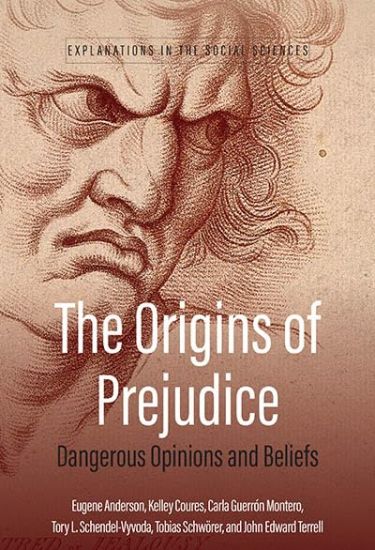
Being prejudiced is usually taken to mean having hasty and poorly founded feelings and opinions, usually negative, that are based on too little real knowledge and careful consideration. Definitions, however, are not explanations. The Origins of Prejudice is a short and unconventional book that shows you step-by-step both how and why all of us who are human often rely uncritically on what we believe to be true about the people, things, and events shaping our lives outside the hidden world of our bony skull. This book aims to show how we can learn from our possibly unintentional acts and self-serving misdeeds to live together in supportive, less conflicted ways.
This book examines the origins of genocide and mass murder in the everyday conflicts of ordinary people, exacerbated by special interests. We examine cases harming people simply because they are considered unworthy and undeserving—for instance, if they are dehumanized. We confine our attention to genocide, mass murder, large-scale killing motivated by hate or desire for gain, and fascism as an ideology since it usually advocates and leads to such killing. The book draws on social psychology, especially recent work on the psychology of prejudice. Much new information on the psychology of fear, hate, intolerance, and violence has appeared in recent years. The world has also learned more on the funding of dehumanization by giant corporations via “dark money,” and on the psychology of genocidal leaders. This allows us to construct a much more detailed back story of why people erupt into mass killing of minorities and vulnerable populations. We thus go on to deal with the whole “problem of evil” (or at least apparently irrational killing) in general, broadening the perspective to include politics, economics, and society at large. We draw on psychology, sociology, economics, political science, public health, anthropology, and biology in a uniquely cross-disciplinary work.
This book examines the origins of genocide and mass murder in the everyday conflicts of ordinary people, exacerbated by special interests. We examine cases harming people simply because they are considered unworthy and undeserving—for instance, if they are dehumanized. We confine our attention to genocide, mass murder, large-scale killing motivated by hate or desire for gain, and fascism as an ideology since it usually advocates and leads to such killing. The book draws on social psychology, especially recent work on the psychology of prejudice. Much new information on the psychology of fear, hate, intolerance, and violence has appeared in recent years. The world has also learned more on the funding of dehumanization by giant corporations via “dark money,” and on the psychology of genocidal leaders. This allows us to construct a much more detailed back story of why people erupt into mass killing of minorities and vulnerable populations. We thus go on to deal with the whole “problem of evil” (or at least apparently irrational killing) in general, broadening the perspective to include politics, economics, and society at large. We draw on psychology, sociology, economics, political science, public health, anthropology, and biology in a uniquely cross-disciplinary work.