Kirjojen hintavertailu. Mukana 12 152 606 kirjaa ja 12 kauppaa.

Kirjailija

Ed Pavlic

Kirjat ja teokset yhdessä paikassa: 10 kirjaa, julkaisuja vuosilta 2001-2023, suosituimpien joukossa Outward. Vertaile teosten hintoja ja tarkista saatavuus suomalaisista kirjakaupoista.

10 kirjaa

Kirjojen julkaisuhaarukka 2001-2023.

Speculation

Speculation

Ed Pavlic

Boston Review/Boston Critic Inc.
2023
nidottu
How can the literary imagination bring us closer to a better world? The world is always changing. But there are also inflection points in history when the world feels changed. Art has the prophetic power to imagine where we are going. It is perhaps no surprise, then, that in a world-historical moment of global upheaval and transformation, speculative literature and other futurist arts are enjoying a renaissance. Boston Review believes that the arts must have a voice in the conversation about how we heal. In this new anthology of poetry, fiction, and essays from renowned writers and newcomers, contributors share with readers their feats of imagining the past and future that help us better understand what it means to be present in the world. Speculation can lead us to collectively imagine better futures, or better ways of understanding our past. Abolition, civil rights, and Black Lives Matter all speculate about a future free of racial violence, just as #MeToo imagines one free of gendered violence. In some of our most joyful private moments, we speculate about what will be delicious and pleasurable, about what notes will sound good played together on an instrument, about spirits and the afterlife, about what we wish a lover would say to us, about what aliens might be like if we ever met them. Such works of the speculative imagination are, thankfully, almost boundless, though we imagine them within the bounds of who we are and what we assume to be true about the world. Where will speculation lead us next?
Repair

Repair

Kali Fajardo-Anstine; Ed Pavlic

Boston Review/Boston Critic Inc.
2022
nidottu
How we can recover from terrible ruptures, the pandemic, toxic politics, racist horrors, class warfare, gendered violence, and ecological brinksmanship. Individually and collectively, we bear deep wounds. Some of these are generations old; all have been worsened by a destructive period of pyrrhic politics that left us ill-equipped to respond to a global health catastrophe. As we struggle to recover our footing and grieve our dead, Boston Review believes that the arts must have a voice in the conversation about how we heal. In this new anthology of poetry, fiction, and essays from renowned writers and newcomers, writers explore whether and how we can repair terrible ruptures, life-threatening illnesses and the pandemic, toxic politics, racist horrors, class warfare, gendered violence, and ecological brinksmanship.
Outward

Outward

Ed Pavlic

University of Minnesota Press
2021
nidottu
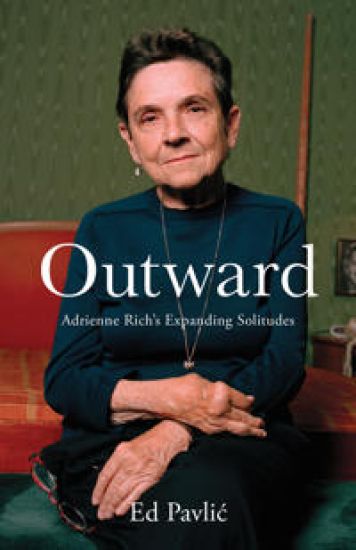
The first scholarly study of Adrienne Rich’s full career examines the poet through her developing approach to the transformative potential of relationships Adrienne Rich is best known as a feminist poet and activist. This iconic status owes especially to her work during the 1970s, while the distinctive political and social visions she achieved during the second half of her career remain inadequately understood. In Outward, poet, scholar, and novelist Ed Pavlic considers Rich’s entire oeuvre to argue that her most profound contribution in poems is her emphasis on not only what goes on “within us” but also what goes on “between us.” Guided by this insight, Pavlic shows how Rich’s most radical work depicts our lives-from the public to the intimate-in shared space rather than in owned privacy.Informed by Pavlic’s friendship and correspondence with Rich, Outward explores how her poems position visionary possibilities to contend with cruelty and violence in our world. Employing an innovative framework, Pavlic examines five kinds of solitude reflected in Rich’s poems: relational solitude, social solitude, fugitive solitude, dissident solitude, and radical solitude. He traces the importance of relationships to her early writing before turning to Rich’s explicitly antiracist and anticapitalist work in the 1980s, which culminates with her most extensive sequence, “An Atlas of the Difficult World.” Pavlic concludes by examining the poet’s twenty-first century work and its depiction of relationships that defy historical divisions based on region, race, class, gender, and sexuality.A deftly written engagement in which one poet works within the poems of another, Outward reveals the development of a major feminist thinker in successive phases as Rich furthers her intimate and erotic, social and political reach. Pavlic illuminates Rich’s belief that social divisions and the power of capital inform but must never fully script our identities or our relationships to each other.
Outward

Outward

Ed Pavlic

University of Minnesota Press
2021
sidottu
The first scholarly study of Adrienne Rich’s full career examines the poet through her developing approach to the transformative potential of relationships Adrienne Rich is best known as a feminist poet and activist. This iconic status owes especially to her work during the 1970s, while the distinctive political and social visions she achieved during the second half of her career remain inadequately understood. In Outward, poet, scholar, and novelist Ed Pavlic considers Rich’s entire oeuvre to argue that her most profound contribution in poems is her emphasis on not only what goes on “within us” but also what goes on “between us.” Guided by this insight, Pavlic shows how Rich’s most radical work depicts our lives-from the public to the intimate-in shared space rather than in owned privacy.Informed by Pavlic’s friendship and correspondence with Rich, Outward explores how her poems position visionary possibilities to contend with cruelty and violence in our world. Employing an innovative framework, Pavlic examines five kinds of solitude reflected in Rich’s poems: relational solitude, social solitude, fugitive solitude, dissident solitude, and radical solitude. He traces the importance of relationships to her early writing before turning to Rich’s explicitly antiracist and anticapitalist work in the 1980s, which culminates with her most extensive sequence, “An Atlas of the Difficult World.” Pavlic concludes by examining the poet’s twenty-first century work and its depiction of relationships that defy historical divisions based on region, race, class, gender, and sexuality.A deftly written engagement in which one poet works within the poems of another, Outward reveals the development of a major feminist thinker in successive phases as Rich furthers her intimate and erotic, social and political reach. Pavlic illuminates Rich’s belief that social divisions and the power of capital inform but must never fully script our identities or our relationships to each other.
Who Can Afford to Improvise?

Who Can Afford to Improvise?

Ed Pavlic

Fordham University Press
2017
pokkari
More than a quarter-century after his death, James Baldwin remains an unparalleled figure in American literature and African American cultural politics. In Who Can Afford to Improvise? Ed Pavlic offers an unconventional, lyrical, and accessible meditation on the life, writings, and legacy of James Baldwin and their relationship to the lyric tradition in black music, from gospel and blues to jazz and R&B. Based on unprecedented access to private correspondence, unpublished manuscripts and attuned to a musically inclined poet's skill in close listening, Who Can Afford to Improvise? frames a new narrative of James Baldwin's work and life. The route retraces the full arc of Baldwin's passage across the pages and stages of his career according to his constant interactions with black musical styles, recordings, and musicians. Presented in three books — or movements — the first listens to Baldwin, in the initial months of his most intense visibility in May 1963 and the publication of The Fire Next Time. It introduces the key terms of his lyrical aesthetic and identifies the shifting contours of Baldwin's career from his early work as a reviewer for left-leaning journals in the 1940s to his last published and unpublished works from the mid-1980s. Book II listens with Baldwin and ruminates on the recorded performances of Billie Holiday and Dinah Washington, singers whose message and methods were closely related to his developing world view. It concludes with the first detailed account of "The Hallelujah Chorus," a performance from July 1, 1973, in which Baldwin shared the stage at Carnegie Hall with Ray Charles. Finally, in Book III, Pavlic reverses our musically inflected reconsideration of Baldwin's voice, projecting it into the contemporary moment and reading its impact on everything from the music of Amy Winehouse, to the street performances of Turf Feinz, and the fire of racial oppression and militarization against black Americans in the 21st century. Always with an ear close to the music, and avoiding the safe box of celebration, Who Can Afford to Improvise? enables a new kind of "lyrical travel" with the instructive clarity and the open-ended mystery Baldwin's work invokes into the world.
Who Can Afford to Improvise?

Who Can Afford to Improvise?

Ed Pavlic

Fordham University Press
2015
sidottu
More than a quarter-century after his death, James Baldwin remains an unparalleled figure in American literature and African American cultural politics. In Who Can Afford to Improvise? Ed Pavlic offers an unconventional, lyrical, and accessible meditation on the life, writings, and legacy of James Baldwin and their relationship to the lyric tradition in black music, from gospel and blues to jazz and R&B. Based on unprecedented access to private correspondence, unpublished manuscripts and attuned to a musically inclined poet's skill in close listening, Who Can Afford to Improvise? frames a new narrative of James Baldwin's work and life. The route retraces the full arc of Baldwin's passage across the pages and stages of his career according to his constant interactions with black musical styles, recordings, and musicians. Presented in three books — or movements — the first listens to Baldwin, in the initial months of his most intense visibility in May 1963 and the publication of The Fire Next Time. It introduces the key terms of his lyrical aesthetic and identifies the shifting contours of Baldwin's career from his early work as a reviewer for left-leaning journals in the 1940s to his last published and unpublished works from the mid-1980s. Book II listens with Baldwin and ruminates on the recorded performances of Billie Holiday and Dinah Washington, singers whose message and methods were closely related to his developing world view. It concludes with the first detailed account of "The Hallelujah Chorus," a performance from July 1, 1973, in which Baldwin shared the stage at Carnegie Hall with Ray Charles. Finally, in Book III, Pavlic reverses our musically inflected reconsideration of Baldwin's voice, projecting it into the contemporary moment and reading its impact on everything from the music of Amy Winehouse, to the street performances of Turf Feinz, and the fire of racial oppression and militarization against black Americans in the 21st century. Always with an ear close to the music, and avoiding the safe box of celebration, Who Can Afford to Improvise? enables a new kind of "lyrical travel" with the instructive clarity and the open-ended mystery Baldwin's work invokes into the world.
Visiting Hours at the Color Line

Visiting Hours at the Color Line

Ed Pavlic

Milkweed Editions
2013
pokkari
Often the most recognized, even brutal, events in American history are assigned a bifurcated public narrative. We divide historical and cultural life into two camps, often segregated by a politicized, racially divided "Color Line." But how do we privately experience the most troubling features of American civilization? Where is the Color Line in the mind, in the body, between bodies, between human beings? Ed Pavlic's Visiting Hours at the Color Line, a 2012 National Poetry Series winner, attempts to complicate this black-and-white, straight-line feature of our collective imagination, and to map its nonlinear, deeply colored timbres and hues. From the daring prose poem to the powerful free verse, Pavlic's lines are musically infused, bearing tones of soul, R&B, and jazz. Meanwhile, joining the influence of James Baldwin with a postmodern consciousness the likes of Samuel Beckett, Pavlic tracks the experiences of American characters through situations both mundane and momentous, and exposes the many textures of this social, historical world as it seeps into the private dimensions of our lives. The resulting poems are intense-at times even violent-ambitious, and psychological, making Visiting Hours at the Color Line a poetic tour de force, by one of the century's most acclaimed American poets.
Winners Have Yet to Be Announced

Winners Have Yet to Be Announced

Ed Pavlic

University of Georgia Press
2008
pokkari
This moving collection of prose poems about seventies soul singer Donny Hathaway presents a complex view of a gifted artist through imagined conversations and interviews that convey the voices, surroundings, and clashing dimensions of Hathaway's life.Among mainstream audiences Hathaway is perhaps best known either as the syrupy voice singing with Roberta Flack in "Where Is the Love" or for his shocking death—he was found dead beneath the open thirteenth-story window of his New York hotel room in 1979 at the age of thirty-three. Less well known are the depth of his classical and gospel training, his wide-ranging intellectual interests, and the respect his musical knowledge, talent, and versatility commanded from collaborators like Curtis Mayfield and Aretha Franklin. Meanwhile, among listeners with special affinity for soul music of the 1970s, even almost thirty years after his death, no voice burns with the intensity of Hathaway's own in the great solo ballads and freedom songs such as "A Song for You," "Giving Up," "Someday We'll All Be Free," and "To Be Young, Gifted, and Black."Winners Have Yet to Be Announced pushes poetry toward the rich characterization and depth of a novel. Yet it is the capacity of poetic language that allows the book to examine Donny Hathaway's vivid and remarkable life without attempting to resolve the mysteries within which he lived and created and sang.
Paraph of Bone & Other Kinds of Blue

Paraph of Bone & Other Kinds of Blue

Ed Pavlic

American Poetry Review
2001
pokkari
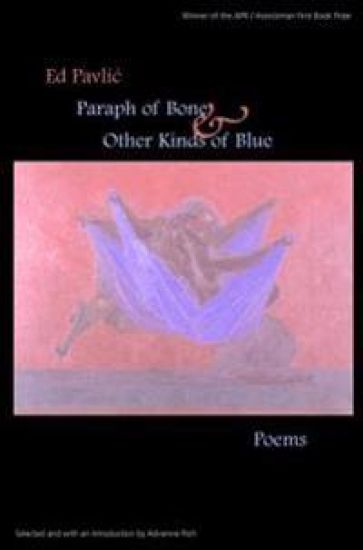
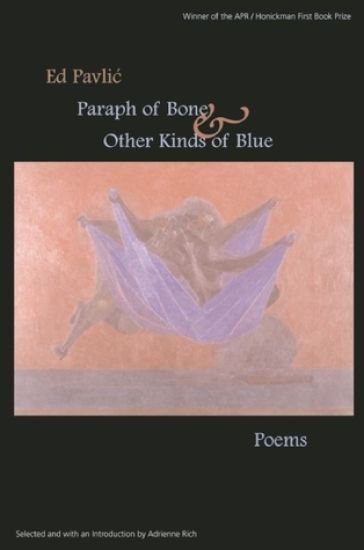
Winner of the APR/Honickman First Book.In her introduction Adrienne Rich describes Paraph of Bone & Other Kinds of Blue, as a fully conceived book, speaking as a whole from the first lines to the last... Mr. Pavlic has listened closely to our most profound American art, the blues and jazz, and that music has not only helped him achieve poetic form but allowed him to explore a mesh of experience extraneous to literary theories... This is intimate and soulful work, breathing, brushing, and tonguing its instrument.In response to Charlie Parker's theory of art, If you don't live it, it won't come out of your horn, Ed Pavlic breathes exuberant life into his poetry through rigorous attention to overlapping facets of language--visual, tonal, rhythmic.from Confessions of a Piano Roll Lover: & this new player, he's just a boy. Well drilled, won't allow his thumb to drag behind his index finger. Mistakes won't leave exit wounds, or bloom in his lapel until they're his alone. Grown. With a pocket Full of rock salt in his gait, & jalape o beard.Ed Pavlic received his BA and MA from the University of Wisconsin-Madison, and a PhD from Indiana University. He currently teach in the English Department at Union College in Schenectady, NY. His work has appeared in African American Review, Doubletake, The Black Warrior Review and elsewhere. His critical book, Crossroads Modernism: Descent and Emergence in African American Modernism is forthcoming in 2002. He lives in Schenectady, NY.