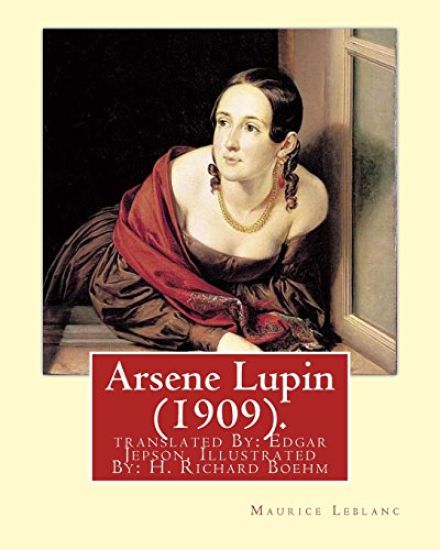
Arsene Lupin (1909). By: Maurice Leblanc: translated By: Edgar Jepson, Illustrated By: H. Richard Boehm (1871-1914).
Edgar Jepson; H. Richard Boehm; Maurice LeBlanc
Createspace Independent Publishing Platform
2018
nidottu
Maurice Marie Emile Leblanc (11 November 1864 - 6 November 1941) was a French novelist and writer of short stories, known primarily as the creator of the fictional gentleman thief and detective Ars ne Lupin, often described as a French counterpart to Arthur Conan Doyle's creation Sherlock Holmes Biography: Leblanc was born in Rouen, Normandy, where he was educated at Lyc e Pierre-Corneille. After studying in several countries and dropping out of law school, he settled in Paris and began to write fiction, both short crime stories and longer novels. The latter, heavily influenced by writers like Gustave Flaubert and Guy de Maupassant, were critically admired but had little commercial success. Leblanc was largely considered little more than a writer of short stories for various French periodicals until the first Ars ne Lupin story appeared in a series of short stories that was serialized in the magazine Je sais tout, starting in No. 6, dated 15 July 1905. Clearly created at editorial request under the influence of and in reaction to the wildly successful Sherlock Holmes stories, the roguish and glamorous Lupin was a surprise success and Leblanc's fame and fortune beckoned. In total, Leblanc went on to write 21 Lupin novels or collections of short stories. The character of Lupin might have been based by Leblanc on French anarchist Marius Jacob, whose trial made headlines in March 1905. It is also possible that Leblanc had also read Octave Mirbeau's Les 21 jours d'un neurasth nique (1901), which features a gentleman thief named Arthur Lebeau, and he had seen Mirbeau's comedy Scrupules (1902), whose main character is a gentleman thief. It was not influenced by E. W. Hornung's gentleman thief, A.J. Raffles, created in 1899, whom Leblanc had not read.By 1907, Leblanc had graduated to writing full-length Lupin novels, and the reviews and sales were so good that Leblanc effectively dedicated the rest of his career to working on the Lupin stories... Edgar Alfred Jepson (1863-1938) was an English author. He largely wrote mainstream adventure and detective fiction, but also supernatural and fantasy stories. He sometimes used the pseudonym R. Edison Page. Early life: Edgar Jepson was born on 28 November 1863 at Kenilworth, Warwickshire. He was the second of five sons and three daughters raised by Alfred and Margaret Jepson. Jepson's father, a dentist, originally hailed from Gainsborough, Lincolnshire, while his mother was a native of London. Edgar Jepson attended Leamington College for Boys (today North Leamington School and later graduated from Balliol College, Oxford. After completing his education, Jepson spent some years living in Barbados, before taking up residence in the King's Bench Walk area of London where he began his literary career............... Henry Richard Boehm Birth Nov 1871 Illinois, USA Death 1 Feb 1914 (aged 42) Ossining, Westchester County, New York, USA Artist/Illustrator. Henry Richard Boehm (known professionally as H. Richard Boehm) was an artist of some note whose work appeared on the covers and inside several magazine like COSMOPOLITAN, LESLIE'S WEEKLY, PEARSON'S, and LADIES' WORLD. He received strong praise from the editors of COSMOPOLITAN who claimed to have "discovered" him...................