Kirjojen hintavertailu. Mukana 12 390 323 kirjaa ja 12 kauppaa.

Kirjailija

Edgar N. Sanchez

Kirjat ja teokset yhdessä paikassa: 15 kirjaa, julkaisuja vuosilta 2001-2023, suosituimpien joukossa Neural Control of Renewable Electrical Power Systems. Vertaile teosten hintoja ja tarkista saatavuus suomalaisista kirjakaupoista.

Mukana myös kirjoitusasut: Edgar N. Sánchez, Edgar N Sanchez

15 kirjaa

Kirjojen julkaisuhaarukka 2001-2023.

Nonlinear Pinning Control of Complex Dynamical Networks

Nonlinear Pinning Control of Complex Dynamical Networks

Edgar N. Sanchez; Carlos J. Vega; Oscar J. Suarez; Guanrong Chen

TAYLOR FRANCIS LTD
2023
nidottu
This book presents two nonlinear control strategies for complex dynamical networks. First, sliding-mode control is used, and then the inverse optimal control approach is employed. For both cases, model-based is considered in Chapter 3 and Chapter 5; then, Chapter 4 and Chapter 6 are based on determining a model for the unknow system using a recurrent neural network, using on-line extended Kalman filtering for learning.The book is organized in four sections. The first one covers mathematical preliminaries, with a brief review for complex networks, and the pinning methodology. Additionally, sliding-mode control and inverse optimal control are introduced. Neural network structures are also discussed along with a description of the high-order ones. The second section presents the analysis and simulation results for sliding-mode control for identical as well as non-identical nodes. The third section describes analysis and simulation results for inverse optimal control considering identical or non-identical nodes. Finally, the last section presents applications of these schemes, using gene regulatory networks and microgrids as examples.
Discrete-Time Recurrent Neural Control

Discrete-Time Recurrent Neural Control

Edgar N. Sanchez

TAYLOR FRANCIS LTD
2022
nidottu
The book presents recent advances in the theory of neural control for discrete-time nonlinear systems with multiple inputs and multiple outputs. The simulation results that appear in each chapter include rigorous mathematical analyses, based on the Lyapunov approach, to establish its properties. The book contains two sections: the first focuses on the analyses of control techniques; the second is dedicated to illustrating results of real-time applications. It also provides solutions for the output trajectory tracking problem of unknown nonlinear systems based on sliding modes and inverse optimal control scheme."This book on Discrete-time Recurrent Neural Control is unique in the literature, with new knowledge and information about the new technique of recurrent neural control especially for discrete-time systems.The book is well organized and clearly presented. It will be welcome by a wide range of researchers in science and engineering, especially graduate students and junior researchers who want to learn the new notion of recurrent neural control. I believe it will have a good market.It is an excellent book after all."— Guanrong Chen, City University of Hong Kong "This book includes very relevant topics, about neural control. In these days, Artificial Neural Networks have been recovering their relevance and well-stablished importance, this due to its great capacity to process big amounts of data. Artificial Neural Networks development always is related to technological advancements; therefore, it is not a surprise that now we are being witnesses of this new era in Artificial Neural Networks, however most of the developments in this research area only focuses on applicability of the proposed schemes. However, Edgar N. Sanchez author of this book does not lose focus and include both important applications as well as a deep theoretical analysis of Artificial Neural Networks to control discrete-time nonlinear systems. It is important to remark that first, the considered Artificial Neural Networks are development in discrete-time this simplify its implementation in real-time; secondly, the proposed applications ranging from modelling of unknown discrete-time on linear systems to control electrical machines with an emphasize to renewable energy systems. However, its applications are not limited to these kind of systems, due to their theoretical foundation it can be applicable to a large class of nonlinear systems. All of these is supported by the solid research done by the author."— Alma Y. Alanis, University of Guadalajara, Mexico"This book discusses in detail; how neural networks can be used for optimal as well as robust control design. Design of neural network controllers for real time applications such as induction motors, boost converters, inverted pendulum and doubly fed induction generators has also been carried out which gives the book an edge over other similar titles. This book will be an asset for the novice to the experienced ones."— Rajesh Joseph Abraham, Indian Institute of Space Science & Technology, Thiruvananthapuram, India
Nonlinear Pinning Control of Complex Dynamical Networks

Nonlinear Pinning Control of Complex Dynamical Networks

Edgar N. Sanchez; Carlos J. Vega; Oscar J. Suarez; Guanrong Chen

Taylor Francis Ltd
2021
sidottu
This book presents two nonlinear control strategies for complex dynamical networks. First, sliding-mode control is used, and then the inverse optimal control approach is employed. For both cases, model-based is considered in Chapter 3 and Chapter 5; then, Chapter 4 and Chapter 6 are based on determining a model for the unknow system using a recurrent neural network, using on-line extended Kalman filtering for learning.The book is organized in four sections. The first one covers mathematical preliminaries, with a brief review for complex networks, and the pinning methodology. Additionally, sliding-mode control and inverse optimal control are introduced. Neural network structures are also discussed along with a description of the high-order ones. The second section presents the analysis and simulation results for sliding-mode control for identical as well as non-identical nodes. The third section describes analysis and simulation results for inverse optimal control considering identical or non-identical nodes. Finally, the last section presents applications of these schemes, using gene regulatory networks and microgrids as examples.
Neural Control of Renewable Electrical Power Systems

Neural Control of Renewable Electrical Power Systems

Edgar N. Sánchez; Larbi Djilali

Springer Nature Switzerland AG
2021
nidottu
This book presents advanced control techniques that use neural networks to deal with grid disturbances in the context renewable energy sources, and to enhance low-voltage ride-through capacity, which is a vital in terms of ensuring that the integration of distributed energy resources into the electrical power network. It presents modern control algorithms based on neural identification for different renewable energy sources, such as wind power, which uses doubly-fed induction generators, solar power, and battery banks for storage. It then discusses the use of the proposed controllers to track doubly-fed induction generator dynamics references: DC voltage, grid power factor, and stator active and reactive power, and the use of simulations to validate their performance. Further, it addresses methods of testing low-voltage ride-through capacity enhancement in the presence of grid disturbances, as well as the experimental validation of the controllers under both normal and abnormalgrid conditions. The book then describes how the proposed control schemes are extended to control a grid-connected microgrid, and the use of an IEEE 9-bus system to evaluate their performance and response in the presence of grid disturbances. Lastly, it examines the real-time simulation of the entire system under normal and abnormal conditions using an Opal-RT simulator.
Neural Control of Renewable Electrical Power Systems

Neural Control of Renewable Electrical Power Systems

Edgar N. Sánchez; Larbi Djilali

Springer Nature Switzerland AG
2020
sidottu
This book presents advanced control techniques that use neural networks to deal with grid disturbances in the context renewable energy sources, and to enhance low-voltage ride-through capacity, which is a vital in terms of ensuring that the integration of distributed energy resources into the electrical power network. It presents modern control algorithms based on neural identification for different renewable energy sources, such as wind power, which uses doubly-fed induction generators, solar power, and battery banks for storage. It then discusses the use of the proposed controllers to track doubly-fed induction generator dynamics references: DC voltage, grid power factor, and stator active and reactive power, and the use of simulations to validate their performance. Further, it addresses methods of testing low-voltage ride-through capacity enhancement in the presence of grid disturbances, as well as the experimental validation of the controllers under both normal and abnormalgrid conditions. The book then describes how the proposed control schemes are extended to control a grid-connected microgrid, and the use of an IEEE 9-bus system to evaluate their performance and response in the presence of grid disturbances. Lastly, it examines the real-time simulation of the entire system under normal and abnormal conditions using an Opal-RT simulator.
Discrete-Time Recurrent Neural Control

Discrete-Time Recurrent Neural Control

Edgar N. Sanchez

CRC Press
2018
sidottu
The book presents recent advances in the theory of neural control for discrete-time nonlinear systems with multiple inputs and multiple outputs. The simulation results that appear in each chapter include rigorous mathematical analyses, based on the Lyapunov approach, to establish its properties. The book contains two sections: the first focuses on the analyses of control techniques; the second is dedicated to illustrating results of real-time applications. It also provides solutions for the output trajectory tracking problem of unknown nonlinear systems based on sliding modes and inverse optimal control scheme."This book on Discrete-time Recurrent Neural Control is unique in the literature, with new knowledge and information about the new technique of recurrent neural control especially for discrete-time systems.The book is well organized and clearly presented. It will be welcome by a wide range of researchers in science and engineering, especially graduate students and junior researchers who want to learn the new notion of recurrent neural control. I believe it will have a good market.It is an excellent book after all."— Guanrong Chen, City University of Hong Kong "This book includes very relevant topics, about neural control. In these days, Artificial Neural Networks have been recovering their relevance and well-stablished importance, this due to its great capacity to process big amounts of data. Artificial Neural Networks development always is related to technological advancements; therefore, it is not a surprise that now we are being witnesses of this new era in Artificial Neural Networks, however most of the developments in this research area only focuses on applicability of the proposed schemes. However, Edgar N. Sanchez author of this book does not lose focus and include both important applications as well as a deep theoretical analysis of Artificial Neural Networks to control discrete-time nonlinear systems. It is important to remark that first, the considered Artificial Neural Networks are development in discrete-time this simplify its implementation in real-time; secondly, the proposed applications ranging from modelling of unknown discrete-time on linear systems to control electrical machines with an emphasize to renewable energy systems. However, its applications are not limited to these kind of systems, due to their theoretical foundation it can be applicable to a large class of nonlinear systems. All of these is supported by the solid research done by the author."— Alma Y. Alanis, University of Guadalajara, Mexico"This book discusses in detail; how neural networks can be used for optimal as well as robust control design. Design of neural network controllers for real time applications such as induction motors, boost converters, inverted pendulum and doubly fed induction generators has also been carried out which gives the book an edge over other similar titles. This book will be an asset for the novice to the experienced ones."— Rajesh Joseph Abraham, Indian Institute of Space Science & Technology, Thiruvananthapuram, India
Decentralized Neural Control: Application to Robotics

Decentralized Neural Control: Application to Robotics

Ramon Garcia-Hernandez; Michel Lopez-Franco; Edgar N. Sanchez; Alma y. Alanis; Jose A. Ruz-Hernandez

Springer International Publishing AG
2018
nidottu
This book provides a decentralized approach for the identification and control of robotics systems. It also presents recent research in decentralized neural control and includes applications to robotics. Decentralized control is free from difficulties due to complexity in design, debugging, data gathering and storage requirements, making it preferable for interconnected systems. Furthermore, as opposed to the centralized approach, it can be implemented with parallel processors.This approach deals with four decentralized control schemes, which are able to identify the robot dynamics. The training of each neural network is performed on-line using an extended Kalman filter (EKF).The first indirect decentralized control scheme applies the discrete-time block control approach, to formulate a nonlinear sliding manifold.The second direct decentralized neural control scheme is based on the backstepping technique, approximated by a high order neural network.The thirdcontrol scheme applies a decentralized neural inverse optimal control for stabilization.The fourth decentralized neural inverse optimal control is designed for trajectory tracking.This comprehensive work on decentralized control of robot manipulators and mobile robots is intended for professors, students and professionals wanting to understand and apply advanced knowledge in their field of work.
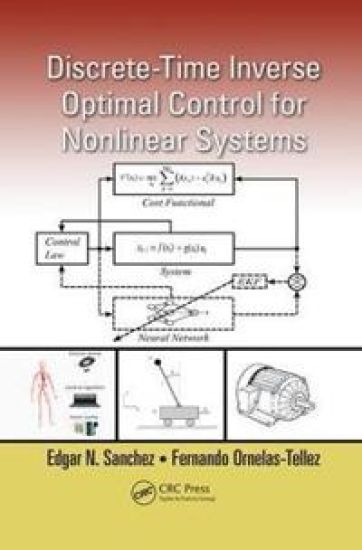
Discrete-Time Inverse Optimal Control for Nonlinear Systems

Discrete-Time Inverse Optimal Control for Nonlinear Systems

Edgar N. Sanchez; Fernando Ornelas-Tellez

CRC Press
2017
nidottu
Discrete-Time Inverse Optimal Control for Nonlinear Systems proposes a novel inverse optimal control scheme for stabilization and trajectory tracking of discrete-time nonlinear systems. This avoids the need to solve the associated Hamilton-Jacobi-Bellman equation and minimizes a cost functional, resulting in a more efficient controller.Design More Efficient Controllers for Stabilization and Trajectory Tracking of Discrete-Time Nonlinear SystemsThe book presents two approaches for controller synthesis: the first based on passivity theory and the second on a control Lyapunov function (CLF). The synthesized discrete-time optimal controller can be directly implemented in real-time systems. The book also proposes the use of recurrent neural networks to model discrete-time nonlinear systems. Combined with the inverse optimal control approach, such models constitute a powerful tool to deal with uncertainties such as unmodeled dynamics and disturbances.Learn from Simulations and an In-Depth Case StudyThe authors include a variety of simulations to illustrate the effectiveness of the synthesized controllers for stabilization and trajectory tracking of discrete-time nonlinear systems. An in-depth case study applies the control schemes to glycemic control in patients with type 1 diabetes mellitus, to calculate the adequate insulin delivery rate required to prevent hyperglycemia and hypoglycemia levels.The discrete-time optimal and robust control techniques proposed can be used in a range of industrial applications, from aerospace and energy to biomedical and electromechanical systems. Highlighting optimal and efficient control algorithms, this is a valuable resource for researchers, engineers, and students working in nonlinear system control.
Decentralized Neural Control: Application to Robotics

Decentralized Neural Control: Application to Robotics

Ramon Garcia-Hernandez; Michel Lopez-Franco; Edgar N. Sanchez; Alma y. Alanis; Jose A. Ruz-Hernandez

Springer International Publishing AG
2017
sidottu
This book provides a decentralized approach for the identification and control of robotics systems. It also presents recent research in decentralized neural control and includes applications to robotics. Decentralized control is free from difficulties due to complexity in design, debugging, data gathering and storage requirements, making it preferable for interconnected systems. Furthermore, as opposed to the centralized approach, it can be implemented with parallel processors.This approach deals with four decentralized control schemes, which are able to identify the robot dynamics. The training of each neural network is performed on-line using an extended Kalman filter (EKF).The first indirect decentralized control scheme applies the discrete-time block control approach, to formulate a nonlinear sliding manifold.The second direct decentralized neural control scheme is based on the backstepping technique, approximated by a high order neural network.The thirdcontrol scheme applies a decentralized neural inverse optimal control for stabilization.The fourth decentralized neural inverse optimal control is designed for trajectory tracking.This comprehensive work on decentralized control of robot manipulators and mobile robots is intended for professors, students and professionals wanting to understand and apply advanced knowledge in their field of work.
Discrete-Time Neural Observers

Discrete-Time Neural Observers

Alma Y Alanis; Edgar N. Sanchez

Academic Press Inc
2017
nidottu
Discrete-Time Neural Observers: Analysis and Applications presents recent advances in the theory of neural state estimation for discrete-time unknown nonlinear systems with multiple inputs and outputs. The book includes rigorous mathematical analyses, based on the Lyapunov approach, that guarantee their properties. In addition, for each chapter, simulation results are included to verify the successful performance of the corresponding proposed schemes. In order to complete the treatment of these schemes, the authors also present simulation and experimental results related to their application in meaningful areas, such as electric three phase induction motors and anaerobic process, which show the applicability of such designs. The proposed schemes can be employed for different applications beyond those presented. The book presents solutions for the state estimation problem of unknown nonlinear systems based on two schemes. For the first one, a full state estimation problem is considered; the second one considers the reduced order case with, and without, the presence of unknown delays. Both schemes are developed in discrete-time using recurrent high order neural networks in order to design the neural observers, and the online training of the respective neural networks is performed by Kalman Filtering.
Doubly Fed Induction Generators

Doubly Fed Induction Generators

Edgar N. Sanchez; Riemann Ruiz-Cruz

Productivity Press
2016
sidottu
Doubly Fed Induction Generators: Control for Wind Energy provides a detailed source of information on the modeling and design of controllers for the doubly fed induction generator (DFIG) used in wind energy applications. Focusing on the use of nonlinear control techniques, this book: Discusses the main features and advantages of the DFIGDescribes key theoretical fundamentals and the DFIG mathematical modelDevelops controllers using inverse optimal control, sliding modes, and neural networksDevises an improvement to add robustness in the presence of parametric variationsDetails the results of real-time implementationsAll controllers presented in the book are tested in a laboratory prototype. Comparisons between the controllers are made by analyzing statistical measures applied to the control objectives.
Discrete-Time Inverse Optimal Control for Nonlinear Systems

Discrete-Time Inverse Optimal Control for Nonlinear Systems

Edgar N. Sanchez; Fernando Ornelas-Tellez

CRC Press Inc
2013
sidottu
Discrete-Time Inverse Optimal Control for Nonlinear Systems proposes a novel inverse optimal control scheme for stabilization and trajectory tracking of discrete-time nonlinear systems. This avoids the need to solve the associated Hamilton-Jacobi-Bellman equation and minimizes a cost functional, resulting in a more efficient controller.Design More Efficient Controllers for Stabilization and Trajectory Tracking of Discrete-Time Nonlinear SystemsThe book presents two approaches for controller synthesis: the first based on passivity theory and the second on a control Lyapunov function (CLF). The synthesized discrete-time optimal controller can be directly implemented in real-time systems. The book also proposes the use of recurrent neural networks to model discrete-time nonlinear systems. Combined with the inverse optimal control approach, such models constitute a powerful tool to deal with uncertainties such as unmodeled dynamics and disturbances.Learn from Simulations and an In-Depth Case StudyThe authors include a variety of simulations to illustrate the effectiveness of the synthesized controllers for stabilization and trajectory tracking of discrete-time nonlinear systems. An in-depth case study applies the control schemes to glycemic control in patients with type 1 diabetes mellitus, to calculate the adequate insulin delivery rate required to prevent hyperglycemia and hypoglycemia levels.The discrete-time optimal and robust control techniques proposed can be used in a range of industrial applications, from aerospace and energy to biomedical and electromechanical systems. Highlighting optimal and efficient control algorithms, this is a valuable resource for researchers, engineers, and students working in nonlinear system control.
Discrete-Time High Order Neural Control

Discrete-Time High Order Neural Control

Edgar N. Sanchez; Alma Y. Alanís; Alexander G. Loukianov

Springer-Verlag Berlin and Heidelberg GmbH Co. K
2010
nidottu
Neural networks have become a well-established methodology as exempli?ed by their applications to identi?cation and control of general nonlinear and complex systems; the use of high order neural networks for modeling and learning has recently increased. Usingneuralnetworks,controlalgorithmscanbedevelopedtoberobustto uncertainties and modeling errors. The most used NN structures are Feedf- ward networks and Recurrent networks. The latter type o?ers a better suited tool to model and control of nonlinear systems. There exist di?erent training algorithms for neural networks, which, h- ever, normally encounter some technical problems such as local minima, slow learning, and high sensitivity to initial conditions, among others. As a viable alternative, new training algorithms, for example, those based on Kalman ?ltering, have been proposed. There already exists publications about trajectory tracking using neural networks; however, most of those works were developed for continuous-time systems. On the other hand, while extensive literature is available for linear discrete-timecontrolsystem,nonlineardiscrete-timecontroldesigntechniques have not been discussed to the same degree. Besides, discrete-time neural networks are better ?tted for real-time implementations.
Discrete-Time High Order Neural Control

Discrete-Time High Order Neural Control

Edgar N. Sanchez; Alma Y. Alanís; Alexander G. Loukianov

Springer-Verlag Berlin and Heidelberg GmbH Co. K
2008
sidottu
Neural networks have become a well-established methodology as exempli?ed by their applications to identi?cation and control of general nonlinear and complex systems; the use of high order neural networks for modeling and learning has recently increased. Usingneuralnetworks,controlalgorithmscanbedevelopedtoberobustto uncertainties and modeling errors. The most used NN structures are Feedf- ward networks and Recurrent networks. The latter type o?ers a better suited tool to model and control of nonlinear systems. There exist di?erent training algorithms for neural networks, which, h- ever, normally encounter some technical problems such as local minima, slow learning, and high sensitivity to initial conditions, among others. As a viable alternative, new training algorithms, for example, those based on Kalman ?ltering, have been proposed. There already exists publications about trajectory tracking using neural networks; however, most of those works were developed for continuous-time systems. On the other hand, while extensive literature is available for linear discrete-timecontrolsystem,nonlineardiscrete-timecontroldesigntechniques have not been discussed to the same degree. Besides, discrete-time neural networks are better ?tted for real-time implementations.
Differential Neural Networks For Robust Nonlinear Control: Identification, State Estimation And Trajectory Tracking
This book deals with continuous time dynamic neural networks theory applied to the solution of basic problems in robust control theory, including identification, state space estimation (based on neuro-observers) and trajectory tracking. The plants to be identified and controlled are assumed to be a priori unknown but belonging to a given class containing internal unmodelled dynamics and external perturbations as well. The error stability analysis and the corresponding error bounds for different problems are presented. The effectiveness of the suggested approach is illustrated by its application to various controlled physical systems (robotic, chaotic, chemical, etc.).