Kirjojen hintavertailu. Mukana 12 558 121 kirjaa ja 12 kauppaa.

Kirjailija

Edmund J.S. Sonuga-Barke

Kirjat ja teokset yhdessä paikassa: 3 kirjaa, julkaisuja vuosilta 2017-2024, suosituimpien joukossa Children's Saving. Vertaile teosten hintoja ja tarkista saatavuus suomalaisista kirjakaupoista.

Mukana myös kirjoitusasut: Edmund J. S Sonuga-Barke

3 kirjaa

Kirjojen julkaisuhaarukka 2017-2024.

Step-by-Step Help for Children with ADHD

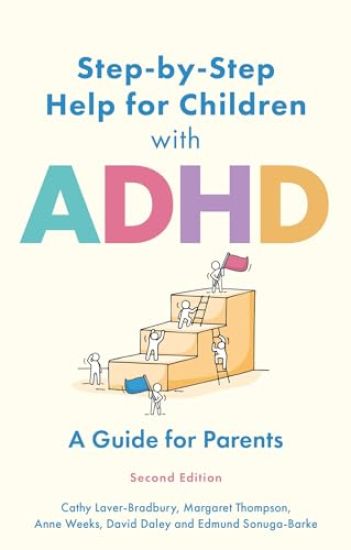
Step-by-Step Help for Children with ADHD

Cathy Laver-Bradbury; Margaret Thompson; Anne Weeks; David Daley; Edmund J. S Sonuga-Barke

JESSICA KINGSLEY PUBLISHERS
2024
pokkari
Raising a child with ADHD can be challenging, but with the right knowledge and tools, parents and professionals can use this tried and tested six-step programme to better understand their ADHD child and help them thrive in any environment.This simple, flexible six-step programme is full of tried-and-tested ideas for parents and professionals supporting families of young children with ADHD. The programme includes games that will help improve the child's attention, exercises to develop waiting skills and tips for supporting the child in successful self-organization. This newly updated second edition incorporates the latest research on ADHD, including insights into hyperfocus and strategies for aiding emotional regulation and also provides proven techniques for behaviour management. In addition to this, the programme now delves deeper into the role of sleep, diet, mindfulness, and social stories in supporting children with ADHD.Based on research and extensive clinical experience, Step by Step Help for Children with ADHD will help families to adapt their parenting to the child, improving relationships and behaviours in the home and at school.
Children's Saving

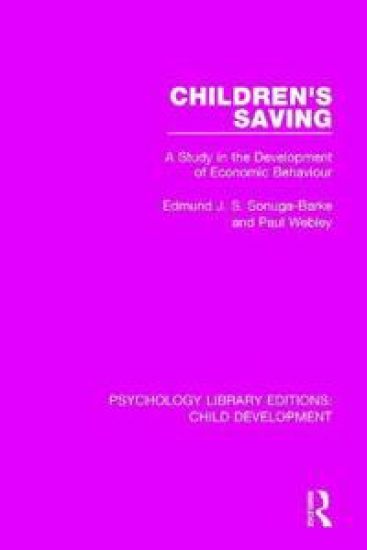
Children's Saving

Edmund J.S. Sonuga-Barke; Paul Webley

Routledge
2019
nidottu
Originally published in 1993, this book presents an alternative approach to the study of the emergence of economic awareness during childhood: a new developmental economic psychology!In the past, attempts to study the emergence of children’s economic consciousness have failed to take account of the practical nature of the "economic" in the history of western cultures. Economic socialisation has been seen as the acquisition of abstract knowledge about the institutions of adult economic culture. The child has been seen as a spectator, acquiring knowledge of that culture, but never really a part of it.However, economic actions, in essence, are directed not towards the attainment of knowledge, but rather towards the practical solution of problems of resource allocation imposed by constraint. Children, just like adults, are faced with practical problems of resource allocation. Their response to these problems may be different from those of adults but no less "economic" for that. This realisation forms the heart of this book. In it children are seen as both inhabitants of their own "playground" economic subculture and actors in the wider economic world of adults, solving, or attempting to solve, practical economic problems.In order to highlight this "child-centred" approach, the authors studied the way children tackle the particular problems posed by limitations of income. How do children learn (a) the relationship between choices available in the present and the future, (b) to spread their limited financial resources over time into the future and (c) about the strategies, such as banking, that allow them to protect those resources from threats and temptations? In short, how do children learn to save?This volume goes some way to answering these and related questions and in so doing sets up an alternative framework for the study of the emergence of economic awareness.
Children's Saving

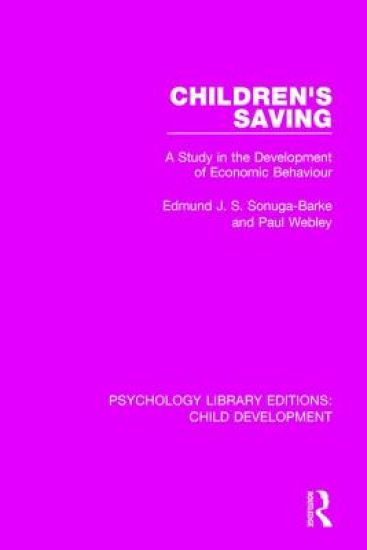
Children's Saving

Edmund J.S. Sonuga-Barke; Paul Webley

Routledge
2017
sidottu
Originally published in 1993, this book presents an alternative approach to the study of the emergence of economic awareness during childhood: a new developmental economic psychology!In the past, attempts to study the emergence of children’s economic consciousness have failed to take account of the practical nature of the "economic" in the history of western cultures. Economic socialisation has been seen as the acquisition of abstract knowledge about the institutions of adult economic culture. The child has been seen as a spectator, acquiring knowledge of that culture, but never really a part of it.However, economic actions, in essence, are directed not towards the attainment of knowledge, but rather towards the practical solution of problems of resource allocation imposed by constraint. Children, just like adults, are faced with practical problems of resource allocation. Their response to these problems may be different from those of adults but no less "economic" for that. This realisation forms the heart of this book. In it children are seen as both inhabitants of their own "playground" economic subculture and actors in the wider economic world of adults, solving, or attempting to solve, practical economic problems.In order to highlight this "child-centred" approach, the authors studied the way children tackle the particular problems posed by limitations of income. How do children learn (a) the relationship between choices available in the present and the future, (b) to spread their limited financial resources over time into the future and (c) about the strategies, such as banking, that allow them to protect those resources from threats and temptations? In short, how do children learn to save?This volume goes some way to answering these and related questions and in so doing sets up an alternative framework for the study of the emergence of economic awareness.