Kirjojen hintavertailu. Mukana 12 390 323 kirjaa ja 12 kauppaa.
Kirjailija
Edmundo Capelas de Oliveira
Kirjat ja teokset yhdessä paikassa: 7 kirjaa, julkaisuja vuosilta 2016-2025, suosituimpien joukossa Analytical Methods in Applied Mathematics. Vertaile teosten hintoja ja tarkista saatavuus suomalaisista kirjakaupoista.
This textbook provides a comprehensive exploration of special functions and fractional calculus, offering a structured approach through solved and proposed exercises. Covering key mathematical concepts such as Mittag-Leffler functions, Kilbas-Saigo functions, and the Erdélyi-Kober fractional integral, it balances theoretical insights with practical applications. Appendices introduce Barnes G-functions and demonstrate the use of Mathematica for fractional calculus, expanding the book’s accessibility. With an updated index and extensive references, this edition serves as a valuable resource for researchers, graduate students, and professionals in applied mathematics and related fields.
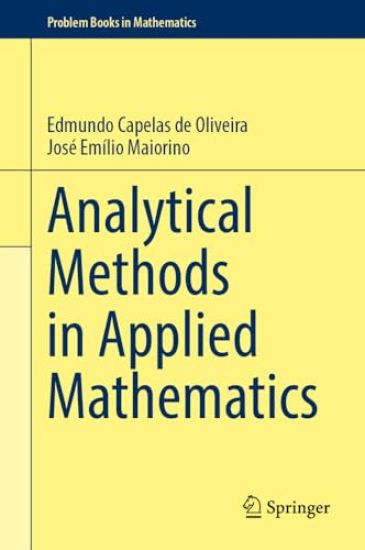
This book compiles an extensive list of solved and proposed problems in mathematical topics in analysis, aimed at students of mathematics, applied mathematics, physics, and engineering. The book begins with an exploration of simple linear and nonlinear ordinary differential equations in Chapter 1, advancing through topics such as power series and the Frobenius method for solving differential equations in Chapter 2. In subsequent chapters, the discussion expands to include functions of complex variables, special functions constructed through the hypergeometric function, and series solutions including Fourier, Fourier-Bessel, and Fourier-Legendre series. Problems in integral transforms, Sturm-Liouville systems, Green's function, linear partial differential equations are also included. The work finishes with a special chapter on fractional calculus and practical applications of the topics presented. With solved examples and step-by-step exercises, this book can be of value to undergraduate and graduate students seeking a hands-on approach on the listed topics, and as a bibliographical complement to STEM courses as well.
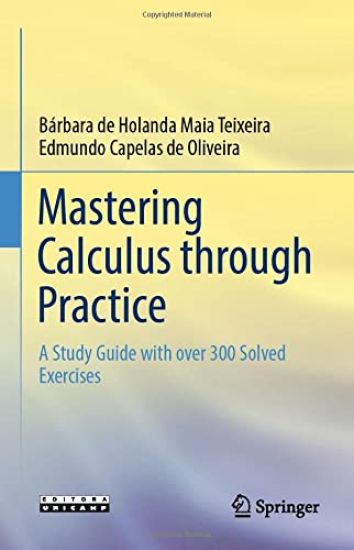
This textbook covers key topics of Elementary Calculus through selected exercises, in a sequence that facilitates development of problem-solving abilities and techniques. It opens with an introduction to fundamental facts of mathematical logic, set theory, and pre-calculus, extending toward functions, limits, derivatives, and integrals. Over 300 solved problems are approached with a simple, direct style, ordered in a way that positively challenges students and helps them build self-confidence as they progress. A special final chapter adds five carefully crafted problems for a comprehensive recap of the work.The book is aimed at first-year students of fields in which calculus and its applications have a role, including Science, Technology, Engineering, Mathematics, Economics, Architecture, Management, and Applied Social Sciences, as well as students of Quantitative Methods courses. It can also serve as rich supplementary reading for self-study.
This textbook covers key topics of Elementary Calculus through selected exercises, in a sequence that facilitates development of problem-solving abilities and techniques. It opens with an introduction to fundamental facts of mathematical logic, set theory, and pre-calculus, extending toward functions, limits, derivatives, and integrals. Over 300 solved problems are approached with a simple, direct style, ordered in a way that positively challenges students and helps them build self-confidence as they progress. A special final chapter adds five carefully crafted problems for a comprehensive recap of the work.The book is aimed at first-year students of fields in which calculus and its applications have a role, including Science, Technology, Engineering, Mathematics, Economics, Architecture, Management, and Applied Social Sciences, as well as students of Quantitative Methods courses. It can also serve as rich supplementary reading for self-study.
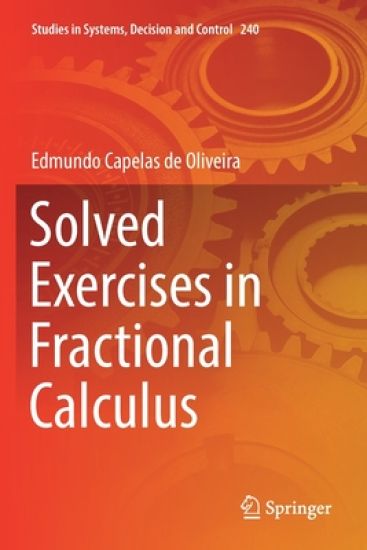
This book contains a brief historical introduction and state of the art in fractional calculus. The author introduces some of the so-called special functions, in particular, those which will be directly involved in calculations. The concepts of fractional integral and fractional derivative are also presented. Each chapter, except for the first one, contains a list of exercises containing suggestions for solving them and at last the resolution itself. At the end of those chapters there is a list of complementary exercises. The last chapter presents several applications of fractional calculus.
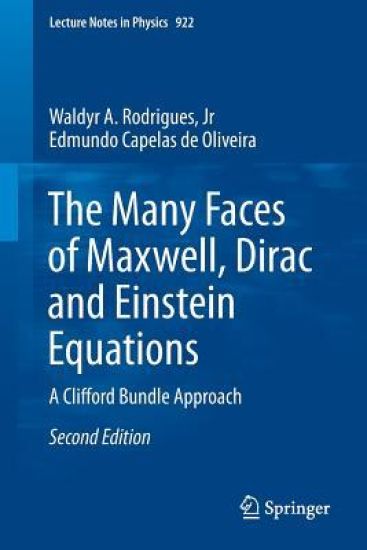
This book is an exposition of the algebra and calculus of differential forms, of the Clifford and Spin-Clifford bundle formalisms, and of vistas to a formulation of important concepts of differential geometry indispensable for an in-depth understanding of space-time physics. The formalism discloses the hidden geometrical nature of spinor fields. Maxwell, Dirac and Einstein fields are shown to have representatives by objects of the same mathematical nature, namely sections of an appropriate Clifford bundle. This approach reveals unity in diversity and suggests relationships that are hidden in the standard formalisms and opens new paths for research. This thoroughly revised second edition also adds three new chapters: on the Clifford bundle approach to the Riemannian or semi-Riemannian differential geometry of branes; on Komar currents in the context of the General Relativity theory; and an analysis of the similarities and main differences between Dirac, Majorana and ELKO spinor fields.The exercises with solutions, the comprehensive list of mathematical symbols, and the list of acronyms and abbreviations are provided for self-study for students as well as for classes.From the reviews of the first edition: “The text is written in a very readable manner and is complemented with plenty of worked-out exercises which are in the style of extended examples. ... their book could also serve as a textbook for graduate students in physics or mathematics." (Alberto Molgado, Mathematical Reviews, 2008 k)