Kirjojen hintavertailu. Mukana 12 145 882 kirjaa ja 12 kauppaa.

Kirjailija

Edna Bonacich

Kirjat ja teokset yhdessä paikassa: 9 kirjaa, julkaisuja vuosilta 1991-2021, suosituimpien joukossa Getting the Goods. Vertaile teosten hintoja ja tarkista saatavuus suomalaisista kirjakaupoista.

9 kirjaa

Kirjojen julkaisuhaarukka 1991-2021.

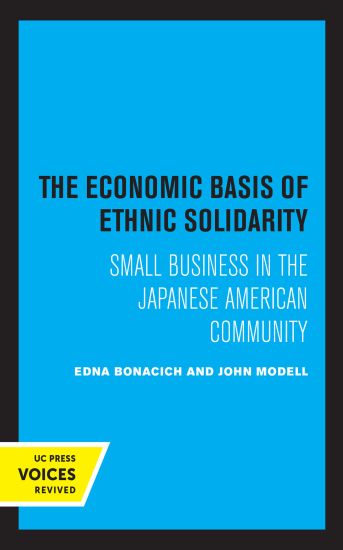
The Economic Basis of Ethnic Solidarity

The Economic Basis of Ethnic Solidarity

Edna Bonacich; John Modell

University of California Press
2021
pokkari
The Economic Basis of Ethnic Solidarity: Small Business in the Japanese American Community explores the intersection of ethnicity and class within the context of Japanese Americans, particularly focusing on the role of economic factors in fostering ethnic solidarity. The book challenges traditional views of ethnicity as a primordial bond rooted in common ancestry, emphasizing that ethnic affiliation is not a natural phenomenon, but a social construct that can be influenced by economic interests. It argues that ethnic groups, particularly middleman minorities like Japanese Americans, often mobilize around shared economic activities, such as small business ownership, to create solidarity. When ethnic groups fail to maintain a strong economic base, their ethnic ties tend to weaken. The book presents a theoretical framework for understanding the relationship between ethnicity and class, using Japanese Americans as a case study. It explores how, historically, the Japanese American community engaged in small businesses as a means of economic adaptation, which in turn helped to preserve a strong ethnic identity. The study shows that this economic model enabled Japanese Americans to develop a sense of community, despite facing racial discrimination and economic challenges. Additionally, the book highlights the differences between the experiences of Japanese Americans and other racial minorities, such as African Americans, emphasizing that the unique economic role of Japanese Americans led to different conflicts and outcomes. The work provides an important analysis of middleman minorities and contributes to broader discussions on ethnic and economic identity. This title is part of UC Press's Voices Revived program, which commemorates University of California Press’s mission to seek out and cultivate the brightest minds and give them voice, reach, and impact. Drawing on a backlist dating to 1893, Voices Revived makes high-quality, peer-reviewed scholarship accessible once again using print-on-demand technology. This title was originally published in 1980.
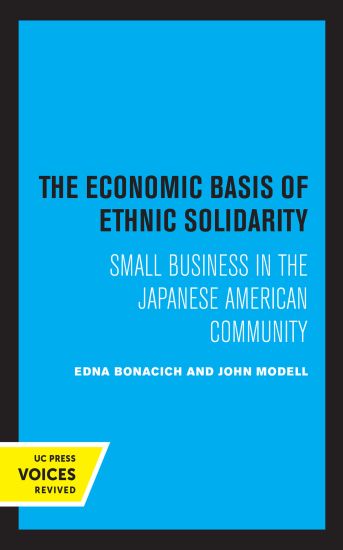
The Economic Basis of Ethnic Solidarity

The Economic Basis of Ethnic Solidarity

Edna Bonacich; John Modell

University of California Press
2021
sidottu
The Economic Basis of Ethnic Solidarity: Small Business in the Japanese American Community explores the intersection of ethnicity and class within the context of Japanese Americans, particularly focusing on the role of economic factors in fostering ethnic solidarity. The book challenges traditional views of ethnicity as a primordial bond rooted in common ancestry, emphasizing that ethnic affiliation is not a natural phenomenon, but a social construct that can be influenced by economic interests. It argues that ethnic groups, particularly middleman minorities like Japanese Americans, often mobilize around shared economic activities, such as small business ownership, to create solidarity. When ethnic groups fail to maintain a strong economic base, their ethnic ties tend to weaken. The book presents a theoretical framework for understanding the relationship between ethnicity and class, using Japanese Americans as a case study. It explores how, historically, the Japanese American community engaged in small businesses as a means of economic adaptation, which in turn helped to preserve a strong ethnic identity. The study shows that this economic model enabled Japanese Americans to develop a sense of community, despite facing racial discrimination and economic challenges. Additionally, the book highlights the differences between the experiences of Japanese Americans and other racial minorities, such as African Americans, emphasizing that the unique economic role of Japanese Americans led to different conflicts and outcomes. The work provides an important analysis of middleman minorities and contributes to broader discussions on ethnic and economic identity. This title is part of UC Press's Voices Revived program, which commemorates University of California Press’s mission to seek out and cultivate the brightest minds and give them voice, reach, and impact. Drawing on a backlist dating to 1893, Voices Revived makes high-quality, peer-reviewed scholarship accessible once again using print-on-demand technology. This title was originally published in 1980.

Getting the Goods

Getting the Goods

Edna Bonacich; Jake B. Wilson

CORNELL UNIVERSITY PRESS
2011
muu
Bonacich and Wilson follow the flow of imports from Asian factories, exploring the roles of importers, container shipping companies, the ports, railroad and trucking companies, and warehouses and their impact on U.S. workers.
Getting the Goods

Getting the Goods

Edna Bonacich; Jake B. Wilson

CORNELL UNIVERSITY PRESS
2011
muu
Bonacich and Wilson follow the flow of imports from Asian factories, exploring the roles of importers, container shipping companies, the ports, railroad and trucking companies, and warehouses and their impact on U.S. workers.
Getting the Goods

Getting the Goods

Edna Bonacich; Jake B. Wilson

Cornell University Press
2008
pokkari
In Getting the Goods, Edna Bonacich and Jake B. Wilson focus on the Southern California ports of Los Angeles and Long Beach—which together receive 40 percent of the nearly $2 trillion worth of goods imported annually to the United States—to examine the impact of the logistics revolution on workers in transportation and distribution. Built around the invention of shipping containers and communications technology, the logistics revolution has enabled giant retailers like Walmart and Target to sell cheap consumer products made using low-wage labor in developing countries. The goods are shipped through an efficient, low-cost, intermodal freight system, in which containers are moved from factories in Asia to distribution centers across the United States without ever being opened. Bonacich and Wilson follow the flow of imports from Asian factories, exploring the roles of importers, container shipping companies, the ports, railroad and trucking companies, and warehouses. At each stage, Getting the Goods raises important questions about how the logistics revolution affects logistics workers. Drawing extensively on interviews with workers and managers at all levels of the supply chain, on industry reports, and on economic data, Bonacich and Wilson find that, in general, conditions have deteriorated for workers. But they also discover that changes in the system of production and distribution provide new strategic opportunities for labor to gain power. A much-needed corrective to both uncritical celebrations of containerization and the global economy and pessimistic predictions about the future of the U.S. labor movement, Getting the Goods will become required reading for scholars and students in sociology, political economy, and labor studies.
Getting the Goods

Getting the Goods

Edna Bonacich; Jake B. Wilson

Cornell University Press
2008
sidottu
In Getting the Goods, Edna Bonacich and Jake B. Wilson focus on the Southern California ports of Los Angeles and Long Beach—which together receive 40 percent of the nearly $2 trillion worth of goods imported annually to the United States—to examine the impact of the logistics revolution on workers in transportation and distribution. Built around the invention of shipping containers and communications technology, the logistics revolution has enabled giant retailers like Walmart and Target to sell cheap consumer products made using low-wage labor in developing countries. The goods are shipped through an efficient, low-cost, intermodal freight system, in which containers are moved from factories in Asia to distribution centers across the United States without ever being opened. Bonacich and Wilson follow the flow of imports from Asian factories, exploring the roles of importers, container shipping companies, the ports, railroad and trucking companies, and warehouses. At each stage, Getting the Goods raises important questions about how the logistics revolution affects logistics workers. Drawing extensively on interviews with workers and managers at all levels of the supply chain, on industry reports, and on economic data, Bonacich and Wilson find that, in general, conditions have deteriorated for workers. But they also discover that changes in the system of production and distribution provide new strategic opportunities for labor to gain power. A much-needed corrective to both uncritical celebrations of containerization and the global economy and pessimistic predictions about the future of the U.S. labor movement, Getting the Goods will become required reading for scholars and students in sociology, political economy, and labor studies.
Immigrant Entrepreneurs

Immigrant Entrepreneurs

Ivan Light; Edna Bonacich

University of California Press
1991
pokkari
A decade in preparation, Immigrant Entrepreneurs offers the most comprehensive case study ever completed of the causes and consequences of immigrant business ownership. Koreans are the most entrepreneurial of America's new immigrants. By the mid-1970s Americans had already become aware that Korean immigrants were opening, buying, and operating numerous business enterprises in major cities. When Koreans flourished in small business, Americans wanted to know how immigrants could find lucrative business opportunities where native-born Americans could not. Somewhat later, when Korean-black conflicts surfaced in a number of cities, Americans also began to fear the implications for intergroup relations of immigrant entrepreneurs who start in the middle rather than at the bottom of the social and economic hierarchy. Nowhere was immigrant enterprise more obvious or impressive than in Los Angeles, the world's largest Korean settlement outside of Korea and America's premier city of small business. Analyzing both the short-run and the long-run causes of Korean entrepreneurship, the authors explain why the Koreans could find, acquire, and operate small business firms more easily than could native-born residents. They also provide a context for distinguishing clashes of culture and clashes of interest which cause black-Korean tensions in cities, and for framing effective policies to minimize the tensions.