Kirjojen hintavertailu. Mukana 12 595 353 kirjaa ja 12 kauppaa.

Kirjailija

Edward Beecher

Kirjat ja teokset yhdessä paikassa: 31 kirjaa, julkaisuja vuosilta 2003-2025, suosituimpien joukossa Narrative of Riots at Alton, in Connection with the Death of Rev. Elijah P. Lovejoy. Vertaile teosten hintoja ja tarkista saatavuus suomalaisista kirjakaupoista.

31 kirjaa

Kirjojen julkaisuhaarukka 2003-2025.

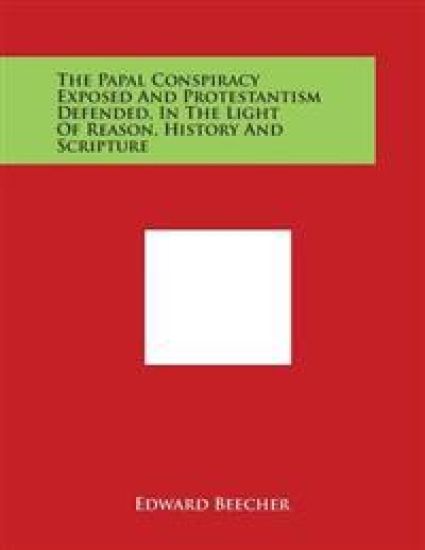
The Papal Conspiracy Exposed..

The Papal Conspiracy Exposed..

Edward Beecher

Hutson Street Press
2025
sidottu
The Papal Conspiracy Exposed by Edward Beecher presents a detailed critique of the papacy and its perceived political and religious influence. Written in 1855, the book reflects the anti-Catholic sentiments prevalent during that era. Beecher meticulously outlines what he views as the conspiracies and overreach of the Catholic Church, aiming to expose its purported threat to both religious and political freedom. This historical document offers insights into the religious and political dynamics of the 19th century, capturing the debates and anxieties surrounding religious authority and national identity. It serves as a valuable resource for understanding the historical context of anti-Catholicism and the complex relationship between religion and politics during this period. This work has been selected by scholars as being culturally important, and is part of the knowledge base of civilization as we know it. This work was reproduced from the original artifact, and remains as true to the original work as possible. Therefore, you will see the original copyright references, library stamps (as most of these works have been housed in our most important libraries around the world), and other notations in the work. This work is in the public domain in the United States of America, and possibly other nations. Within the United States, you may freely copy and distribute this work, as no entity (individual or corporate) has a copyright on the body of the work. As a reproduction of a historical artifact, this work may contain missing or blurred pages, poor pictures, errant marks, etc. Scholars believe, and we concur, that this work is important enough to be preserved, reproduced, and made generally available to the public. We appreciate your support of the preservation process, and thank you for being an important part of keeping this knowledge alive and relevant.
Concord Of Ages: The Individual And Organic Harmony Of God And Man
Beecher's perspective and style very much reflect the best aspects of Nineteenth Century America prior to the Civil War. This does not mean that it comes from a time of great peace and tranquility, but rather that it is fraught with the angst that eventually resulted in the Civil War. The fact that this book is thoroughly modern, but not postmodern makes it a very interesting for anyone who truly wants to understand the world we actually live in today.Beecher was not a backwater hick or a Southern sympathizer, but represents the best of American theology and literature of his day. His sister was the famous Harriet Beecher Stowe, author of Uncle Tom's Cabin. Edward was widely recognized as the best scholar among the Beechers, and the Beecher family produced an amazing array of scholars. Interestingly, his scholarship landed him in conflict with the religious pundits of every stripe in his day. The two conflicting trends in Nineteenth Century America involved the consolidation of Reformation churches, which had become the American Establishment, and the rejection of religious establishment mentality that has been described by many as a continuation of the principle of the Reformation.
Conflict Of Ages: The Great Debate of the Moral Relations of God and Man
This is a dangerous book, dangerous because it deals with perhaps the most serious conflict in history, and I commend it with some trepidation. That conflict began in Genesis and has continued unabated through history. Beecher's book was originally published when America was deeply conflicted over the Great Awakenings and the New School/Old School controversies that set the stage for the American Civil War.Beecher wrote, "...soon after the opening of the Reformation, the power of that system was so far broken, and consistent and free thought had so much more scope, that the whole system was so modified as better to accord with the fundamental principles of the Pelagian theory of human nature. The same was true in the case of Dr. John Taylor. The doctrine of the Trinity was dropped in each case. Yet, at first, the whole system was not reduced to its natural and consistent level. Socinus still retained the worship of Christ, and persecuted Davides for dissenting from his views. Dr. J. Taylor approximated as near to the Trinity as the Arianism of Dr. S. Clarke would allow. He also did not remove from his doctrine all the language which belonged to the orthodox doctrine of the atonement. It was not until the close of the last and the beginning of the present century that the principles of the Pelagian theory were fully and consistently developed in modern Unitarianism" (p. 272).The world and the Christian churches had turned toward Pelagianism and away from the Trinity, and Beecher sought a solution to this problem. Many people today have come to realize that something very fundamental or basic has gone awry in Christendom and in the world. There are calls for reformation and revival coming from nearly every corner of the church and the world today.Ross calls for Beecher's work to be reevaluated afresh and works to correct Beecher's infatuation with preexistence by sug-gesting a Trinitarian solution to the problem Beecher presented.Edward Beecher (1803-1895), a noted theologian, the son of Lyman Beecher and brother to Harriet Beecher Stowe and Henry Ward Beecher, was senior editor of The Congregationalist (1849-1855), and an associate editor of the Christian Union from 1870.