Kirjojen hintavertailu. Mukana 12 253 895 kirjaa ja 12 kauppaa.

Kirjailija

Edward G. Keating

Kirjat ja teokset yhdessä paikassa: 22 kirjaa, julkaisuja vuosilta 1995-2017, suosituimpien joukossa Australia's Naval Shipbuilding Enterprise. Vertaile teosten hintoja ja tarkista saatavuus suomalaisista kirjakaupoista.

Mukana myös kirjoitusasut: Edward G Keating

22 kirjaa

Kirjojen julkaisuhaarukka 1995-2017.

Australia's Naval Shipbuilding Enterprise

Australia's Naval Shipbuilding Enterprise

John Birkler; John F. Schank; Mark V. Arena; Edward G. Keating; Joel B. Predd; James Black; Irina Danescu; Dan Jenkins; James G. Kallimani; Gordon T. Lee; Roger Lough; Robert Murphy; David Nicholls; Deborah Peetz; Brian Perkinson; Jerry M. Sollinger; Shane Tierney; Obaid Younossi

RAND
2015
pokkari
To prepare for its next Defence White Paper, Australia is examining an enterprise-level naval shipbuilding plan. To support this effort, RAND researchers explore the feasibility of Australia sustaining a domestic naval shipbuilding industry compared with buying ships from foreign shipbuilders. The authors outline the complex consequences and trade-offs of both options.

The Effects of Travel and Tourism on California's Economy

The Effects of Travel and Tourism on California's Economy

Matthew D Baird; Edward G Keating; Olena Bogdan

RAND
2017
nidottu
In California, travel/tourism employs a diverse workforce and contributes meaningfully to the state's economy. This report evaluates the role of travel/tourism in the state's economy. It uses data on the state's tourism and labor force to provide insight about tourism workers in California and how their careers evolve and should be of interest to policymakers and researchers interested in economic development issues and career pathways.
U.S. Department of Defense Experiences with Substituting Government Employees for Military Personnel

U.S. Department of Defense Experiences with Substituting Government Employees for Military Personnel

Jennifer Lamping Lewis; Edward G. Keating; Leslie Adrienne Payne; Brian J. Gordon; Julia Pollak; Andrew Madler; H. G. Massey; Gillian S. Oak

RAND
2016
pokkari
This report examines recent patterns in military-to-civilian conversion that is, converting military positions to government civilian positions to identify the primary impediments to such conversions. The authors reviewed relevant statutes and policies, held discussions with U.S. Department of Defense (DoD) subject matter experts, and analyzed administrative data on DoD military and civilian personnel."
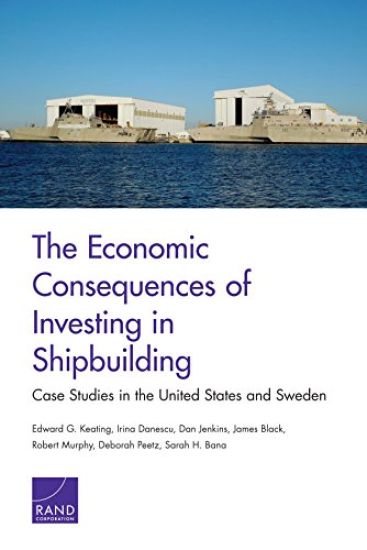
The Economic Consequences of Investing in Shipbuilding

The Economic Consequences of Investing in Shipbuilding

Edward G. Keating; Irina Danescu; Dan Jenkins; James Black; Robert Murphy; Deborah Peetz; Sarah H. Bana

RAND
2015
pokkari
This report assesses the economic impacts that a shipbuilder has on its local community and region. The authors utilize a case study methodology to examine two U.S. shipbuilders and the Saab Aeronautics Gripen program in Sweden. While each shipbuilder has had beneficial effects on its local economy, neither shipbuilder has given rise to the ecosystem of favorable spillovers and spin-offs that the Gripen program seems to have created.
DOD Depot-Level Reparable Supply Chain Management

DOD Depot-Level Reparable Supply Chain Management

Eric Peltz; Marygail K Brauner; Edward G. Keating; Evan Saltzman; Daniel Tremblay; Patricia Boren

RAND
2014
pokkari
Examines Department of Defense depot-level reparable (DLR) supply chain management to identify the most common reasons for apparent inventory excess and customer support shortfalls and assess how DLR supply chain management could be improved to enhance customer support and reduce costs.
Funding Ammunition Ports

Funding Ammunition Ports

Edward G. Keating; Daniel Sommerhauser

RAND
2012
pokkari
The U.S. Army's two ammunition ports--Military Ocean Terminal Concord (MOTCO) and Military Ocean Terminal Sunny Point (MOTSU)--have different funding approaches; a central question in this research is what the most appropriate financial structure should be. To help answer this question, the authors develop two variations of an ammunition port funding policy, both featuring customers paying marginal costs for port services.
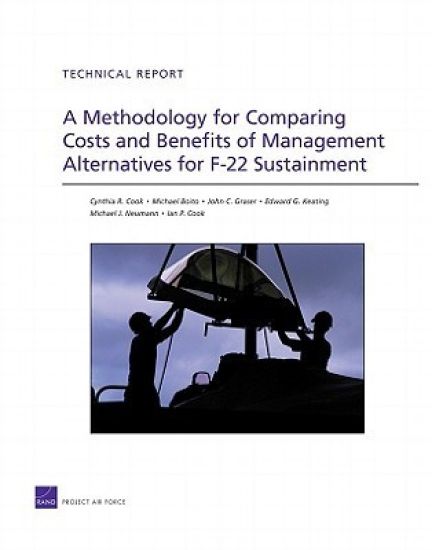
A Methodology for Comparing Costs and Benefits of Management Alternatives for F-22 Sustainment

A Methodology for Comparing Costs and Benefits of Management Alternatives for F-22 Sustainment

Cynthia R. Cook; Michael Boito; John C. Graser; Edward G. Keating; Michael J. Neumann

RAND
2011
pokkari
The U.S. Air Force asked RAND Project AIR FORCE to perform a congressionally required assessment of contractor versus organic management of F-22 air vehicle and F119 engine sustainment to determine the most cost-effective approach. The methodology involved the development of notional government sustainment organizations and a consideration of a variety of factors relevant to such a decision, including the asserted benefits of each approach.
Evaluating the Desirability of Navy F/A-18e/F Service Life Extension Programs (Sleps)

Evaluating the Desirability of Navy F/A-18e/F Service Life Extension Programs (Sleps)

Edward G. Keating; Irv Blickstein; Michael Boito; Jess Chandler; Deborah Peetz

RAND
2011
pokkari
As Navy aircraft age, leaders must decide whether to modify and upgrade the aging systems or replace them. Preliminary planning has begun as to the feasibility and desirability of a service life extension program (SLEP) on the F/A-18E/F versus buying replacement Joint Strike Fighters (JSFs). This report presents ranges of parameter values that favor versus oppose undertaking E/F SLEPs.
An Analysis of the Populations of the Air Force's Medical and Professional Officer Corps

An Analysis of the Populations of the Air Force's Medical and Professional Officer Corps

Edward G. Keating; Hugh G. Massey; Judith D. Mele; Benjamin F. Mundell

RAND
2010
pokkari
Analyzes the Air Force's seven medical and professional officer corps the Biomedical Sciences Corps, the Chaplain Corps, the Dental Corps, the Judge Advocate General Corps (attorneys), the Medical Corps (physicians), the Medical Service Corps, and the Nurse Corps with regard to end strengths, accession levels, promotion flow, and attrition since the late 1970s. Recent accession and retention trends have been most adverse in the Nurse Corps."
Air Force Physician and Dentist Multiyear Special Pay

Air Force Physician and Dentist Multiyear Special Pay

Edward G Keating; Marygail K Brauner; Lionel A Galway; Judith D Mele; James J Burks

RAND
2009
pokkari
Discusses the tendencies of Air Force physicians and dentists to accept Multiyear Special Pay (MSP). Eligible dentists have often accepted MSP although a majority of eligible physicians have not. Increasing MSP levels appears to increase the percentage of physicians who choose to accept MSP rather than leaving Air Force service.
The Defense Acquisition Workforce

The Defense Acquisition Workforce

Susan M. Gates; Edward G. Keating; Adria D. Jewell; Lindsay Daugherty; Bryan Tysinger; Albert A. Robbert; Ralph Masi

RAND
2008
pokkari
This book summarizes defense acquisition workforce analysis that RAND has undertaken in support of human capital strategic planning. The report covers the civilian acquisition workforce, the careers of acquisition workforce senior executive service members, and the military acquisition workforce and its implications for the larger workforce. It also provides projection model that uses data on the civilian acquisition workforce as a key input.
Using the Steel-vessel Material-cost Index to Mitigate Shipbuilder Risk

Using the Steel-vessel Material-cost Index to Mitigate Shipbuilder Risk

Edward G. Keating; Robert Murphy; John F. Schank; John Birkler

RAND
2008
pokkari
The more accurately a cost index captures a shipbuilder's risk, the less the Navy should have to pay its shipbuilders. The Navy uses such indexes to correct for significant cost risks outside its shipbuilders' control. A longtime material-cost index in Navy shipbuilding is the steel-vessel index, but it is outdated and volatile. The authors urge the Navy to develop a modern-vessel index that more appropriately represents the materials used today.
Base Realignment and Closure (BRAC) and Organizational Restructuring in the DoD

Base Realignment and Closure (BRAC) and Organizational Restructuring in the DoD

Dina G. Levy; Joy S. Moini; Tessa Kaganoff; Edward G. Keating; Catherine H. Augustine; Tora Kay Bikson; Kristin Leuschner; Susan M. Gates

RAND
2004
pokkari
Looks at how Department of Defense (DoD) education, training, and development institutions are affected by the consolidation of DoD facilities and changes in governance structure. The Department of Defense (DoD) often improves its efficiency by consolidating facilities (mainly through base realignment and closure, or BRAC) and changing its governance structure. These shifts significantly affect the education, training, and development (ET&D) institutions that support DoD personnel, with such impact as relocation. With an eye toward the 2005 BRAC, RAND researchers look at four case studies of the 1990s and from them make recommendations for ET&D institutions that may be affected by future shifts in defense infrastructure. (PW)
Challenges in Defense Working Capital Fund Pricing

Challenges in Defense Working Capital Fund Pricing

Edward G. Keating; Susan M. Gates; Christopher Paul; Aimee Bower; Leah Brooks; Jennifer E. Pace

RAND
2003
pokkari
The Defense Finance and Accounting Service (DFAS) provides finance and accounting services to customers within the Department of Defense. The authors examine the DFAS pricing structure and its impact on customer demand, the agency's workload, and equity in pricing. The authors found that the DFAS's uniform pricing for finance outputs creates cross-customer subsidization, suggesting a need for nonlinear, customer-specific pricing. The authors also examine whether any negative effects arose from the October 1999 switch from unit billing to hourly billing for DFAS accounting work and found no significant evidence that they had.
Aging Aircraft Repair-Replacement Decisions with Depot-Level Capacity as a Policy Choice Variable
One-liner: When is it more cost efficient to replace an aircraft rather than continue to maintain it? 450-character abstract: The report presents a model of the repair-replace decision for aging aircraft and data describing the C-5A cargo aircraft. The authors examine the decision whether to modify or retire the C-5A fleet. They also extend the modeling approach to evaluate prospective investment in additional depot-level capacity. The study's preliminary conclusion is that the C-5A's planned reliability enhancement and re-engining program modification is worthwhile if it occurs soon.