Kirjojen hintavertailu. Mukana 12 245 790 kirjaa ja 12 kauppaa.

Kirjailija

Edward Geist

Kirjat ja teokset yhdessä paikassa: 17 kirjaa, julkaisuja vuosilta 2016-2025, suosituimpien joukossa Adaptive Engagement for Undergoverned Spaces. Vertaile teosten hintoja ja tarkista saatavuus suomalaisista kirjakaupoista.

17 kirjaa

Kirjojen julkaisuhaarukka 2016-2025.

Emerging Technology Beyond 2035

Emerging Technology Beyond 2035

Bryan Boling; Benjamin Boudreaux; Alexis A Blanc; Christy Foran; Moon Kim; Kelly Klima; Erin N Leidy; Samantha McBirney; Danielle C Tarraf; Edward Geist

RAND Corporation
2022
pokkari
This report presents the development and implementation of a technology assessment process to help the Army understand the implications of key emerging technologies that could be crucial to Army missions in the years 2035 to 2050. This work aims to assist the Army for shifting operational environments, such as operations in extreme weather conditions. Emerging technologies might help the Army succeed in key missions and promote U.S. interests.
Adaptive Engagement for Undergoverned Spaces

Adaptive Engagement for Undergoverned Spaces

Aaron B Frank; Elizabeth M Bartels; Adam R Grissom; Jonathan S Blake; Gabrielle Tarini; Kelly Elizabeth Eusebi; Joseph N Mait; Elisa Jayne Bienenstock; Andrew M Parker; Steven W Popper; Paul K Davis; Edward Geist; Ben Connable; Zev Winkelman; Robert L Axtell; Justin Grana; Robert J Lempert; Kelly Klima; Sara Turner; James R Watson; Michael J Gaines; Yuna Huh Wong; Jasmin Léveillé; Timothy Marler

RAND Corporation
2022
pokkari
Exploring the Role Nuclear Weapons Could Play in Deterring Russian Threats to the Baltic States

Exploring the Role Nuclear Weapons Could Play in Deterring Russian Threats to the Baltic States

Paul K Davis; J Michael Gilmore; David R Frelinger; Edward Geist; Christopher K Gilmore; Jenny Oberholtzer; Danielle C Tarraf

RAND
2019
nidottu
Despite its global advantages, the North Atlantic Treaty Organization (NATO)'s current deterrent posture in the Baltic states is militarily weak and generally questionable. A Russian invasion there would almost surely capture some or all of those states' capital cities within a few days, presenting NATO with a fait accompli. This report examines what role nonstrategic nuclear weapons could play in deterring such an invasion.
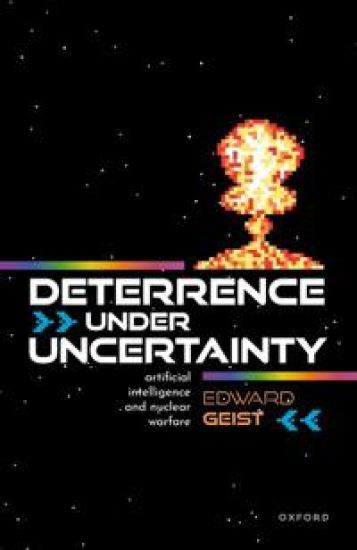
Deterrence under Uncertainty

Deterrence under Uncertainty

Edward Geist

Oxford University Press
2025
nidottu
For decades, films such as WarGames and The Terminator have warned that the combination of artificial intelligence and nuclear weapons might be a recipe for an apocalypse. Might these prophecies of doom become reality in coming decades? Using insights from computer science, Deterrence under Uncertainty: Artificial Intelligence and Nuclear Warfare evaluates how AI could make nuclear war winnable, and whether that possibility is likely. Detailed chapters explain how the landscape of nuclear deterrence is changing and debunks the myths of machine intelligence and nuclear weapons. This book gives a practitioner's perspective on how artificial intelligence (AI) and other emerging technologies could change the role of nuclear weapons in international relations.
Understanding the Limits of Artificial Intelligence for Warfighters

Understanding the Limits of Artificial Intelligence for Warfighters

Edward Geist; Aaron B Frank; Lance Menthe

RAND Corporation
2024
pokkari
Rapid progress in artificial intelligence (AI) for game-playing has inspired intense interest in the possible benefits of the technology for wargames. Advocates have suggested that AI might make wargames more effective or make it possible to apply wargames to novel problems. This report presents an assessment of the limits to applying AI technologies to wargaming and opportunities for future investments to productively employ AI in wargames.
Deterrence under Uncertainty:

Deterrence under Uncertainty:

Edward Geist

Oxford University Press
2023
sidottu
For decades, films such as WarGames and The Terminator have warned that the combination of artificial intelligence and nuclear weapons might be a recipe for an apocalypse. Might these prophecies of doom become reality in coming decades? Using insights from computer science, Deterrence under Uncertainty: Artificial Intelligence and Nuclear Warfare evaluates how AI could make nuclear war winnable, and whether that possibility is likely. Detailed chapters explain how the landscape of nuclear deterrence is changing and debunks the myths of machine intelligence and nuclear weapons. This book gives a practitioner's perspective on how artificial intelligence and other emerging technologies could change the role of nuclear weapons in international relations.
Opportunities and Risks of 5G Military Use in Europe

Opportunities and Risks of 5G Military Use in Europe

Mary Lee; James Dimarogonas; Edward Geist

RAND Corporation
2023
pokkari
The fifth-generation (5G) technology standard for broadband cellular communications is expanding in Europe and will offer many more capabilities than the existing fourth generation long-term evolution standard. The authors consider U.S. military uses of the 5G technology standard for cellular communications in a notional 2030 time frame, concentrating on a future smart logistics mission in the Baltics and surrounding countries.
Mitigating Challenges to U.S.-Russia Strategic Stability

Mitigating Challenges to U.S.-Russia Strategic Stability

Samuel Charap; John J Drennan; Luke Griffith; Edward Geist; Brian G Carlson

RAND Corporation
2022
nidottu
U.S.-Russia strategic stability is based on mutual vulnerability to retaliation, which eliminates the incentive to strike first. Yet the United States has developed capabilities that Moscow fears could be used for a first strike. These threat perceptions have become a significant source of instability. The authors examine the origins of this dynamic and its impact on bilateral stability and evaluate policy changes that could mitigate that impact.
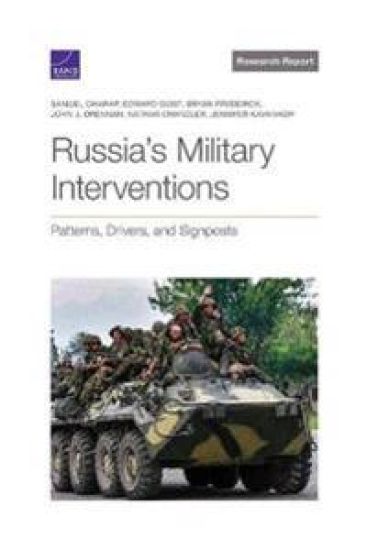
Russia's Military Interventions

Russia's Military Interventions

Samuel Charap; Edward Geist; Bryan Frederick; John J Drennan; Nathan Chandler; Jennifer Kavanagh

RAND
2021
nidottu
Despite Russia's relatively small global economic footprint, it has engaged in more interventions than any other U.S. competitor since the end of the Cold War. In this report, the authors assess when, where, and why Russia conducts military interventions by analyzing the 25 interventions that Russia has undertaken since 1991, including detailed case studies of the 2008 Russia-Georgia War and Moscow's involvement in the ongoing Syrian civil war.
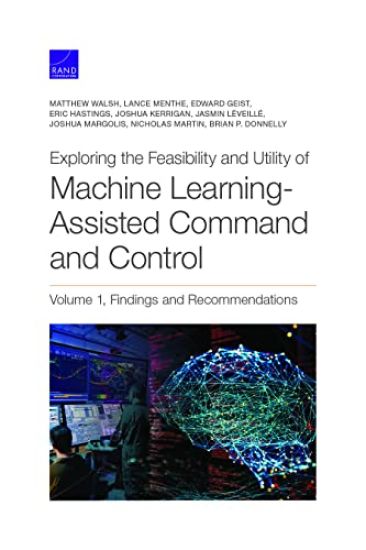
Exploring the Feasibility and Utility of Machine Learning-Assisted Command and Control, Volume 1
This report, which describes the potential for artificial intelligence (AI) systems to assist in Air Force command and control (C2) from a technical perspective, presents an analytical framework for assessing the suitability of a given AI system for a given C2 problem. The authors also provide metrics that can be used to evaluate AI systems and to demonstrate and socialize their utility.
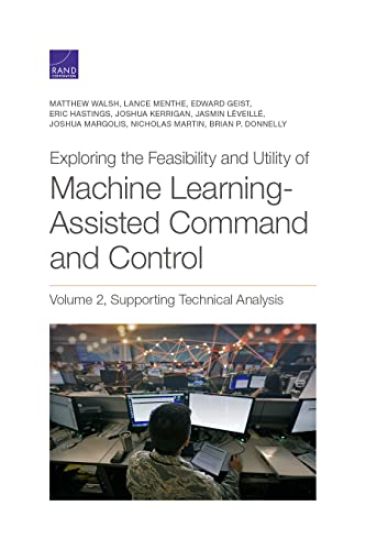
Exploring the Feasibility and Utility of Machine Learning-Assisted Command and Control, Volume 2
This volume serves as the technical analysis to a report concerning the potential for artificial intelligence systems to assist in Air Force command and control (C2). The authors present their analysis of the problem characteristics and solution capabilities described in Volume 1. They provide details about the expert panel used to gather data and three technical case studies that demonstrate a wide range of solutions to various C2 problems.
Counter-Radicalization Bot Research

Counter-Radicalization Bot Research

William Marcellino; Madeline Magnuson; Anne Stickells; Benjamin Boudreaux; Todd C Helmus; Edward Geist; Zev Winkelman

RAND
2020
nidottu
The speed of online recruitment for violent extremist organizations has challenged existing efforts to intervene with counter-radicalization, leading to global instability and violence. The U.S. government's counter-radicalization messaging enterprise may benefit from using promising emerging technology tools, particularly bots, to rapidly detect targets of such recruitment efforts and deliver counter-radicalization content to them.
The Future of the Russian Military

The Future of the Russian Military

Andrew Radin; Lynn E Davis; Edward Geist

RAND
2019
nidottu
Since 2008 Russia's military forces have improved, enabling Russian military operations in Crimea, eastern Ukraine, and Syria. Researchers analyze the societal, political, economic, and demographic factors that undergird Russian military power. Based on these factors, they analyze how Russian ground combat capabilities will evolve. The challenge for the U.S. military will be to compete in different regions without provoking escalation.
Technological Lessons from the Fukushima Dai-Ichi Accident

Technological Lessons from the Fukushima Dai-Ichi Accident

Cynthia Dion-Schwarz; Sarah E. Evans; Edward Geist; Scott Warren Harold; V. Ray Koym; Scott Savitz; Lloyd Thrall

RAND
2016
pokkari
This study draws lessons regarding technological countermeasures to radioactive contamination caused by the Fukushima Dai-Ichi nuclear power plant accident. It focuses on contamination measurement, efforts to limit dispersal, decontamination, and storage of radioactive materials. The report analyzes technological successes and identifies capability gaps that could be redressed through novel technologies or improved use of existing technologies.