Kirjailija
Edward J. Larson
Kirjat ja teokset yhdessä paikassa: 21 kirjaa, julkaisuja vuosilta 1996-2026, suosituimpien joukossa A Magnificent Catastrophe. Vertaile teosten hintoja ja tarkista saatavuus suomalaisista kirjakaupoista.
Mukana myös kirjoitusasut: Edward J Larson
21 kirjaa
Kirjojen julkaisuhaarukka 1996-2026.
CHOICE Outstanding Academic Title"They could write like angels and scheme like demons." So begins Pulitzer Prize-winner Edward Larson's masterful account of the wild ride that was the 1800 presidential election—an election so convulsive and so momentous to the future of American democracy that Thomas Jefferson would later dub it "America's second revolution." This was America's first true presidential campaign, giving birth to our two-party system and indelibly etching the lines of partisanship that have so profoundly shaped American politics ever since. The contest featured two of our most beloved Founding Fathers, once warm friends, facing off as the heads of their two still-forming parties—the hot-tempered but sharp-minded John Adams, and the eloquent yet enigmatic Thomas Jefferson—flanked by the brilliant tacticians Alexander Hamilton and Aaron Burr, who later settled their own differences in a duel. The country was descending into turmoil, reeling from the terrors of the French Revolution, and on the brink of war with France. Blistering accusations flew as our young nation was torn apart along party lines: Adams and his elitist Federalists would squelch liberty and impose a British-style monarchy; Jefferson and his radically democratizing Republicans would throw the country into chaos and debase the role of religion in American life. The stakes could not have been higher. As the competition heated up, other founders joined the fray—James Madison, John Jay, James Monroe, Gouverneur Morris, George Clinton, John Marshall, Horatio Gates, and even George Washington—some of them emerging from retirement to respond to the political crisis gripping the nation and threatening its future. Drawing on unprecedented, meticulous research of the day-to-day unfolding drama, from diaries and letters of the principal players as well as accounts in the fast-evolving partisan press, Larson vividly re-creates the mounting tension as one state after another voted and the press had the lead passing back and forth. The outcome remained shrouded in doubt long after the voting ended, and as Inauguration Day approached, Congress met in closed session to resolve the crisis. In its first great electoral challenge, our fragile experiment in constitutional democracy hung in the balance. A Magnificent Catastrophe is history writing at its evocative best: the riveting story of the last great contest of the founding period.
The self-evident truths of 1776 hover over America’s divisions—as inspiring ideals, as measures of how far the nation still must come, as the hypocrisy of slaveholders, as intrusions on local traditions. The revolutionary politics of 1776 turned from securing the rights of Englishmen to establishing the authority of an independent nation. The battlefields of 1776 cast the military mould for the war years to come and gave an enduring symbol of gritty determination. Drawing together the eloquence of Jefferson and the insistence of Paine, the strategies of generals and the audacious tactics of armies on the move and the powerful political movement that transformed colonies into states, this history of 1776 is a leading scholar’s distillation of the pivotal events that must be reckoned with two hundred and fifty years after the nation’s birth.
New attention from historians and journalists is raising pointed questions about the founding period: was the American revolution waged to preserve slavery, and was the Constitution a pact with slavery or a landmark in the antislavery movement? Leaders of the founding who called for American liberty are scrutinised for enslaving Black people themselves: George Washington consistently refused to recognise the freedom of those who escaped his Mount Vernon plantation. And we have long needed a history of the founding that fully includes Black Americans in the Revolutionary protests, the war and the debates over slavery and freedom that followed. We now have that history in Edward J. Larson’s insightful synthesis of the founding. With slavery thriving in Britain’s Caribbean empire and practiced in all of the American colonies, the independence movement’s calls for liberty proved narrow, though some Black observers and others made their full implications clear. In the war, both sides employed strategies to draw needed support from free and enslaved Blacks, whose responses varied by local conditions. By the time of the Constitutional Convention, a widening sectional divide shaped the fateful compromises over slavery that would prove disastrous in the coming decades. Larson’s narrative delivers poignant moments that deepen our understanding: we witness New York’s tumultuous welcome of Washington as liberator through the eyes of Daniel Payne, a Black man who had escaped enslavement at Mount Vernon two years before. Indeed, throughout Larson’s brilliant history it is the voices of Black Americans that prove the most convincing of all on the urgency of liberty.
A tale of grit and real teamwork in the wilds of Antarctica when the hunger for knowledge reigns supreme.Anything can happen in a pure wilderness experienced by few humans—a place where unseen menace waits everywhere. This story is an unembellished account of a scientist and his team exploring the last place on Earth. But, unlike most recent books on Antarctica, the reader becomes embedded with geologist Bruce Luyendyk’s team. They share the challenges, companionship, failures, bravery, and success brought to light from scientific research pursued in an unforgiving place, Marie Byrd Land, or Mighty Bad Land. The geologists make surprising discoveries. Luyendyk realizes that vast submarine plateaus in the southwest Pacific are continental pieces that broke away from the Marie Byrd Land sector of Gondwana. He coined “Zealandia” to describe this newly recognized submerged continent. Only the tops of its mountains poke above sea level to host the nation of New Zealand. This stunning revelation of a submerged eighth continent promises economic and geopolitical consequences reverberating into the twenty-first century. The story occurs in the 1990s and fills a gap in the timeline of Antarctic exploration between the Heroic Age, the age of military exploration, and before the modern era of science. Danger is exponentially greater, isolation a constant threat without GPS, satellite phones, and the internet. As the expedition’s leader, Luyendyk stands up to his demons that surface under the extreme duress of his experience, like nearly losing two team members.
New attention from historians and journalists is raising pointed questions about the founding period: was the American revolution waged to preserve slavery, and was the Constitution a pact with slavery or a landmark in the antislavery movement? Leaders of the founding who called for American liberty are scrutinised for enslaving Black people themselves: George Washington consistently refused to recognise the freedom of those who escaped his Mount Vernon plantation. And we have long needed a history of the founding that fully includes Black Americans in the Revolutionary protests, the war and the debates over slavery and freedom that followed. We now have that history in Edward J. Larson’s insightful synthesis of the founding. With slavery thriving in Britain’s Caribbean empire and practiced in all of the American colonies, the independence movement’s calls for liberty proved narrow, though some Black observers and others made their full implications clear. In the war, both sides employed strategies to draw needed support from free and enslaved Blacks, whose responses varied by local conditions. By the time of the Constitutional Convention, a widening sectional divide shaped the fateful compromises over slavery that would prove disastrous in the coming decades. Larson’s narrative delivers poignant moments that deepen our understanding: we witness New York’s tumultuous welcome of Washington as liberator through the eyes of Daniel Payne, a Black man who had escaped enslavement at Mount Vernon two years before. Indeed, throughout Larson’s brilliant history it is the voices of Black Americans that prove the most convincing of all on the urgency of liberty.
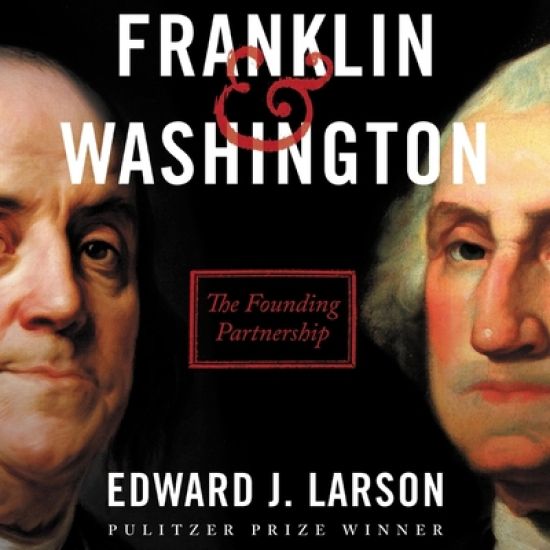
"Larson's elegantly written dual biography reveals that the partnership of Franklin and Washington was indispensable to the success of the Revolution." —Gordon S. Wood From the Pulitzer Prize-winning historian comes a masterful, first-of-its-kind dual biography of Benjamin Franklin and George Washington, illuminating their partnership's enduring importance. NATIONAL BESTSELLER • One of Washington Post's "10 Books to Read in February" • One of USA Today’s “Must-Read Books" of Winter 2020 • One of Publishers Weekly's "Top Ten" Spring 2020 Memoirs/BiographiesTheirs was a three-decade-long bond that, more than any other pairing, would forge the United States. Vastly different men, Benjamin Franklin—an abolitionist freethinker from the urban north—and George Washington—a slaveholding general from the agrarian south—were the indispensable authors of American independence and the two key partners in the attempt to craft a more perfect union at the Constitutional Convention, held in Franklin’s Philadelphia and presided over by Washington. And yet their teamwork has been little remarked upon in the centuries since.Illuminating Franklin and Washington’s relationship with striking new detail and energy, Pulitzer Prize–winning historian Edward J. Larson shows that theirs was truly an intimate working friendship that amplified the talents of each for collective advancement of the American project.After long supporting British rule, both Franklin and Washington became key early proponents of independence. Their friendship gained historical significance during the American Revolution, when Franklin led America’s diplomatic mission in Europe (securing money and an alliance with France) and Washington commanded the Continental Army. Victory required both of these efforts to succeed, and success, in turn, required their mutual coordination and cooperation. In the 1780s, the two sought to strengthen the union, leading to the framing and ratification of the Constitution, the founding document that bears their stamp.Franklin and Washington—the two most revered figures in the early republic—staked their lives and fortunes on the American experiment in liberty and were committed to its preservation. Today the United States is the world’s great superpower, and yet we also wrestle with the government Franklin and Washington created more than two centuries ago—the power of the executive branch, the principle of checks and balances, the electoral college—as well as the wounds of their compromise over slavery. Now, as the founding institutions appear under new stress, it is time to understand their origins through the fresh lens of Larson’s Franklin & Washington, a major addition to the literature of the founding era.
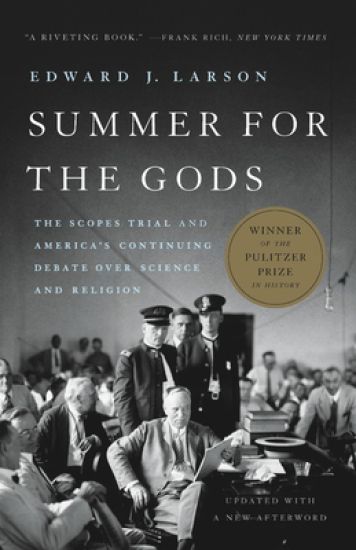
In the summer of 1925, the sleepy hamlet of Dayton, Tennessee, became the setting for one of the twentieth century's most contentious courtroom dramas, pitting William Jennings Bryan and the anti-Darwinists against a teacher named John Scopes, represented by Clarence Darrow and the ACLU, in a famous debate over science, religion, and their place in public education. That trial marked the start of a battle that continues to this day -- in cities and states throughout the country.Edward Larson's classic Summer for the Gods -- winner of the Pulitzer Prize in History -- is the single most authoritative account of this pivotal event. The 'Monkey Trial,' as it was playfully nicknamed, was instigated by the American Civil Liberties Union to challenge a controversial Tennessee law banning the teaching of human evolution in public schools. The Tennessee statute represented the first major victory for an intense national campaign against Darwinism, launched in the 1920s by Protestant fundamentalists and led by the famed politician and orator William Jennings Bryan. At the behest of the ACLU, a teacher named John Scopes agreed to challenge the statute, and what resulted was a trial of mythic proportions. Bryan joined the prosecutors and acclaimed criminal attorney Clarence Darrow led the defense -- a dramatic legal matchup that spurred enormous media attention and later inspired the classic play Inherit the Wind.Now with a new epilogue assessing the resonance of this history in America today, Summer of the Gods is the authoritative examination of the Scopes trial and its religious, cultural, educational, and political legacies.
Larson's elegantly written dual biography reveals that the partnership of Franklin and Washington was indispensable to the success of the Revolution. --Gordon S. Wood From the Pulitzer Prize-winning historian comes a masterful, first-of-its-kind dual biography of Benjamin Franklin and George Washington, illuminating their partnership's enduring importance. One of USA Today's "Must-Read Books of Winter 2020 - One of Publishers Weekly's Top Ten Spring 2020 Memoirs/BiographiesTheirs was a three-decade-long bond that, more than any other pairing, would forge the United States. Vastly different men, Benjamin Franklin--an abolitionist freethinker from the urban north--and George Washington--a slavehold-ing general from the agrarian south--were the indispensable authors of American independence and the two key partners in the attempt to craft a more perfect union at the Constitutional Convention, held in Franklin's Philadelphia and presided over by Washington. And yet their teamwork has been little remarked upon in the centuries since.Illuminating Franklin and Washington's relationship with striking new detail and energy, Pulitzer Prize-winning historian Edward J. Larson shows that theirs was truly an intimate working friendship that amplified the talents of each for collective advancement of the American project.During the French and Indian War, Franklin supplied the wagons for General Edward Braddock's ill-fated assault on Fort Duquesne, and Washington buried the general's body under the dirt road traveled by those retreating wagons. After long sup-porting British rule, both became key early proponents of inde-pendence. Rekindled during the Second Continental Congress in 1775, their friendship gained historical significance during the American Revolution, when Franklin led America's diplomatic mission in Europe (securing money and an alliance with France) and Washington commanded the Continental Army. Victory required both of these efforts to succeed, and success, in turn, required their mutual coordination and cooperation. In the 1780s, the two sought to strengthen the union, leading to the framing and ratification of the Constitution, the founding document that bears their stamp.Franklin and Washington--the two most revered figures in the early republic--staked their lives and fortunes on the American experiment in liberty and were committed to its preservation. Today the United States is the world's great super-power, and yet we also wrestle with the government Franklin and Washington created more than two centuries ago--the power of the executive branch, the principle of checks and balances, the electoral college--as well as the wounds of their compromise over slavery. Now, as the founding institutions appear under new stress, it is time to understand their origins through the fresh lens of Larson's Franklin & Washington, a major addition to the literature of the founding era.
Franklin & Washington: The Founding Partnership
Edward J. Larson
William Morrow Large Print
2020
nidottu
"Larson's elegantly written dual biography reveals that the partnership of Franklin and Washington was indispensable to the success of the Revolution." --Gordon S. Wood From the Pulitzer Prize-winning historian comes a masterful, first-of-its-kind dual biography of Benjamin Franklin and George Washington, illuminating their partnership's enduring importance. NATIONAL BESTSELLER - One of Washington Post's "10 Books to Read in February" - One of USA Today's "Must-Read Books" of Winter 2020 - One of Publishers Weekly's "Top Ten" Spring 2020 Memoirs/BiographiesTheirs was a three-decade-long bond that, more than any other pairing, would forge the United States. Vastly different men, Benjamin Franklin--an abolitionist freethinker from the urban north--and George Washington--a slavehold-ing general from the agrarian south--were the indispensable authors of American independence and the two key partners in the attempt to craft a more perfect union at the Constitutional Convention, held in Franklin's Philadelphia and presided over by Washington. And yet their teamwork has been little remarked upon in the centuries since.Illuminating Franklin and Washington's relationship with striking new detail and energy, Pulitzer Prize-winning historian Edward J. Larson shows that theirs was truly an intimate working friendship that amplified the talents of each for collective advancement of the American project.After long sup-porting British rule, both Franklin and Washington became key early proponents of inde-pendence. Their friendship gained historical significance during the American Revolution, when Franklin led America's diplomatic mission in Europe (securing money and an alliance with France) and Washington commanded the Continental Army. Victory required both of these efforts to succeed, and success, in turn, required their mutual coordination and cooperation. In the 1780s, the two sought to strengthen the union, leading to the framing and ratification of the Constitution, the founding document that bears their stamp.Franklin and Washington--the two most revered figures in the early republic--staked their lives and fortunes on the American experiment in liberty and were committed to its preservation. Today the United States is the world's great super-power, and yet we also wrestle with the government Franklin and Washington created more than two centuries ago--the power of the executive branch, the principle of checks and balances, the electoral college--as well as the wounds of their compromise over slavery. Now, as the founding institutions appear under new stress, it is time to understand their origins through the fresh lens of Larson's Franklin & Washington, a major addition to the literature of the founding era.
Winner of the National Outdoor Book Award From the Pulitzer Prize-winning historian, a "suspenseful" (WSJ) and "adrenaline-fueled" (Outside) entwined narrative of the most adventurous year of all time, when three expeditions simultaneously raced to the top, bottom, and heights of the world. As 1909 dawned, the greatest jewels of exploration—set at the world’s frozen extremes—lay unclaimed: the North and South Poles and the so-called “Third Pole,” the pole of altitude, located in unexplored heights of the Himalaya. Before the calendar turned, three expeditions had faced death, mutiny, and the harshest conditions on the planet to plant flags at the furthest edges of the Earth.In the course of one extraordinary year, Americans Robert Peary and Matthew Henson were hailed worldwide at the discovers of the North Pole; Britain’s Ernest Shackleton had set a new geographic “Furthest South” record, while his expedition mate, Australian Douglas Mawson, had reached the Magnetic South Pole; and at the roof of the world, Italy’s Duke of the Abruzzi had attained an altitude record that would stand for a generation, the result of the first major mountaineering expedition to the Himalaya's eastern Karakoram, where the daring aristocrat attempted K2 and established the standard route up the most notorious mountain on the planet. Based on extensive archival and on-the-ground research, Edward J. Larson weaves these narratives into one thrilling adventure story. Larson, author of the acclaimed polar history Empire of Ice, draws on his own voyages to the Himalaya, the arctic, and the ice sheets of the Antarctic, where he himself reached the South Pole and lived in Shackleton’s Cape Royds hut as a fellow in the National Science Foundations’ Antarctic Artists and Writers Program. These three legendary expeditions, overlapping in time, danger, and stakes, were glorified upon their return, their leaders celebrated as the preeminent heroes of their day. Stripping away the myth, Larson, a master historian, illuminates one of the great, overlooked tales of exploration, revealing the extraordinary human achievement at the heart of these journeys.
A captivating historical survey of the key debates, questions, and controversies at the intersection of science and religion Throughout history, scientific discovery has clashed with religious dogma, creating conflict, controversy, and sometimes violent dispute. In this enlightening and accessible volume, distinguished historian and Pulitzer Prize–winning author Edward Larson and Michael Ruse, philosopher of science and Gifford Lecturer, offer their distinctive viewpoints on the sometimes contentious relationship between science and religion. The authors explore how scientists, philosophers, and theologians through time and today approach vitally important topics, including cosmology, geology, evolution, genetics, neurobiology, gender, and the environment. Broaching their subjects from both historical and philosophical perspectives, Larson and Ruse avoid rancor and polemic as they address many of the core issues currently under debate by the adherents of science and the advocates of faith, shedding light on the richly diverse field of ideas at the crossroads where science meets spiritual belief.
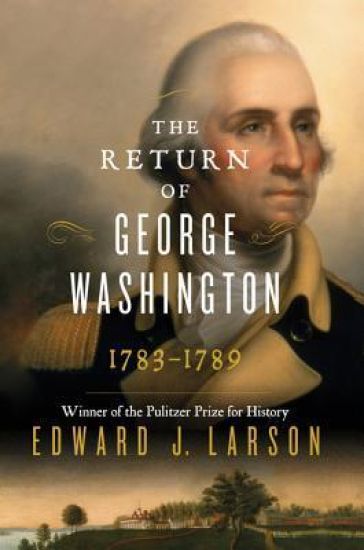
NEW YORK TIMES BESTSELLERAn elegantly written account of leadership at the most pivotal moment in American history (Philadelphia Inquirer)Pulitzer Prize-winning historian Edward J. Larson reveals how George Washington saved the United States by coming out of retirement to lead the Constitutional Convention and serve as our first president.After leading the Continental Army to victory in the Revolutionary War, George Washington shocked the world: he retired. In December 1783, General Washington, the most powerful man in the country, stepped down as Commander in Chief and returned to private life at Mount Vernon. Yet as Washington contentedly grew his estate, the fledgling American experiment floundered. Under the Articles of Confederation, the weak central government was unable to raise revenue to pay its debts or reach a consensus on national policy. The states bickered and grew apart. When a Constitutional Convention was established to address these problems, its chances of success were slim. Jefferson, Madison, and the other Founding Fathers realized that only one man could unite the fractious states: George Washington. Reluctant, but duty-bound, Washington rode to Philadelphia in the summer of 1787 to preside over the Convention.Although Washington is often overlooked in most accounts of the period, this masterful new history from Pulitzer Prize-winner Edward J. Larson brilliantly uncovers Washington's vital role in shaping the Convention--and shows how it was only with Washington's support and his willingness to serve as President that the states were brought together and ratified the Constitution, thereby saving the country.
From a Pulitzer Prize–winning historian, a riveting account of the great expeditions of Antarctica's Heroic Age that restores their status as grand scientific enterprises Published to coincide with the centenary of the first expeditions to reach the South Pole, An Empire of Ice presents a fascinating new take on Antarctic exploration. Retold with added information, it's the first book to place the famed voyages of Norwegian explorer Roald Amundsen, his British rivals Robert Scott and Ernest Shackleton, and others in a larger scientific, social, and geopolitical context.Efficient, well prepared, and focused solely on the goal of getting to his destination and back, Amundsen has earned his place in history as the first to reach the South Pole. Scott, meanwhile, has been reduced in the public mind to a dashing incompetent who stands for little more than relentless perseverance in the face of inevitable defeat. An Empire of Ice offers a new perspective on the Antarctic expeditions of the early twentieth century by looking at the British efforts for what they actually were: massive scientific enterprises in which reaching the South Pole was but a spectacular sideshow. By focusing on the larger purpose, Edward Larson deepens our appreciation of the explorers' achievements, shares little-known stories, and shows what the Heroic Age of Antarctic discovery was really about.
Few issues besides evolution have so strained Americans' professed tradition of tolerance. Few historians besides Pulitzer Prize winner Edward J. Larson have so perceptively chronicled evolution's divisive presence on the American scene. This slim volume reviews the key aspects, current and historical, of the creation-evolution debate in the United States.Larson discusses such topics as the transatlantic response to Darwinism, the American controversy over teaching evolution in public schools, and the religious views of American scientists. He recalls the theological qualms about evolution held by some leading scientists of Darwin's time. He looks at the 2006 Dover, Pennsylvania, court decision on teaching Intelligent Design and other cases leading back to the landmark 1925 Scopes trial. Drawing on surveys that Larson conducted, he discusses attitudes of American scientists toward the existence of God and the afterlife.By looking at the changing motivations and backgrounds of the stakeholders in the creation-evolution debate—clergy, scientists, lawmakers, educators, and others—Larson promotes a more nuanced view of the question than most of us have. This is no incidental benefit for Larson's readers; it is one of the book's driving purposes. If we cede the debate to those who would frame it simplistically rather than embrace its complexity, warns Larson, we will not advance beyond the naive regard of organized religion as the enemy of intellectual freedom or the equally myopic myth of the scientist as courageous loner willing to die for the truth.
Evolution: The Remarkable History of a Scientific Theory
Edward J. Larson
Modern Library
2006
nidottu
A Pulitzer Prize-winning science historian traces the history of evolutionary theory and philosophy, from the eighteenth-century emergence of paleontology, through the dramatic breakthroughs of Darwin, to the backlash against evolutionism, to its resurrection through the science of genetics and the rise of sociobiology. Reprint. 20,000 first printing.
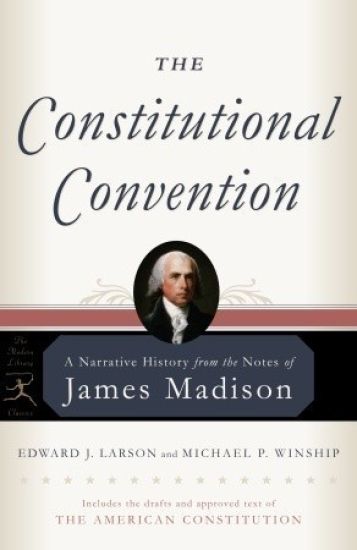
The Constitutional Convention
JAMES MADISON; Edward J. Larson; Michael P. Winship
Modern Library Inc
2005
pokkari
In 1787, the American union was in disarray. The incompatible demands of the separate states threatened its existence; some states were even in danger of turning into the kind of tyranny they had so recently deposed. A truly national government was needed, one that could raise money, regulate commerce, and defend the states against foreign threats-without becoming as overbearing as England. So thirty-six-year-old James Madison believed. That summer, the Virginian was instrumental in organizing the Constitutional Convention, in which one of the world's greatest documents would be debated, created, and signed. Inspired by a sense of history in the making, he kept the most extensive notes of any attendee.Now two esteemed scholars have made these minutes accessible to everyone. Presented with modern punctuation and spelling, judicious cuts, and helpful notes-plus fascinating background information on every delegate and an overview of the tumultuous times-here is the great drama of how the Constitution came to be, from the opening statements to the final votes. This Modern Library Paperback Classic also includes an Introduction and appendices from the authors.
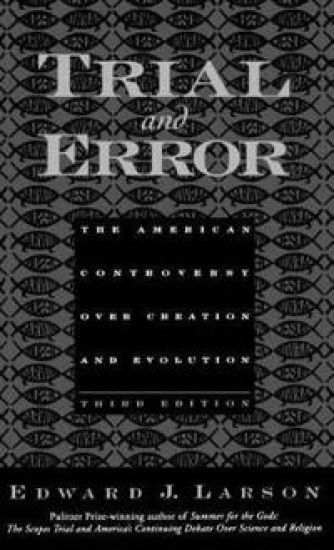
The debate over teaching evolution in the public schools remains one of the most emotionally charged controversies in twentieth-century America. This third edition of Edward J. Larson's highly acclaimed study - which ranges from before the Scopes trial of 1925 to the creationism disputes of the 1980's - offers the first comprehensive account of the educational and legal battles erupting from this persistent belief.
Trial and Error traces the coverage or lack thereof, of evolution in textbooks used in American public schools from the mid-1800s to the present. While the teaching of Darwinian evolution was common and not controversial in the late 19th century and into the early 20th century, the debates between evolutionists and creationists, those who argue that the Biblical theory of origins deserves equal treatment, have flared throughout the twentieth century--first in the 1920s, most famously in the Scopes trial; again in the 1960s, when the regional legislation banning the teaching of evolution was overturned, notably in Arkansas and Louisiana; and throughout the 1980s with various controversies over science textbooks, including California. Larson proposes to bring the subject up to the present through a discussion of recent trends, including the "intelligent design" movement, led by Phillip Johnson, a revised form of anti-evolutionism that gained popularity on college campuses; the impact of Michael Behe's versions of evolution; and debates over what counts as evidence for and against evolution--all of which have influenced debates over science standards, particularly at state and local levels. This new chapter will chronicle anti-evolution actions in Kansas and elsewhere and counter-actions by the National Academy of Science and other anti-creationist groups. This updated classic work presents a balanced historical interpretation of legal and educational debates over evolutionism, and will appeal to those interested in the fields of history, religion, science, and law.
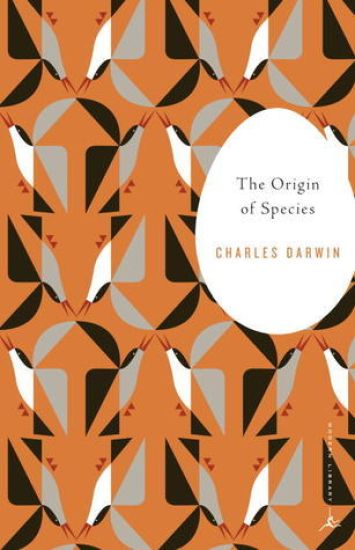
Perhaps the most readable and accessible of the great works of scientific imagination, The Origin of Species sold out on the day it was published in 1859. Theologians quickly labeled Charles Darwin the most dangerous man in England, and, as the Saturday Review noted, the uproar over the book quickly "passed beyond the bounds of the study and lecture-room into the drawing-room and the public street." Yet, after reading it, Darwin's friend and colleague T. H. Huxley had a different reaction: "How extremely stupid not to have thought of that."Based largely on Darwin's experience as a naturalist while on a five-year voyage aboard H.M.S. Beagle, The Origin of Species set forth a theory of evolution and natural selection that challenged contemporary beliefs about divine providence and the immutability of species. A landmark contribution to philosophical and scientific thought, this edition also includes an introductory historical sketch and a glossary Darwin later added to the original text.Charles Darwin grew up considered, by his own account, "a very ordinary boy, rather below the common standard of intellect." A quirk of fate kept him from the career his father had deemed appropriate--that of a country parson--when a botanist recommended Darwin for an appointment as a naturalist aboard H.M.S. Beagle from 1831 to 1836. Darwin is also the author of the five-volume work Zoology of the Voyage of the Beagle (1839) and The Descent of Man (1871).