Kirjojen hintavertailu. Mukana 12 207 858 kirjaa ja 12 kauppaa.

Kirjailija

Edward L. Ayers

Kirjat ja teokset yhdessä paikassa: 15 kirjaa, julkaisuja vuosilta 1996-2024, suosituimpien joukossa The Thin Light of Freedom. Vertaile teosten hintoja ja tarkista saatavuus suomalaisista kirjakaupoista.

15 kirjaa

Kirjojen julkaisuhaarukka 1996-2024.

American Visions

American Visions

Edward L. Ayers

WW NORTON CO
2024
nidottu
With so many of our histories falling into dour critique or blatant celebration, here is a welcome departure: a book that offers hope as well as honesty about the American past. The early decades of the nineteenth century saw the expansion of slavery, Native dispossession and wars with Canada and Mexico. Mass immigration and powerful religious movements sent tremors through American society. But even as the powerful defended the status quo, others defied it: voices from the margins moved the centre; eccentric visions altered the accepted wisdom and acts of empathy questioned self-interest. Edward L. Ayers’s rich history examines the visions that moved Frederick Douglass, Margaret Fuller, the Native American activist William Apess and others to challenge entrenched practices and beliefs. So, Lydia Maria Child condemned the racism of her fellow northerners at great personal cost. Melville and Thoreau, Joseph Smith and Samuel Morse all charted new paths for America in the realms of art, nature, belief and technology. It was Henry David Thoreau who, speaking of John Brown, challenged a hostile crowd "Is it not possible that an individual may be right and a government wrong?" Through decades of award-winning scholarship on the American Civil War, Edward L. Ayers has himself ventured beyond the interpretative status quo to recover the range of possibilities embedded in the past as it was lived. Here he turns that distinctive historical sensibility to a period when bold visionaries and critics built vigorous traditions of dissent and innovation into the foundation of the nation. Those traditions remain alive for us today.
American Visions

American Visions

Edward L. Ayers

WW NORTON CO
2023
sidottu
With so many of our histories falling into dour critique or blatant celebration, here is a welcome departure: a book that offers hope as well as honesty about the American past. The early decades of the nineteenth century saw the expansion of slavery, Native dispossession, mass immigration and wars with continental neighbours. And yet eccentric visions altered the accepted wisdom; voices from the margins moved the centre; acts of empathy defied self-interest. Edward L. Ayers’s rich history examines the visions that moved Frederick Douglass, Margaret Fuller and the Native American activist William Apess to challenge vastly powerful practices and beliefs. Melville and Thoreau, Joseph Smith and Samuel Morse were similarly moved to harness their creativity to forge new paths forward. These visionaries and critics built vigorous traditions of innovation and dissent into the very foundation of the nation.
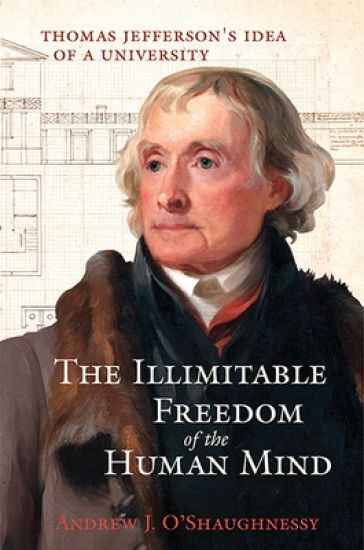
The Illimitable Freedom of the Human Mind

The Illimitable Freedom of the Human Mind

Andrew J. O’Shaughnessy; Edward L. Ayers

University of Virginia Press
2021
sidottu
Already renowned as a statesman, Thomas Jefferson in his retirement from government turned his attention to the founding of an institution of higher learning. Never merely a patron, the former president oversaw every aspect of the creation of what would become the University of Virginia. Along with the Declaration of Independence and the Virginia Statute for Religious Freedom, he regarded it as one of the three greatest achievements in his life. Nonetheless, historians often treat this period as an epilogue to Jefferson’s career.In The Illimitable Freedom of the Human Mind, Andrew O’Shaughnessy offers a twin biography of Jefferson in retirement and of the University of Virginia in its earliest years. He reveals how Jefferson’s vision anticipated the modern university and profoundly influenced the development of American higher education. The University of Virginia was the most visible apex of what was a much broader educational vision that distinguishes Jefferson as one of the earliest advocates of a public education system.Just as Jefferson’s proclamation that "all men are created equal" was tainted by the ongoing institution of slavery, however, so was his university. O’Shaughnessy addresses this tragic conflict in Jefferson’s conception of the university and society, showing how Jefferson’s loftier aspirations for the university were not fully realized. Nevertheless, his remarkable vision in founding the university remains vital to any consideration of the role of education in the success of the democratic experiment.
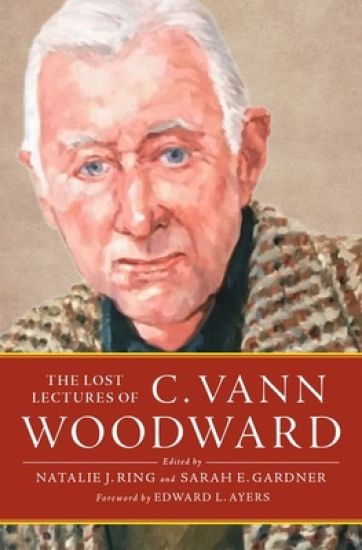
The Lost Lectures of C. Vann Woodward

The Lost Lectures of C. Vann Woodward

C. Vann Woodward; Edward L. Ayers

Oxford University Press Inc
2020
sidottu
C. Vann Woodward is one of the most significant historians of the post-Reconstruction South. Over his career of nearly seven decades, he wrote nine books; won the Bancroft and Pulitzer Prizes; penned hundreds of book reviews, opinion pieces, and scholarly essays; and gained national and international recognition as a public intellectual. Even today historians must contend with Woodward's sweeping interpretations about southern history. What is less known about Woodward is his scholarly interest in the history of white antebellum southern dissenters, the immediate consequences of emancipation, and the history of Reconstruction in the years prior to the Compromise of 1877. Woodward addressed these topics in three mid-century lecture series that have never before been published. The Lost Lectures of C. Vann Woodward presents for the first time lectures that showcase his life-long interest in exploring the contours and limits of nineteenth-century liberalism during key moments of social upheaval in the South. Historians Natalie J. Ring and Sarah E. Gardner analyze these works, drawing on correspondence, published and unpublished material, and Woodward's personal notes. They also chronicle his failed attempts to finish a much-awaited comprehensive history of Reconstruction and reflect on the challenges of writing about the failures of post-Civil War American society during the civil rights era, dubbed the Second Reconstruction. With an insightful foreword by eminent Southern historian Edward L. Ayers, The Lost Lectures of C. Vann Woodward offers new perspectives on this towering authority on nineteenth- and twentieth-century southern history and his attempts to make sense of the past amidst the tumultuous times in which he lived.
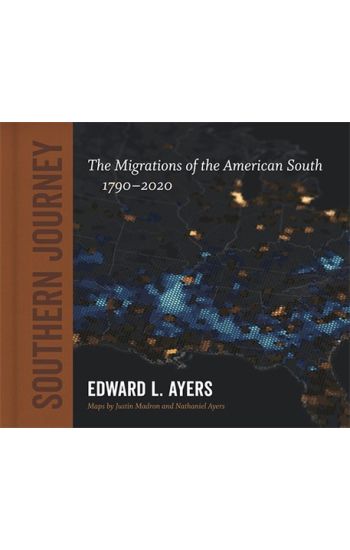
Southern Journey

Southern Journey

Edward L. Ayers

Louisiana State University Press
2020
sidottu
Taking a wide focus, Southern Journey narrates the evolution of southern history from the founding of the nation to the present day by focusing on the settling, unsettling, and resettling of the South. Using migration as the dominant theme of southern history and including indigenous, white, black, and immigrant people in the story, Edward L. Ayers cuts across the usual geographic, thematic, and chronological boundaries that subdivide southern history. Ayers explains the major contours and events of the southern past from a fresh perspective, weaving geography with history in innovative ways. He uses unique color maps created with sophisticated geographic information system (GIS) tools to interpret massive data sets from a humanistic perspective, providing a view of movement within the South with a clarity, detail, and continuity we have not seen before. The South has never stood still; it is - and always has been - changing in deep, radical, sometimes contradictory ways, often in divergent directions. Ayers's history of migration in the South is a broad yet deep reinterpretation of the region's past that informs our understanding of the population, economy, politics, and culture of the South today. Southern Journey is not only a pioneering work of history; it is a grand recasting of the South's past by one of its most renowned and appreciated scholars.
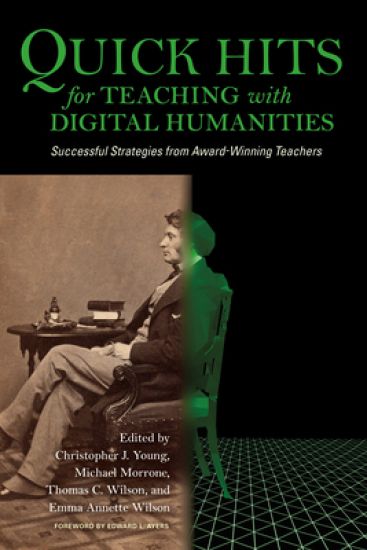
Quick Hits for Teaching with Digital Humanities

Quick Hits for Teaching with Digital Humanities

Edward L. Ayers

Indiana University Press
2020
pokkari
Quick Hits for Teaching with Digital Humanities: Successful Strategies from Award-Winning Teachers is an edited collection of 24 articles that aims to introduce faculty, administrators, and staff to ways in which digital techniques from the arts, humanities, and social sciences can be incorporated in the classroom. These techniques can enhance learning and professional development experiences for undergraduate and graduate students and faculty alike. This essential handbook illustrates the breadth of digital humanities across the disciplines with rich examples that bring best practices to life. Anyone who teaches at an institution of higher learning will find entry into new digital paradigms. As the authors share simple and complex ways to introduce digital humanities into the classroom, they expand understandings of what constitutes these current technologies for learning.
The Thin Light of Freedom

The Thin Light of Freedom

Edward L. Ayers

WW Norton Co
2018
nidottu
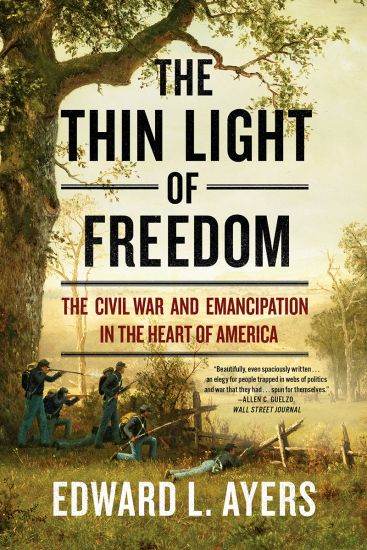
At the crux of America’s history stand two astounding events: the immediate and complete destruction of the most powerful system of slavery in the modern world, followed by a political reconstruction in which new constitutions established the fundamental rights of citizens for formerly enslaved people. Few people living in 1860 would have dared imagine either event, and yet, in retrospect, both seem to have been inevitable. In a beautifully crafted narrative, Edward L. Ayers restores the drama of the unexpected to the history of the Civil War. From the same vantage point occupied by his unforgettable characters, Ayers captures the strategic savvy of Lee and his local lieutenants, and the clear vision of equal rights animating black troops from Pennsylvania. We see the war itself become a scourge to the Valley, its pitched battles punctuating a cycle of vicious attack and reprisal in which armies burned whole towns for retribution. In the weeks and months after emancipation, from the streets of Staunton, Virginia, we see black and white residents testing the limits of freedom as political leaders negotiate the terms of readmission to the Union. With analysis as powerful as its narrative, here is a landmark history of the Civil War.
The Thin Light of Freedom

The Thin Light of Freedom

Edward L. Ayers

WW NORTON CO
2017
sidottu
Virginia’s Great Valley, prosperous in peace, invited destruction in war. Voracious Union and Confederate armies ground up the valley, consuming crops, livestock, fences and human life. Pitched battles at Gettysburg, Lynchburg and Cedar Creek punctuated a cycle of vicious attacks and reprisals in which armies burned whole towns for retribution. North of the Mason-Dixon line, free black families sent husbands and sons to fight with the US Colored Troops. In letters home, even as Lincoln commemorated the dead at Gettysburg, they spoke movingly of a war for emancipation. As defeat and the end of slavery descended on Virginia, with the drama of Reconstruction unfolding in Washington, the classrooms of the Freedmen’s Bureau schools spoke of a new society struggling to emerge. Here is history at its best: powerful, insightful and grounded in human detail.
The Field of Honor

The Field of Honor

Edward L. Ayers

University of South Carolina Press
2017
sidottu
For more than thirty years, the study of honor has been fundamental to understanding southern culture and history. Defined chiefly as reputation or public esteem, honor penetrated virtually every aspect of southern ethics and behavior, including race, gender, law, education, religion, and violence. In The Field of Honor: Essays on Southern Character and American Identity, editors John Mayfield and Todd Hagstette bring together new research by twenty emerging and established scholars who study the varied practices and principles of honor in its American context, across an array of academic disciplines.Following pathbreaking works by Bertram Wyatt-Brown, Dickson D. Bruce, and Edward L. Ayers, this collection notes that honor became a distinctive mark of southern culture and something that—alongside slavery—set the South distinctly off from the rest of the United States. This anthology brings together the work of a variety of writers who collectively explore both honor’s range and its limitations, revealing a South largely divided between the demands of honor and the challenges of an emerging market culture—one common to the United States at large. They do so by methodologically examining legal studies, market behaviors, gender, violence, and religious and literary expressions.Honor emerges here as a tool used to negotiate modernity’s challenges rather than as a rigid tradition and set of assumptions codified in unyielding rules and rhetoric. Some topics are traditional for the study of honor, some are new, but all explore the question: how different really is the South from America writ large? The Field of Honor builds an essential bridge between two distinct definitions of southern—and, by extension, American—character and identity.
Oh, Shenandoah

Oh, Shenandoah

Andre Kushnir; Edward L. Ayers

George F. Thompson
2016
sidottu
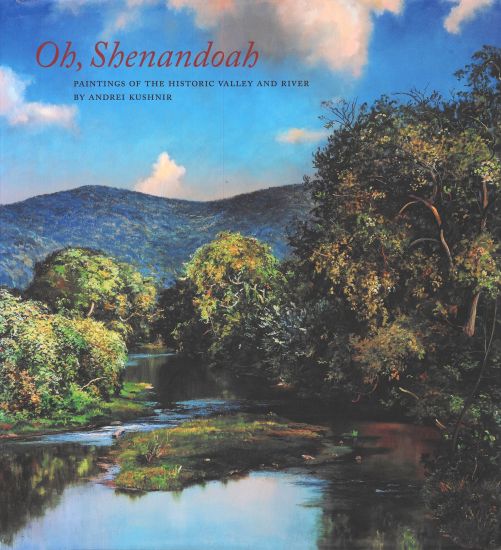
The Shenandoah Valley is widely renowned for its beauty and its idyllic landscape of farms, fields, historic towns, and Civil War battlefields. Framed to the east and west by the majestic Blue Ridge and Allegheny Mountains, the region is defined by the river made famous in the 1882 song ""Oh, Shenandoah.""The highly regarded painter Andrei Kushnir has spent years traveling throughout every corner of the Shenandoah Valley, capturing its myriad landscapes and architectural features with panache and an extraordinary appreciation for place. The paintings collected here highlight Kushnir’s rare ability to paint any landscape before him—pastoral or industrial, recreational or social, rural or urban, riparian or agricultural—all the while working out in the elements, en plein air. By organizing Kushnir’s paintings along highways US 11, US 340, and VA 42, enabling travelers to follow the paintings in geographical order, the book captures the Shenandoah Valley and its famous river in a uniquely comprehensive and intuitive way.In addition to the 263 plein-air paintings, Oh, Shenandoah presents in-depth historical and curatorial essays by Warren R. Hofstra, William M. S. Rasmussen, and Jeffrey C. Everett about the Valley and Kushnir’s significant contribution to our understanding of it, adding a rich, textual component to complement Kushnir's artistry.
The Promise of the New South

The Promise of the New South

Edward L. Ayers

Oxford University Press Inc
2007
sidottu
At a public picnic in the South in the 1890s, a young man paid five cents for his first chance to hear the revolutionary Edison talking machine. He eagerly listened as the soundman placed the needle down, only to find that through the tubes he held to his ears came the chilling sounds of a lynching. In this story, with its blend of new technology and old hatreds, genteel picnics and mob violence, Edward Ayers captures the history of the South in the years between Reconstruction and the turn of the century. Ranging from the Georgia coast to the Tennessee mountains, from the power brokers to tenant farmers, Ayers depicts a land of startling contrasts. Ayers takes us from remote Southern towns, revolutionized by the spread of the railroads, to the statehouses where Democratic Redeemers swept away the legacy of Reconstruction; from the small farmers, trapped into growing nothing but cotton, to the new industries of Birmingham; from abuse and intimacy in the family to tumultuous public meetings of the prohibitionists. He explores every aspect of society, politics, and the economy, detailing the importance of each in the emerging New South. Central to the entire story is the role of race relations, from alliances and friendships between blacks and whites to the spread of Jim Crows laws and disfranchisement. The teeming nineteenth-century South comes to life in these pages. When this book first appeared in 1992, it won a broad array of prizes and was a finalist for both the National Book Award and the Pulitzer Prize. The citation for the National Book Award declared Promise of the New South a vivid and masterfully detailed picture of the evolution of a new society. The Atlantic called it "one of the broadest and most original interpretations of southern history of the past twenty years."
What Caused the Civil War?

What Caused the Civil War?

Edward L. Ayers

WW Norton Co
2006
nidottu
The Southern past has proven to be fertile ground for great works of history. Peculiarities of tragic proportions—a system of slavery flourishing in a land of freedom, secession and Civil War tearing at a federal Union, deep poverty persisting in a nation of fast-paced development—have fed the imaginations of some of our most accomplished historians. Foremost in their ranks today is Edward L. Ayers, author of the award-winning and ongoing study of the Civil War in the heart of America, the Valley of the Shadow Project. In wide-ranging essays on the Civil War, the New South, and the twentieth-century South, Ayers turns over the rich soil of Southern life to explore the sources of the nation's and his own history. The title essay, original here, distills his vast research and offers a fresh perspective on the nation's central historical event.
In the Presence of Mine Enemies

In the Presence of Mine Enemies

Edward L. Ayers

WW Norton Co
2004
nidottu
Our standard Civil War histories tell a reassuring story of the triumph, in an inevitable conflict, of the dynamic, free-labor North over the traditional, slave-based South, vindicating the freedom principles built into the nation's foundations. But at the time, on the borderlands of Pennsylvania and Virginia, no one expected war, and no one knew how it would turn out. The one certainty was that any war between the states would be fought in their fields and streets. Edward L. Ayers gives us a different Civil War, built on an intimate scale. He charts the descent into war in the Great Valley spanning Pennsylvania and Virginia. Connected by strong ties of every kind, including the tendrils of slavery, the people of this borderland sought alternatives to secession and war. When none remained, they took up war with startling intensity. As this book relays with a vivid immediacy, it came to their doorsteps in hunger, disease, and measureless death. Ayers's Civil War emerges from the lives of everyday people as well as those who helped shape history—John Brown and Frederick Douglass, Lincoln, Jackson, and Lee. His story ends with the valley ravaged, Lincoln's support fragmenting, and Confederate forces massing for a battle at Gettysburg.
Southern Crossing

Southern Crossing

Edward L. Ayers

Oxford University Press Inc
1996
nidottu
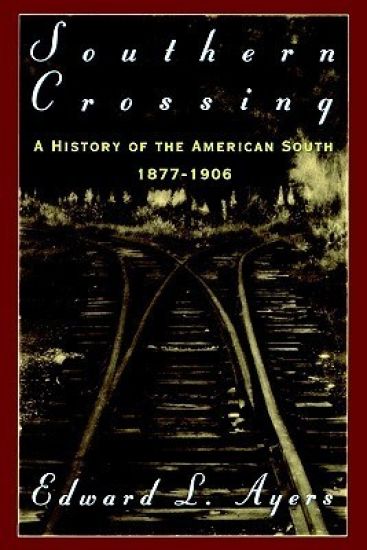
Edward L. Ayers's The Promise of the New South was a widely heralded history of the American South between the 1870s and the 1900s. Southern Junction represents an abridgement of this book, offering a glimpse into a society undergoing the sudden confontation with the promises, costs, and consequences of modern life
All Over the Map

All Over the Map

Edward L. Ayers; Patricia Nelson Limerick; Stephen Nissenbaum; Peter S. Onuf

Johns Hopkins University Press
1996
pokkari
Even as Americans keep moving "all over the map" in the late twentieth century, they cherish memories of the places they come from. But where do these places-these regions-come from? What makes them so real? In this groundbreaking book a distinguished group of historians explores the concept of region in America, traces changes the idea has undergone in our national experience, and examines its meaning for Americans today. Far from diminishing in importance, the authors conclude, regional differences continue to play a significant role in Americans' self-image. Regional identity, in fact, has always been fed by the very forces that many people think threaten its existence today: a central government, an aggressive economy, and connections with places beyond regional boundaries. Calling into question widely held notions about how Americans came to differ from one another and explaining why those differences continue to flourish, this iconoclastic study-by scholars with differing regional ties-will refresh and redirect the centuries-old discussion over Americans' conceptions of themselves.