Kirjojen hintavertailu. Mukana 12 595 353 kirjaa ja 12 kauppaa.

Kirjailija

Edward L. Keenan

Kirjat ja teokset yhdessä paikassa: 12 kirjaa, julkaisuja vuosilta 1971-2018, suosituimpien joukossa Boolean Semantics for Natural Language. Vertaile teosten hintoja ja tarkista saatavuus suomalaisista kirjakaupoista.

Mukana myös kirjoitusasut: Edward L Keenan

12 kirjaa

Kirjojen julkaisuhaarukka 1971-2018.

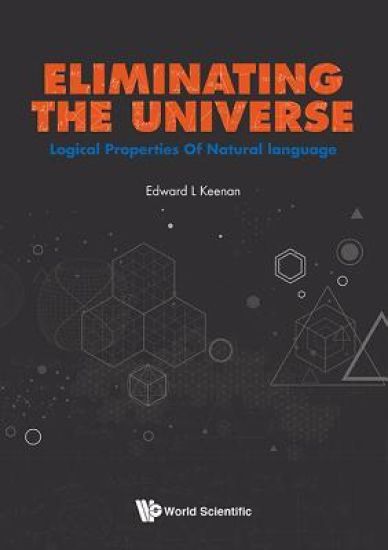
Eliminating The Universe: Logical Properties Of Natural Language

Eliminating The Universe: Logical Properties Of Natural Language

Edward L Keenan

World Scientific Publishing Co Pte Ltd
2018
sidottu
This book synthesizes the author's work (1980s-2015) on the logical expressive power of natural language. It extends the tools and concepts of model theory as used in (higher order) predicate logic to the study of natural language semantics. It focuses on boolean structure, generalized quantification (separated from variable binding), covering some cases of anaphora. Different categories — predicates, adjective, quantifiers — are modeled by non-isomorphic boolean lattices.Of empirical linguistic interest is the expressibility of many natural classes of quantifiers defined in terms of their logical (automorphism invariant) properties. Some of these correlate with classes used syntactically in generative grammar. In other cases we find general (possibly universal) constraints on possible quantifier denotations in natural language.Also of novel logical interest are entailment paradigms that depend on relations between pairs or triples of generalized quantifier denoting expressions, ones that are in some cases inherently vague. In addition we note novel binary quantifiers that lie beyond the 'Frege boundary' in that they are provably not identical to any iterated application of unary quantifiers.Of philosophical interest is the existence of models which make the same sentences true as standard models but which lack a universe and hence, seemingly, a notion of 'reference'. Moreover, these models generalize to ones in which we can represent (some) intensional expressions without the use of novel ontological objects, such as 'possible worlds' or 'propositions'.
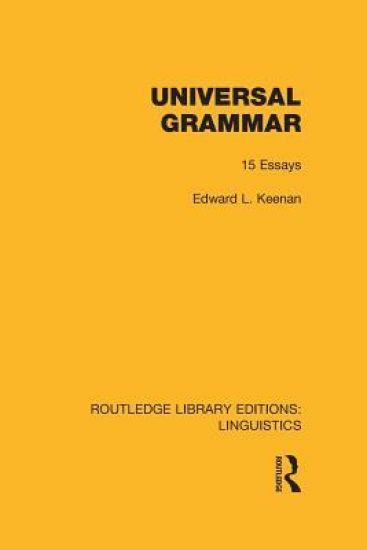
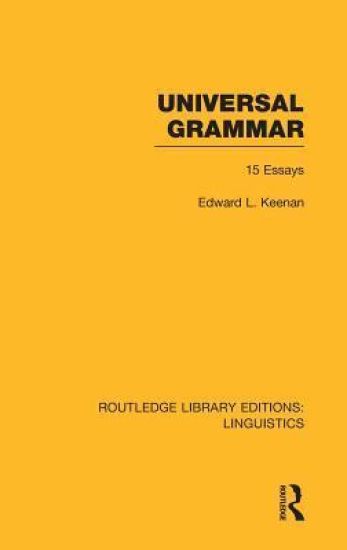
Universal Grammar (RLE Linguistics A: General Linguistics)
This collection of 15 articles reflects Edward Keenan’s long-standing research interests in the comparative syntax of the languages of the world. It includes two seminal ‘foundation’ articles, Noun Phrase Accessibility and Universal Grammar (with Bernard Comrie) and Towards a Universal Definition of ‘Subject of’. Most of the other articles have appeared in a variety of relatively inaccessible places, and so this book brings together for the first time a large body of work supporting the research directions taken in the foundation articles. In addition, one article of a psycholinguistic sort was specially prepared for this volume.
Universal Grammar (RLE Linguistics A: General Linguistics)
This collection of 15 articles reflects Edward Keenan’s long-standing research interests in the comparative syntax of the languages of the world. It includes two seminal ‘foundation’ articles, Noun Phrase Accessibility and Universal Grammar (with Bernard Comrie) and Towards a Universal Definition of ‘Subject of’. Most of the other articles have appeared in a variety of relatively inaccessible places, and so this book brings together for the first time a large body of work supporting the research directions taken in the foundation articles. In addition, one article of a psycholinguistic sort was specially prepared for this volume.
Josef Dobrovský and the Origins of the Igor' Tale

Josef Dobrovský and the Origins of the Igor' Tale

Edward L. Keenan

Harvard Ukrainian Research Institute,U.S.
2004
sidottu
This controversial and groundbreaking book revisits the origins of one of the most beloved works of East Slavic literature, the Slovo o polku Igoreve (The Igor' Tale). Edward Keenan delves into the history of the publication of the Tale and produces a meticulous analysis of its language in order to demonstrate that the text is not an authentic twelfth-century document. Rather, Keenan argues that it is a product of the late eighteenth century, created by the Bohemian scholar Josef Dobrovský. Keenan’s thought-provoking insights into the creation and publication of the Tale will spark scholarly debate for many years.
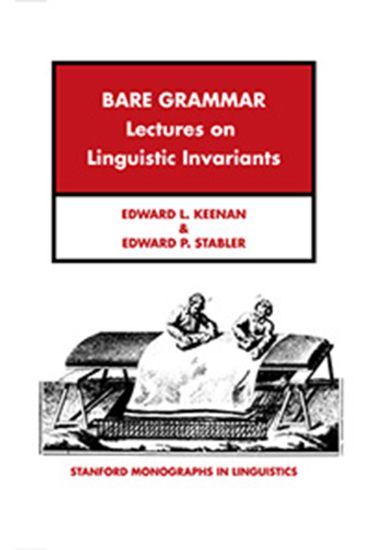
Bare Grammar

Bare Grammar

Edward L. Keenan; Edward P. Stabler

Centre for the Study of Language Information
2002
sidottu
Without assuming arbitrary restrictions on grammar notation at the outset, 'Bare Grammars' aim to provide the most straightforward definitions of the constructions present in human languages, together with a compositional semantics. A simple generative approach is presented which induces a natural algebraic notion of structure, with the surprising result that not only classical syntactic relations (like c-command) but also certain morphological relations concerning identity of particular morphemes (e.g. case markers) are properly structural. Formal models of case marking, verb voice, anaphora, are considered, and linguistic universals are proposed that do not assume any kind of structural isomorphism between languages. A strong form of compositionality is defended, together with the hypothesis that grammatical morphemes ('syntactic constants') always denote semantic constants, revealing that the relation between form and meaning is not subject to arbitrary dictates of linguistic convention, history, and accidents of human biology.
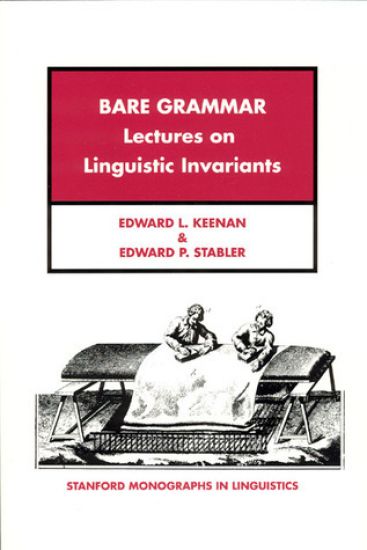
Bare Grammar

Bare Grammar

Edward L. Keenan; Edward P. Stabler

Centre for the Study of Language Information
2002
pokkari
Without assuming arbitrary restrictions on grammar notation at the outset, 'Bare Grammars' aim to provide the most straightforward definitions of the constructions present in human languages, together with a compositional semantics. A simple generative approach is presented which induces a natural algebraic notion of structure, with the surprising result that not only classical syntactic relations (like c-command) but also certain morphological relations concerning identity of particular morphemes (e.g. case markers) are properly structural. Formal models of case marking, verb voice, anaphora, are considered, and linguistic universals are proposed that do not assume any kind of structural isomorphism between languages. A strong form of compositionality is defended, together with the hypothesis that grammatical morphemes ('syntactic constants') always denote semantic constants, revealing that the relation between form and meaning is not subject to arbitrary dictates of linguistic convention, history, and accidents of human biology.
Boolean Semantics for Natural Language

Boolean Semantics for Natural Language

Edward L. Keenan; L.M. Faltz

Kluwer Academic Publishers
1984
nidottu
In the spring of 1978, one of the authors of this book was sitting in on a course in logic for linguists given by the other author. In attempting to present some of Montague's insights in an elementary way (hopefully avoid­ ing the notation which many find difficult at first), the authors began dis­ cussions aimed towards the construction of a simple model-theoretical semantic apparatus which could be applied directly to a small English-like language and used to illustrate the methods of formal logical interpretation. In these discussions two points impressed themselves on us. First, our task could be simplified by using boolean algebras and boolean homomorphisms in the models; and second, the boolean approach we were developing had much more widespread relevance to the logical structure of English than we first thought. During the summer and fall of 1978 we continued work on the system, proving the more fundamental theorems (including what we have come to call the Justification Theorem) and outlining the way in which an intensional interpretation scheme could be developed which made use of the boolean approach (which was originally strictly extensional). We presented our findings in a monograph (Keenan and Faltz, 1978) which the UCLA Linguistics Department kindly published as part of their series called Occa­ sional Papers in Linguistics; one of the authors also presented the system at a colloquium held at the Winter Meeting of the Linguistic Society of America in December 1978.
Boolean Semantics for Natural Language

Boolean Semantics for Natural Language

Edward L. Keenan; L.M. Faltz

Kluwer Academic Publishers
1984
sidottu
In the spring of 1978, one of the authors of this book was sitting in on a course in logic for linguists given by the other author. In attempting to present some of Montague's insights in an elementary way (hopefully avoid­ ing the notation which many find difficult at first), the authors began dis­ cussions aimed towards the construction of a simple model-theoretical semantic apparatus which could be applied directly to a small English-like language and used to illustrate the methods of formal logical interpretation. In these discussions two points impressed themselves on us. First, our task could be simplified by using boolean algebras and boolean homomorphisms in the models; and second, the boolean approach we were developing had much more widespread relevance to the logical structure of English than we first thought. During the summer and fall of 1978 we continued work on the system, proving the more fundamental theorems (including what we have come to call the Justification Theorem) and outlining the way in which an intensional interpretation scheme could be developed which made use of the boolean approach (which was originally strictly extensional). We presented our findings in a monograph (Keenan and Faltz, 1978) which the UCLA Linguistics Department kindly published as part of their series called Occa­ sional Papers in Linguistics; one of the authors also presented the system at a colloquium held at the Winter Meeting of the Linguistic Society of America in December 1978.
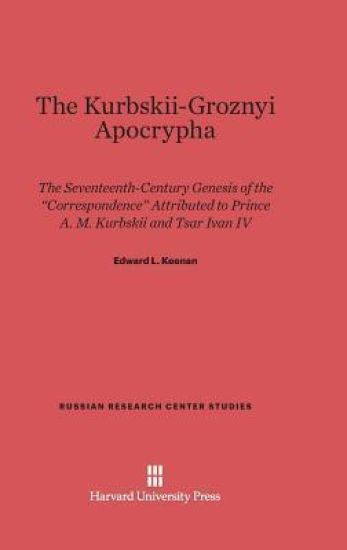
The Kurbskii-Groznyi Apocrypha

The Kurbskii-Groznyi Apocrypha

Edward L Keenan

Harvard University Press
1971
sidottu
For centuries the exchange of letters between Ivan the Terrible (1530-1584) and Prince Kurbskii, Muscovy's first notable defector, has been considered an authentic and important source for sixteenth-century Russian history. The Ivan portrayed in these letters has dominated posterity's perception of him and his time. But the provenance of the "Correspondence" has never been properly established. Edward L. Keenan draws on all the tools of source study and literary criticism to demonstrate that the "Correspondence" is a forgery, and in fact was composed some decades later in the seventeenth century. He concentrates on the first letter of Kurbskii, which is the earliest of the letters as well as a source for the later ones, and concludes that it was written between 1623 and 1625 by Semen Ivanovich Shakhovskoi--a conclusion that will necessitate the re-evaluation of sixteenth-century Russian history as it has previously been written by scholars throughout the world. Keenan discusses at length the implications of his discovery and sketches directions for future study, which will include a reconstruction of our conception of sixteenth- and seventeenth-century political thought, of Ivan's personality--indeed of the nature of his reign--and of the evolution of Muscovite state ideology.
Mathematical Structures in Languages

Mathematical Structures in Languages

Edward L. Keenan; Lawrence S. Moss

Centre for the Study of Language Information
2017
sidottu
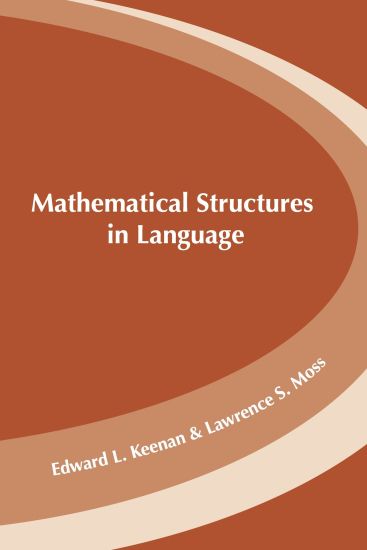
Mathematical Structures in Languages introduces a number of mathematical concepts that are of interest to the working linguist. The areas covered include basic set theory and logic, formal languages and automata, trees, partial orders, lattices, Boolean structure, generalized quantifier theory, and linguistic invariants, the last drawing on Edward L. Keenan and Edward Stabler's Bare Grammar: A Study of Language Invariants, also published by CSLI Publications. Ideal for advanced undergraduate and graduate students of linguistics, this book contains numerous exercises and will be a valuable resource for courses on mathematical topics in linguistics. The product of many years of teaching, Mathematic Structures in Languages is very much a book to be read and learned from.
Mathematical Structures in Languages

Mathematical Structures in Languages

Edward L. Keenan; Lawrence S. Moss

Centre for the Study of Language Information
2016
nidottu
Mathematical Structures in Languages introduces a number of mathematical concepts that are of interest to the working linguist. The areas covered include basic set theory and logic, formal languages and automata, trees, partial orders, lattices, Boolean structure, generalized quantifier theory, and linguistic invariants, the last drawing on Edward L. Keenan and Edward Stabler's Bare Grammar: A Study of Language Invariants, also published by CSLI Publications. Ideal for advanced undergraduate and graduate students of linguistics, this book contains numerous exercises and will be a valuable resource for courses on mathematical topics in linguistics. The product of many years of teaching, Mathematic Structures in Languages is very much a book to be read and learned from.
Formal Semantics of Natural Language

Formal Semantics of Natural Language

Edward L. Keenan

Cambridge University Press
2009
pokkari
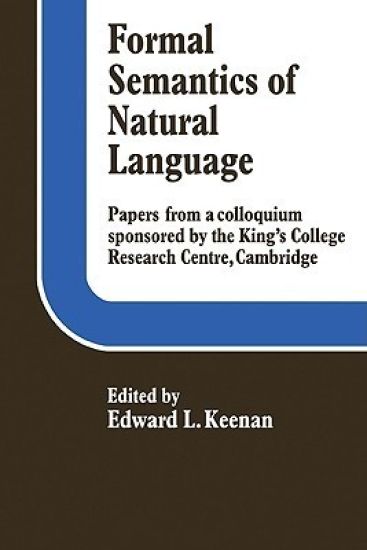
A volume of studies in natural language semantics which brings together work by philosophers, logicians and linguists. The main topics treated are: quantification and reference in natural language; the relations between formal logic, programming languages and natural language; pragmatics and discourse meaning; surface syntax and logical meaning. The volume derives from a colloquium organised in 1973 by the Kings College Research Centre, Cambridge and the papers have been edited for publication by Professor Keenan. It is hoped that the collection will make available some of the best work in this fast-moving field and will stimulate further progress by juxtaposing the different approaches and interests represented here.