Kirjojen hintavertailu. Mukana 12 595 353 kirjaa ja 12 kauppaa.

Kirjailija

Edward P. Stabler

Kirjat ja teokset yhdessä paikassa: 5 kirjaa, julkaisuja vuosilta 2001-2013, suosituimpien joukossa Bare Grammar. Vertaile teosten hintoja ja tarkista saatavuus suomalaisista kirjakaupoista.

5 kirjaa

Kirjojen julkaisuhaarukka 2001-2013.

Bare Grammar

Bare Grammar

Edward L. Keenan; Edward P. Stabler

Centre for the Study of Language Information
2002
sidottu
Without assuming arbitrary restrictions on grammar notation at the outset, 'Bare Grammars' aim to provide the most straightforward definitions of the constructions present in human languages, together with a compositional semantics. A simple generative approach is presented which induces a natural algebraic notion of structure, with the surprising result that not only classical syntactic relations (like c-command) but also certain morphological relations concerning identity of particular morphemes (e.g. case markers) are properly structural. Formal models of case marking, verb voice, anaphora, are considered, and linguistic universals are proposed that do not assume any kind of structural isomorphism between languages. A strong form of compositionality is defended, together with the hypothesis that grammatical morphemes ('syntactic constants') always denote semantic constants, revealing that the relation between form and meaning is not subject to arbitrary dictates of linguistic convention, history, and accidents of human biology.
Bare Grammar

Bare Grammar

Edward L. Keenan; Edward P. Stabler

Centre for the Study of Language Information
2002
pokkari
Without assuming arbitrary restrictions on grammar notation at the outset, 'Bare Grammars' aim to provide the most straightforward definitions of the constructions present in human languages, together with a compositional semantics. A simple generative approach is presented which induces a natural algebraic notion of structure, with the surprising result that not only classical syntactic relations (like c-command) but also certain morphological relations concerning identity of particular morphemes (e.g. case markers) are properly structural. Formal models of case marking, verb voice, anaphora, are considered, and linguistic universals are proposed that do not assume any kind of structural isomorphism between languages. A strong form of compositionality is defended, together with the hypothesis that grammatical morphemes ('syntactic constants') always denote semantic constants, revealing that the relation between form and meaning is not subject to arbitrary dictates of linguistic convention, history, and accidents of human biology.
Answer Key For Linguistics

Answer Key For Linguistics

Victoria A. Fromkin; Donca Steriade; Pamela Munro; Bruce P. Hayes; Susan Curtiss; Anna Szabolcsi; Tim Stowell; Edward P. Stabler; Dominique Sportiche; Hilda Koopman; Patricia Keating; Nina Hyams

Blackwell Publishers
2001
nidottu
Linguistics: An Introduction to Linguistic Theory is a textbook, written for introductory courses in linguistic theory for undergraduate linguistics majors and first-year graduate students. Twelve major figures in the field bring their expertise to each of the core areas of the field - morphology, syntax, semantics, phonetics, phonology, and language acquisition. In each section the book is concerned with discussing the underlying principles common to all languages, showing how these are revealed in language acquisition and in the specific grammars of the world's languages. Theoretical concepts are introduced through the analysis of a wide set of language data from Arabic to Zulu. The student will learn how to "do" linguistics by working through real linguistic data. Each section explains how to define and solve a problem; organizes the data into paradigms revealing the structured patterns in the data; formulates generalizations based on these patterns; proposes rules or principles to account for the generalization; seeks independent evidence in its argument for the proposed theoretical construct. The book brings the latest developments in theoretical linguistics to bear in its discussion of the traditional issues. It covers these subjects in greater depth than is found in most introductory texts permitting the student to proceed directly, after using this text, to graduate courses in the field. It contains problems, a glossary, and a bibliography for further reading. Linguistics is supported by an instructor's manual.
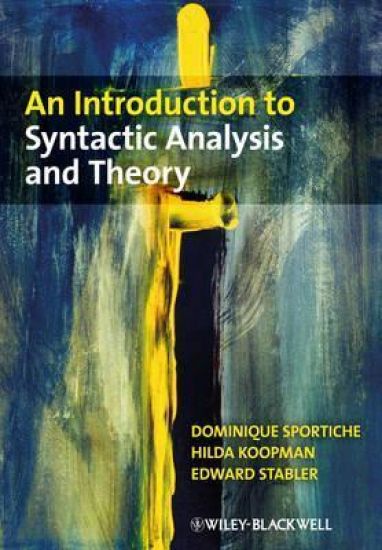
An Introduction to Syntactic Analysis and Theory

An Introduction to Syntactic Analysis and Theory

Dominique Sportiche; Hilda Koopman; Edward P. Stabler

Wiley-Blackwell (an imprint of John Wiley Sons Ltd)
2013
sidottu
An Introduction to Syntactic Analysis and Theory offers beginning students a comprehensive overview of and introduction to our current understanding of the rules and principles that govern the syntax of natural languages. Includes numerous pedagogical features such as 'practice' boxes and sidebars, designed to facilitate understanding of both the 'hows' and the 'whys' of sentence structureGuides readers through syntactic and morphological structures in a progressive mannerTakes the mystery out of one of the most crucial aspects of the workings of language – the principles and processes behind the structure of sentencesIdeal for students with minimal knowledge of current syntactic research, it progresses in theoretical difficulty from basic ideas and theories to more complex and advanced, up to date concepts in syntactic theory
An Introduction to Syntactic Analysis and Theory

An Introduction to Syntactic Analysis and Theory

Dominique Sportiche; Hilda Koopman; Edward P. Stabler

Wiley-Blackwell (an imprint of John Wiley Sons Ltd)
2013
nidottu
An Introduction to Syntactic Analysis and Theory offers beginning students a comprehensive overview of and introduction to our current understanding of the rules and principles that govern the syntax of natural languages. Includes numerous pedagogical features such as 'practice' boxes and sidebars, designed to facilitate understanding of both the 'hows' and the 'whys' of sentence structureGuides readers through syntactic and morphological structures in a progressive mannerTakes the mystery out of one of the most crucial aspects of the workings of language – the principles and processes behind the structure of sentencesIdeal for students with minimal knowledge of current syntactic research, it progresses in theoretical difficulty from basic ideas and theories to more complex and advanced, up to date concepts in syntactic theory