Kirjojen hintavertailu. Mukana 12 595 353 kirjaa ja 12 kauppaa.
Kirjailija
Edward S. Herman
Kirjat ja teokset yhdessä paikassa: 12 kirjaa, julkaisuja vuosilta 1982-2025, suosituimpien joukossa Manufacturing Consent. Vertaile teosten hintoja ja tarkista saatavuus suomalaisista kirjakaupoista.
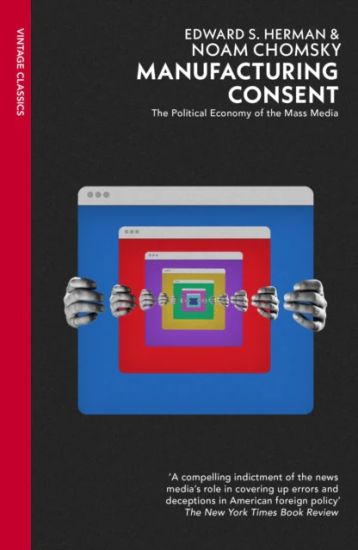
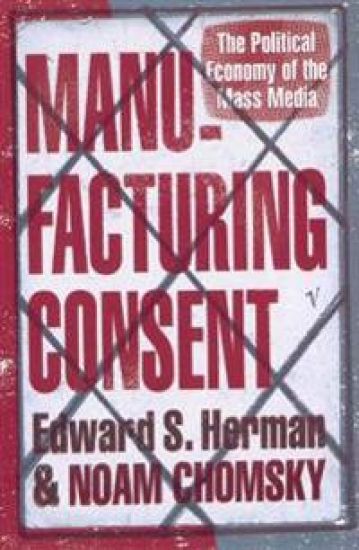
A detailed and compelling political study of how elite forces shape mass media.Edward S Herman and Noam Chomsky investigate how an underlying elite consensus structures mainstream media. Here they skilfully dissect the way in which the marketplace and the economics of publishing significantly shape the news.This book reveals how issues are framed and topics chosen, and the double standards underlying accounts of free elections, a free press, and governmental repression between Nicaragua and El Salvador; between the Russian invasion of Afghanistan and the American invasion of Vietnam; between the genocide in Cambodia under a pro-American government and genocide under Pol Pot.What emerges from this ground-breaking work is an account of just how propagandistic our mass media can be, and how we can learn to read them and see their function in a radically new way.
In this collection, no fewer than 30 of Edward S. Herman and David Peterson's essays in the critique of the "Art of Deceit" spanning a period of close to 20 years have been published together in one volume for the first time. They bring impressive levels of skepticism and scholarship to bear on the often hidden-in plain-sight systems of false belief (or ideologies) that rule both intellectual and popular culture. They cover the real as opposed to the ideological uses of the word 'terrorism'; the long-term U.S. and media misrepresentations of the Islamic Republic of Iran and Honduras, the former Yugoslavia, and Rwanda; the warmongering work of the late writer Christopher Hitchens, as well as the multiple systematic falsehoods of the "New Humanitarians," who shared a penchant for advocating War in the name of Peace and Human Rights. As long-time Herman collaborator Noam Chomsky remarked, the result constitutes "A real triumph." This collection demands to be read and studied closely and carefully. "This collection of essays and articles by Edward S. Herman and David Peterson is some of the finest media analysis I have ever read. Herman is mandatory reading for anyone serious about news media analysis, and in Peterson he has a worthy collaborator. This book is also a compendium of the great global political struggles of the past three decades. For media critics and political observers alike, this is a book worth reading and keeping around as an invaluable reference book. It is Herman and Peterson at their best." - ROBERT W. McCHESNEY, Gutgsell Endowed Professor, Department of Communications, University of Illinois at Urbana-Champaign "As humanity owes Hannah Arendt for the courage of her pen, so we owe Edward Herman for a lifetime's revelations of the banality of evil in our midst. This extraordinary collection with David Peterson is a truth teller's guide." - JOHN PILGER, journalist, war correspondent, film-maker and author of Freedom Next Time: Resisting the Empire "A forensic demolition of the corporate media which is saturated with propaganda serving elite and oppressive state-corporate interests that are now actually threatening human survival in an age of climate chaos. This is a truly indispensable book." - DAVID CROMWELL, Co-Editor, Media Lens "The greatest political writing partnership since Herman and Chomsky, Herman and Peterson are a crucial antidote to the extremist corporate media system sometimes described as 'mainstream'. At close to 900 pages, Like A Cuttlefish Spurting Out Ink, is a treasure trove of razor-sharp but ultimately compassionate analysis derailing the deceptions that keep the West's Perpetual War machine on track and killing with impunity. Don't miss it."- DAVID EDWARDS, Co-Editor, Media Lens Edward S. Herman (1925-2017) was professor of finance at the Wharton School, University of Pennsylvania, and wrote extensively on economics, political economy, and the media. Among his books were Corporate Control, Corporate Power (Cambridge University Press, 1981), The Real Terror Network (South End Press, 1982), and, with Noam Chomsky, the two-volume The Political Economy of Human Rights (South End Press, 1979; Haymarket Books, 2014), and Manufacturing Consent (Pantheon, 2nd. Ed., 2002). David Peterson is an independent journalist and researcher based in Chicago. Together, they were coauthors of The Politics of Genocide (Monthly Review Press, 2nd. Ed., 2011), and Enduring Lies: The Rwandan Genocide in the Propaganda System, 20 Years Later (The Real News Books, 2014).
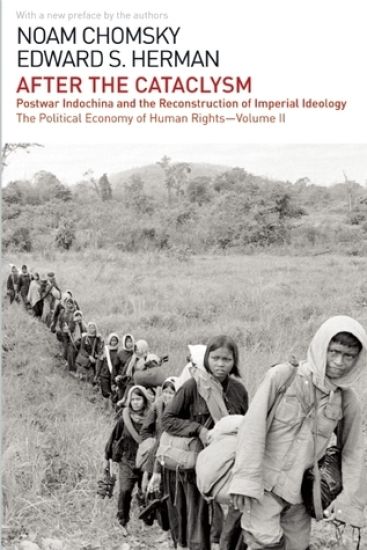
The second volume of The Political Economy of Human Rights remains one of the most controversial works produced by Chomsky to date. In a much discussed chapter on Cambodia, Chomsky and Herman questioned official Western narratives on the Khmer Rouge and suggested that the evidence available did not match up to the assertions being made at that time. These claims would resurface in a recent controversy with the Continental philosopher Slavoj Zizek and readers will now be able to judge for themselves the veracity of Zizek's claims. The work also contains important analysis of Western interventions across Indochina, including Vietnam and Laos, and provides a searing critique of American imperial aspirations in the region.
The Political Economy of Human Rights is an important two volume work, co-authored with Edward Herman – also co-author of the classic Manufacturing Consent – which provides a complete dissection of American foreign policy during the 1960s and '70s, looking at the entire sweep of the Cold War during that period, including events in Vietnam, Cambodia, Indonesia and Latin America. For those looking to develop a broad understanding of American foreign policy during the 20th Century this work has been a vital resource and is now available to a new generation of scholars and activists.
With a new preface by the authors, this companion book to The Washington Connection and Third World Fascism, dissects the aftermath of the war in Southeast Asia, the refugee problem, the Vietnam/Cambodia conflict and the Pol Pot regime.
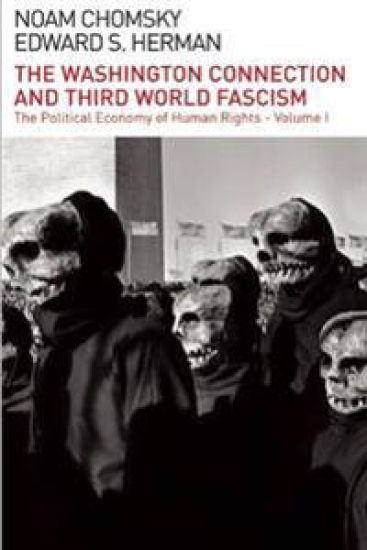
A brilliant, shattering, and convincing account of United States-backed suppression of political and human rights in Latin America, Asia, and Africa and the role of the media in misreporting these policies The Washington Connection and Third World Fascism relentlessly dissects the official views of establishment scholars and their journals. The "best and brightest" pundits of the status quo emerge from this book thoroughly denuded of their credibility.
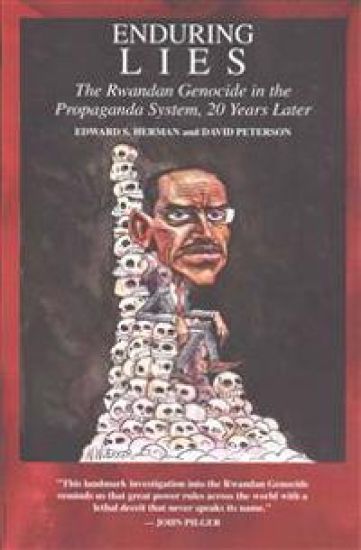
The Rwandan genocide of 1994 has been called the "fastest, most efficient killing spree of the twentieth century. In 100 days, some 800,000 Tutsi and politically moderate Hutu were murdered. The United States did almost nothing to try to stop it" (U.S. Ambassador to the United Nations Samantha Power, writing in 2002). In their book, Enduring Lies: The Rwandan Genocide in the Propaganda System, 20 Year Later (The Real News Books), Edward S. Herman and David Peterson challenge these beliefs. With sections devoted to "The 'Rwandan Genocide' by the Numbers," the Tutsi-led Rwandan Patriotic Front's October 1990 invasion of Rwanda from Uganda and Paul Kagame's ensuing 46-month war of conquest, the April 6, 1994 shoot-down of the Hutu President Juv nal Habyarimana's jet on its return to Kigali, universally regarded as the event that triggered the mass bloodshed which followed, the mythical Hutu "conspiracy to commit genocide" against the country's minority Tutsi population, the West's alleged "failure to intervene" to stop the killings, Kagame Power's triumph in Rwanda and its spread to the neighboring Democratic Republic of Congo, with a death toll running in the millions, and to the pernicious role played by the U.S., U.K., and Canadian governments, as well as by the United Nations, human rights groups, the media and intellectuals in promulgating a false history of 1994 Rwanda, the authors cross-examine what they call the "standard model" of the Rwandan genocide. "A brilliant dissection of the Western propaganda system on Rwanda," writes Christopher Black, a Canadian attorney and the lead defense counsel before the International Criminal Tribunal for Rwanda.
In this impressive book, Edward S. Herman and David Peterson examine the uses and abuses of the word "genocide." They argue persuasively that the label is highly politicized and that in the United States it is used by the government, journalists, and academics to brand as evil those nations and political movements that in one way or another interfere with the imperial interests of U.S. capitalism. Thus the word "genocide" is seldom applied when the perpetrators are U.S. allies (or even the United States itself), while it is used almost indiscriminately when murders are committed or are alleged to have been committed by enemies of the United States and U.S. business interests. One set of rules applies to cases such as U.S. aggression in Vietnam, Israeli oppression of Palestinians, Indonesian slaughter of so-called communists and the people of East Timor, U.S. bombings in Serbia and Kosovo, the U.S. war of "liberation" in Iraq, and mass murders committed by U.S. allies in Rwanda and the Republic of Congo. Another set applies to cases such as Serbian aggression in Kosovo and Bosnia, killings carried out by U.S. enemies in Rwanda and Darfur, Saddam Hussein, any and all actions by Iran, and a host of others.With its careful and voluminous documentation, close reading of the U.S. media and political and scholarly writing on the subject, and clear and incisive charts, The Politics of Genocide is both a damning condemnation and stunning expose of a deeply rooted and effective system of propaganda aimed at deceiving the population while promoting the expansion of a cruel and heartless imperial system.
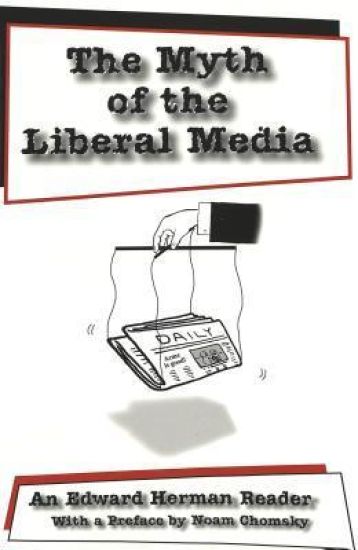
The Myth of the Liberal Media contends that the mainstream media are parts of a market system and that their performance is shaped primarily by proprietor/owner and advertiser interests. Using a propaganda model, it is argued that the commercial media protect and propagandize for the corporate system. Case studies of major media institutions--the New York Times, the Wall Street Journal, the Philadelphia Inquirer--are supplemented by detailed analyses of "word tricks and propaganda" and the media's treatment of topics such as Third World elections, the Persian Gulf War, the North American Free Trade Agreement, the fall of Suharto, and corporate junk science.
A detailed and compelling political study of how elite forces shape mass media.Edward S Herman and Noam Chomsky investigate how an underlying elite consensus structures mainstream media. Here they skilfully dissect the way in which the marketplace and the economics of publishing significantly shape the news.This book reveals how issues are framed and topics chosen, and the double standards underlying accounts of free elections, a free press, and governmental repression between Nicaragua and El Salvador; between the Russian invasion of Afghanistan and the American invasion of Vietnam; between the genocide in Cambodia under a pro-American government and genocide under Pol Pot.What emerges from this ground-breaking work is an account of just how propagandistic our mass media can be, and how we can learn to read them and see their function in a radically new way.
Deep and detailed research into the workings of corporate enables Professor Herman to throw considerable light on how the board of directors operates, how important outside directors are, how new members are selected, and how multiple directorships interlock the large corporations. Throughout the book the author contrasts the power of the managers with that of other interest groups - bankers, family - and he concludes that power lies with the managers. But this has not changed the basic objectives of the corporation - the pursuit of growth and profits - nor has it enhanced social responsibility. After thorough investigation Edward Herman concludes that government regulation has done surprisingly little to reduce the autonomy of the corporation. Just as the influence of bankers and investors has been resisted, so has the effect of regulation. Improved communications and controls, geographic dispersion, and the enhanced adaptability and mobility of the large corporation have all played a part in maintaining corporate power and managerial control. Corporate Control, Corporate Power will be essential reading for executives, policy makers, regulators, and all those concerned to make the corporation more responsible and accountable.