Kirjojen hintavertailu. Mukana 12 390 323 kirjaa ja 12 kauppaa.

Kirjailija

Edward Scheinerman

Kirjat ja teokset yhdessä paikassa: 6 kirjaa, julkaisuja vuosilta 2006-2024, suosituimpien joukossa C++ for Mathematicians. Vertaile teosten hintoja ja tarkista saatavuus suomalaisista kirjakaupoista.

6 kirjaa

Kirjojen julkaisuhaarukka 2006-2024.

From Counting to Continuum

From Counting to Continuum

Edward Scheinerman

Cambridge University Press
2024
sidottu
Understanding the natural numbers, which we use to count things, comes naturally. Meanwhile, the real numbers, which include a wide range of numbers from whole numbers to fractions to exotic ones like p, are, frankly, really difficult to describe rigorously. Instead of waiting to take a theorem-proof graduate course to appreciate the real numbers, readers new to university-level mathematics can explore the core ideas behind the construction of the real numbers in this friendly introduction. Beginning with the intuitive notion of counting, the book progresses step-by-step to the real numbers. Each sort of number is defined in terms of a simpler kind by developing an equivalence relation on a previous idea. We find the finite sets' equivalence classes are the natural numbers. Integers are equivalence classes of pairs of natural numbers. Modular numbers are equivalence classes of integers. And so forth. Exercises and their solutions are included.
From Counting to Continuum

From Counting to Continuum

Edward Scheinerman

Cambridge University Press
2024
pokkari
Understanding the natural numbers, which we use to count things, comes naturally. Meanwhile, the real numbers, which include a wide range of numbers from whole numbers to fractions to exotic ones like p, are, frankly, really difficult to describe rigorously. Instead of waiting to take a theorem-proof graduate course to appreciate the real numbers, readers new to university-level mathematics can explore the core ideas behind the construction of the real numbers in this friendly introduction. Beginning with the intuitive notion of counting, the book progresses step-by-step to the real numbers. Each sort of number is defined in terms of a simpler kind by developing an equivalence relation on a previous idea. We find the finite sets' equivalence classes are the natural numbers. Integers are equivalence classes of pairs of natural numbers. Modular numbers are equivalence classes of integers. And so forth. Exercises and their solutions are included.
C++ for Mathematicians

C++ for Mathematicians

Edward Scheinerman

CRC Press
2018
sidottu
For problems that require extensive computation, a C++ program can race through billions of examples faster than most other computing choices. C++ enables mathematicians of virtually any discipline to create programs to meet their needs quickly, and is available on most computer systems at no cost. C++ for Mathematicians: An Introduction for Students and Professionals accentuates C++ concepts that are most valuable for pure and applied mathematical research.This is the first book available on C++ programming that is written specifically for a mathematical audience; it omits the language’s more obscure features in favor of the aspects of greatest utility for mathematical work. The author explains how to use C++ to formulate conjectures, create images and diagrams, verify proofs, build mathematical structures, and explore myriad examples. Emphasizing the essential role of practice as part of the learning process, the book is ideally designed for undergraduate coursework as well as self-study. Each chapter provides many problems and solutions which complement the text and enable you to learn quickly how to apply them to your own problems. Accompanying downloadable resources provide all numbered programs so that readers can easily use or adapt the code as needed. Presenting clear explanations and examples from the world of mathematics that develop concepts from the ground up, C++ for Mathematicians can be used again and again as a resource for applying C++ to problems that range from the basic to the complex.
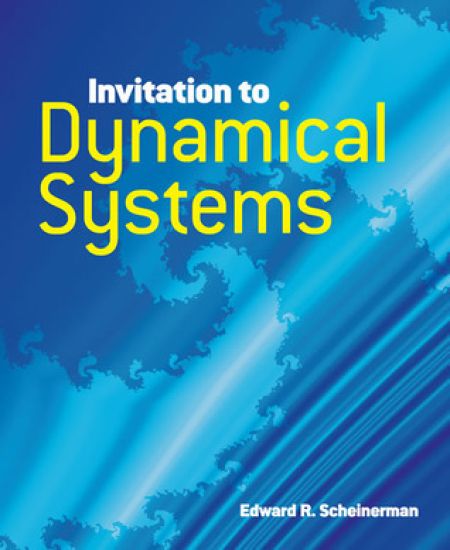
Invitation to Dynamical Systems

Invitation to Dynamical Systems

Edward Scheinerman; R. Furth

Dover Publications Inc.
2012
nidottu
This text is designed for those who wish to study mathematics beyond linear algebra but are not ready for abstract material. Rather than a theorem-proof-corollary-remark style of exposition, it stresses geometry, intuition, and dynamical systems. An appendix explains how to write MATLAB, Mathematica, and C programs to compute dynamical systems. 1996 edition.
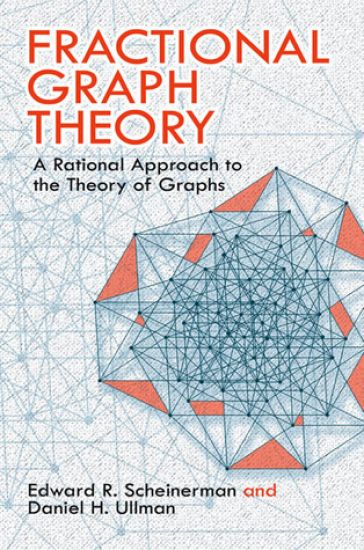
Fractional Graph Theory

Fractional Graph Theory

Edward Scheinerman

Dover Publications Inc.
2012
nidottu
This volume explores the various ways in which integer-valued graph theory concepts can be modified to derive nonintegral values. It explains the general theory of hypergraphs and presents in-depth coverage of fundamental and advanced topics, including fractional matching, fractional coloring, fractional edge coloring, fractional arboricity via matroid methods, fractional isomorphism, and additional subjects. 1997 edition.
C++ for Mathematicians

C++ for Mathematicians

Edward Scheinerman

CRC Press Inc
2006
nidottu
For problems that require extensive computation, a C++ program can race through billions of examples faster than most other computing choices. C++ enables mathematicians of virtually any discipline to create programs to meet their needs quickly, and is available on most computer systems at no cost. C++ for Mathematicians: An Introduction for Students and Professionals accentuates C++ concepts that are most valuable for pure and applied mathematical research.This is the first book available on C++ programming that is written specifically for a mathematical audience; it omits the language’s more obscure features in favor of the aspects of greatest utility for mathematical work. The author explains how to use C++ to formulate conjectures, create images and diagrams, verify proofs, build mathematical structures, and explore myriad examples. Emphasizing the essential role of practice as part of the learning process, the book is ideally designed for undergraduate coursework as well as self-study. Each chapter provides many problems and solutions which complement the text and enable you to learn quickly how to apply them to your own problems. Accompanying downloadable resources provide all numbered programs so that readers can easily use or adapt the code as needed. Presenting clear explanations and examples from the world of mathematics that develop concepts from the ground up, C++ for Mathematicians can be used again and again as a resource for applying C++ to problems that range from the basic to the complex.