Kirjojen hintavertailu. Mukana 12 595 353 kirjaa ja 12 kauppaa.

Kirjailija

Efim Sandler

Kirjat ja teokset yhdessä paikassa: 6 kirjaa, julkaisuja vuosilta 2022-2025, suosituimpien joukossa Lebanese Civil War. Vertaile teosten hintoja ja tarkista saatavuus suomalaisista kirjakaupoista.

6 kirjaa

Kirjojen julkaisuhaarukka 2022-2025.

Battle for Grozny Volume 2

Battle for Grozny Volume 2

Efim Sandler

HELION COMPANY
2025
pokkari
The New Year assault on Grozny by Russian forces was the most famous and controversial action of the 1st Chechen War. Entering Grozny from four directions, Russian troops with poor knowledge of the city and totally unprepared found themselves trapped, isolated and annihilated by numerous Chechen detachments. Unfortunately, due to the complexity and chaotic nature of the events, almost no official documentation exists. The reconstruction of the assault has been created from numerous veteran accounts, research publications, and video footage. Battle for Grozny is the first attempt to present a complete picture to the English-speaking audience.At first, the resistance offered by Chechens on 31 December 1994 had been relatively moderate and sporadic. All Russian forces besides the Group West managed to reach their objectives way before the planned timeline. The 131st Separate Motor-Rifle Brigade received a controversial order to move towards the railway station. With no knowledge of Grozny and never having trained for urban combat, the Brigade moved in and reached the station by noon, meeting the 81st Motor-Rifle Regiment. In the late afternoon, Chechens started to hammer Russian forces from multiple directions, knocking out the armor one by one. Trying to organize defensive lines, both units were suffering heavy casualties while all relief efforts were completely blocked by Chechens. During the night and the next day most of the Russian units left Grozny with disastrous losses in men and materiel. On the morning of 1 January, Russian aviation mistakenly attacked the positions of the 129th Motor-Rifle Regiment with devastating results - making it the worst friendly fire incident of the entire war. The only Group that managed to hold their positions was that of General Lev Rokhlin, who skillfully organized the defenses of the city hospital and cannery plant, leaving a narrow corridor for reinforcements.Battle for Grozny, Volume 2, is based on numerous little-known publications, veterans' accounts from both sides, extensive pictorial and video footage, and focuses on the reconstruction of the events that happened over two days of a New Year.
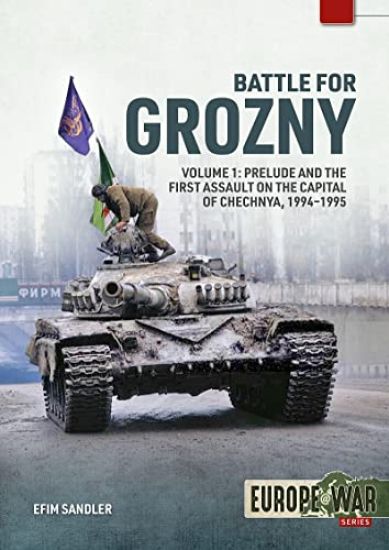
Battle for Grozny, Volume 1

Battle for Grozny, Volume 1

Efim Sandler

HELION COMPANY
2023
pokkari
After a declaration of independence and the seizure military assets located in the self-proclaimed Republic of Ichkeria, Chechen influence in the Northern Caucuses region was rapidly growing. By the 1994 Russian leadership became very concerned about the situation when, in addition to the other issues, Dzhokhar Dudaev de-facto took control of the oil and gas pipelines. After a series of unsuccessful attempts by Yeltsyn and his government to reshuffle the situation it was decided to go for a limited armed action targeted upon the overthrow Dudaev at the hands of Russian-sponsored opposition. The opposition eventually failed and a large military operation by Russian forces was launched on 9 December 1994.From the first days, Russian troops, totally unprepared for the tough resistance encountered found themselves in a bloody fight against Dudaev's well-trained and well-armed militants. Grozny was the major objective as the Russian command considered that taking over the city would break Chechen resistance at once. To pave the way to the city the Russians had to secure Khankala airfield as it was the major aerial hub of the area. The Fight for Khankala became the first major engagement between Russian and Chechen forces.On 30 December 1994, Russian forces received orders to enter Grozny and take control of key objectives, eliminating the opposition. In the second half of 31 December, Russian armored convoys started to enter the city from four directions, what was to come next became the most horrible night in modern Russian military history.Battle for Grozny, Volume 1 is based on the numerous little known publications and veteran accounts from both sides, extensive pictorial and video footage, and focuses upon the reconstruction of events that happened prior to and during the New Year of 1994-1995.
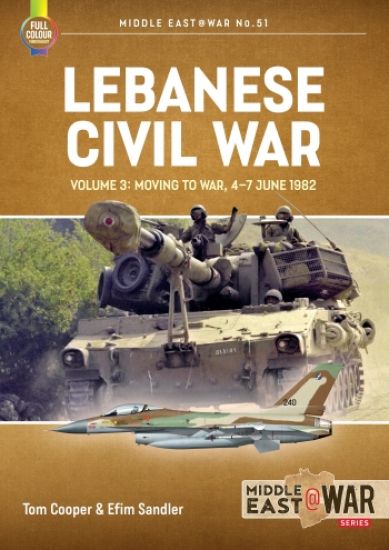
Lebanese Civil War

Lebanese Civil War

Tom Cooper; Efim Sandler

HELION COMPANY
2022
pokkari
Following years of growing tensions, in June 1982 Israel launched an all-out invasion of Lebanon. During the night from 5 to 6 June 1982, four armored divisions of the Israeli Defense Force moved into starting positions near the border with Lebanon, while a full paratrooper division was embarked on amphibious assault ships. Looking forward to engaging the enemy, the Israelis then crossed the border late on the morning of 6 June, and promptly became involved in the bitter battle of Tyre, landings at Awali, and the highly-symbolic assault on Beaufort Castle. The next day saw a further intensification of combat, with the Israelis securing Tyre and then attacking Sidon, and clashing with the Syrian armed forces for the first time in years. Fighting for Jezzine and Ein Zehalta quickly conflagrated into major armored engagements, while after their landing, the sea-borne Israeli forces launched their advance on Beirut through the positions of Palestinian militants and their Lebanese allies, and then onto some of the best units of the Syrian Arab Army.Based on extensive interviews with veterans from all involved parties, focusing on minute reconstructions of combat operations, and richly illustrated with exclusive photography, Lebanese Civil War, Volume 3, offers unsurpassed coverage of one of the most spectacular and most tragic conflicts of the late twentieth century.
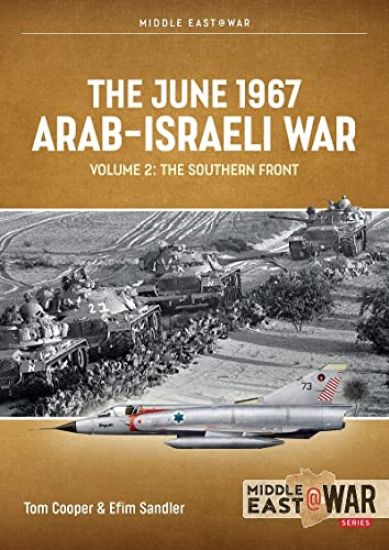
The June 1967 Arab-Israeli War Volume 2

The June 1967 Arab-Israeli War Volume 2

Tom Cooper; Efim Sandler

HELION COMPANY
2025
pokkari
In June 1967 Israel, which seemed on the verge of being annihilated by its Arab neighbors, took six days to redraw the Middle Eastern strategic map in one of the most dramatic reversals of fortune in modern times.The success was almost a decade in the making following the Suez Crisis of 1956 with the Israeli forces being radically changed under the direction of the Magi. These changes created an army and air force upon which the country would rely when it became obvious the international community would take no action to implement guarantees made after the Suez Crisis.The Israeli forces were honed in low-level clashes during the 1960s, notably the Water Wars which the Israelis did so much to provoke. By contrast the Arab forces became complacent, usually due to supplies of arms from the Warsaw Pact, but - with proper training - this complacency could have been turned into military effectiveness. The Arab forces were, however, plagued by the fact that command too often depended upon political reliability rather than military effectiveness.In the case of the Egyptian forces their effectiveness was further undermined by their commitment to the debilitating Yemen Civil War which meant they were in no condition to confront Israel. Syria and Jordan, whose forces alone could not fight the Israelis, complained loudly about President Nasser's lack of action against Israel. In the spring of 1967 Nasser decided to regain the prestige he had lost since the heady days of the Suez Crisis with a demonstration in the Sinai Peninsula. This was interpreted by the Israelis as preparations for an invasion and Nasser did nothing to persuade them otherwise. When it was clear the international community would do nothing, the Israelis decided to strike.Initially Israel aimed to attack only Egypt, but Syria and Jordan then provoked attacks upon their territory. The Israeli campaign was heralded by a massive surprise air attack first on the Egyptians and then on the other neighboring states. Ground offensives then followed in succession as the war, like Topsy in Uncle Tom's Cabin 'just growed.' These campaigns were not always examples of military perfection, as will be scene, and the general post-war back-slapping drowned out serious questions about the future of Israel's army.
Lebanese Civil War Volume 5: Rushing to the Deadline, 11-12 June 1982
The days of 11-13 June, 1982, proved that Arik Sharon's plan was over-ambitious and adventuristic. Dragging the IDF into the fight with Syrians appeared to be more complicated despite IDF superiority in technology and training. The armored units were moving too slowly and were stuck in numerous engagements all over the place.In the Western zone, after several failed attempts to take higher ground and open the road to Beirut, IDF finally made its gain and secured Kfar Sil after a very tough fight that lasted not less than 18 hours.In the Central zone, after getting the upper hand over the Syrian forces in Ein Zhalta and Jezzine, Israelis continued to crawl towards Beirut-Damascus Highway but the tempo had been lost and it was obvious that the Sharon expectation could not be matched.In Bekaa Valley, Eastern zone, IDF moved 399 Brigade to the north in order to reach Beirut Damascus Highway in the quickest possible way. That move turned out to be a disaster and one of the worst fights in IDF history. It took tremendous effort of two Israeli divisions to recover the troubled Brigade while suffering losses in men and machines.Besides the major battles, Israeli forces continued to clear the area while having tough opposition hotspots like Ein-Hilweh and finally, the controversial engagement between IDF anti-tank units and Syrian T-72s.
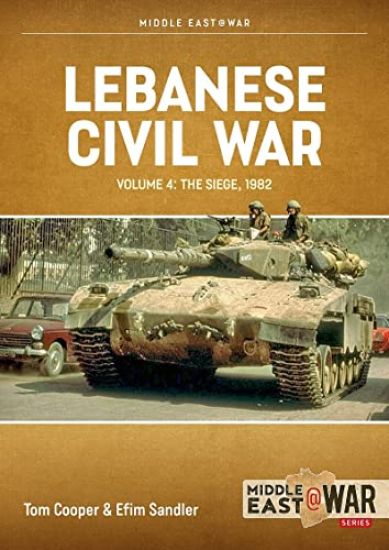
Lebanese Civil War Volume 4

Lebanese Civil War Volume 4

Tom Cooper; Efim Sandler

HELION COMPANY
2025
pokkari
Following years of growing tensions, in June 1982 Israel launched an all-out invasion of Lebanon. Following initial advances on Palestinian-controlled Tyre and Sidon, Beaufort Castle, and the amphibious landing at Awali, on 8 June 1982 the Israeli Defense Force initiated operations against the Syrian armed forces deployed in southern-central Lebanon. What were initially minor firefights for Jezzine and Ein Zehalta developed into major armor battles in which Syrian Gazelle helicopters took a heavy toll of Israeli armor. The following battles of Ein el-Hilweh, Khalde, and Kfar Sil are remembered by participants from all parties for their ferocity and the relentless resistance of Palestinian and Syrian combatants.Finding no other solution, on 9 June 1982 the Israelis initiated Operation Mole Cricket 19, aiming to destroy the integrated air defense system of the Syrian Arab Air Force and the Syrian Arab Air Defense Force deployed in eastern-central Lebanon. On the ground, the Israeli and Syrian armies clashed in a major battle at Lake Qaroun, which soon expanded all the way to the Syrian border.On the other side of the country, the Israeli forces fought their way to Beirut Airport. In a headlong rush for the crucial road connecting Beirut and Damascus, on 10 and 11 June an Israeli armored battalion advanced on the village of Sultan Yacoub, provoking an epic battle. Finally, on 11 June 1982, the Israelis exacted revenge of a sort when their units, equipped with US-made BGM-71 TOW anti-tank guided missiles, ambushed Syrian armor at Jebel Barouch.Based on extensive interviews with veterans from all parties, focusing on minute reconstructions of combat operations, and richly illustrated with exclusive photography, Lebanese Civil War, Volume 4, offers unsurpassed coverage of one of most spectacular and most tragic conflicts of the late twentieth century.