Kirjojen hintavertailu. Mukana 12 657 676 kirjaa ja 12 kauppaa.

Kirjailija

Ehud Ben Zvi

Kirjat ja teokset yhdessä paikassa: 12 kirjaa, julkaisuja vuosilta 1991-2024, suosituimpien joukossa Micah F.O.T.L.. Vertaile teosten hintoja ja tarkista saatavuus suomalaisista kirjakaupoista.

12 kirjaa

Kirjojen julkaisuhaarukka 1991-2024.

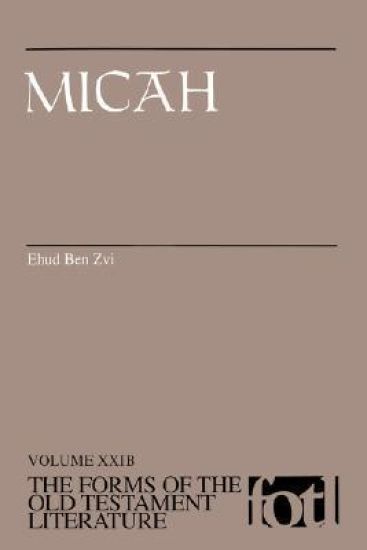
Micah F.O.T.L.

Micah F.O.T.L.

Ehud Ben Zvi

William B Eerdmans Publishing Co
2000
nidottu
The Forms of the Old Testament Literature Series has long been acknowledged as a unique and valuable commentary on the Old Testament. The volumes in the FOTL series are specifically concerned to explore the structure, genre, setting, and intention of each type of biblical literature so the fullest possible meaning of Scripture can be uncovered. This new addition to the FOTL commentary series presents a complete form-critical analysis of the book of Micah. Ehud Ben Zvi looks at how Micah was read by its ancient audience and explores the social setting that stands behind it. Emphasis is placed on the construction of the past, on the images of the future, and on the relevance of both of these to the present of the community or communities of readers for whom the book was intended. His various lines of investigation lead to a deeper understanding of Micah and its enduring message.

1 Chronicles

1 Chronicles

Ehud Ben Zvi

Kohlhammer
2024
sidottu
There has been much interest in the Book of Chronicles in recent years. A book long considered marginal has become one of the most central in current studies. This is due, in part, to the increased and increasing emphasis on Persian period Yehud (and Samaria), and to the fact that Chronicles may provide a window for understanding how other books that later became biblical were understood at the time. In addition, Chronicles is also a second "national" history and as such it served to reconfigure and reimagine the past/s communicated by other books. This commentary makes use of (social) memory (and other social-anthropological) approaches, examines the ongoing construction of meaning at the level of the separate units in the book, that of the book as a whole, and that of the book as part of a extant "library" within which it constantly interacts and modifies. Explorations of the influence of the book and its images of the past over time round off the analysis.
Social Memory among the Literati of Yehud

Social Memory among the Literati of Yehud

Ehud Ben Zvi

De Gruyter
2021
isokokoinen pokkari
Ehud Ben Zvi has been at the forefront of exploring how the study of social memory contributes to our understanding of the intellectual worldof the literati of the early Second Temple period and their textual repertoire. Many of his studies on the matter and several new relevant works are here collected together providing a very useful resource for furthering research and teaching in this area.The essays included here address, inter alia, prophets as sites of memory, kings as sites memory, Jerusalem as a site of memory, a mnemonic system shaped by two interacting ‘national’ histories, matters of identity and othering as framed and explored via memories, mnemonic metanarratives making sense of the past and serving various didactic purposes and their problems, memories of past and futures events shared by the literati, issues of gender constructions and memory, memories understood by the group as ‘counterfactual’ and their importance, and, in multiple ways, how and why shared memories served as a (safe) playground for exploring multiple, central ideological issues within the group and of generative grammars governing systemic preferences and dis-preferences for particular memories.
The Signs of Jonah

The Signs of Jonah

Ehud Ben Zvi

Continuum International Publishing Group Ltd.
2009
nidottu
In this new and refreshing approach to the story, Ben Zvi starts with the premise that Jonah, like most books, was written to be read. He therefore concentrates on intended and unintended readership(s) of Jonah and the network of messages that they were likely to derive through their reading and rereading. He starts with the historical and social matrix of the production and reading of the book in antiquity, analyzes its self-critical approach and its metaprophetic character as a comment on the genre of prophetic books and on prophets. How does the historical fact of Nineveh's destruction acually shape the reading? Or the perception of Jonah as a runaway slave?Ben Zvi demonstrates the malleability of interpretation of the Book of Jonah and its limitations, as attested in different communities of readers. He asks why certain messages are easily accepted by particular historical communities, whereas others are not raised at all.
The Production of Prophecy

The Production of Prophecy

Diana Vikander Edelman; Ehud Ben Zvi

Equinox Publishing Ltd
2009
sidottu
The Persian and Hellenistic periods saw the production and use of a variety of authoritative texts in Israel. 'The Production of Prophecy' brings together a range of influential biblical scholars to examine the construction of prophecy and prophetic books during the Persian period. Drawing on methodological and comparative research and studies of particular biblical texts, the volume explores biblical prophecy as a written phenomenon, examining the prophets of the past, setting this within the general history of Yehud. The relationship between prophetic and other authoritative, written texts is explored, as well as the general social and ideological setting in which the prophetic books emerged.
The Production of Prophecy

The Production of Prophecy

Diana Vikander Edelman; Ehud Ben Zvi

Equinox Publishing Ltd
2009
nidottu
The Persian and Hellenistic periods saw the production and use of a variety of authoritative texts in Israel. 'The Production of Prophecy' brings together a range of influential biblical scholars to examine the construction of prophecy and prophetic books during the Persian period. Drawing on methodological and comparative research and studies of particular biblical texts, the volume explores biblical prophecy as a written phenomenon, examining the prophets of the past, setting this within the general history of Yehud. The relationship between prophetic and other authoritative, written texts is explored, as well as the general social and ideological setting in which the prophetic books emerged.
History, Literature and Theology in the Book of Chronicles
History, Literature and Theology in the Book of Chronicles presents a new way of approaching this key biblical text, arguing that the Book employs both multiple viewpoints and the knowledge of the past held by its intended readership to reshape social memory and reinforce the authority of God. The Book of Chronicles communicates to its intended readership a theological worldview built around multiple, partial perspectives which inform and balance each other. This is a worldview which emphasizes the limitations of all human knowledge, even of theologically "proper" knowledge. When Chronicles presents the past as explainable it also affirms that those who inhabited it could not predict the future. And, despite expanding an "explainable" past, the Book deliberately frames some of YHWH's actions - crucial events in Israel's social memory - as unexplainable in human terms. The Book serves to rationalise divinely ordained, prescriptive behaviour through its emphasis on the impossibility of adequate human understanding of a past, present and future governed by YHWH.
History, Literature and Theology in the Book of Chronicles
History, Literature and Theology in the Book of Chronicles presents a new way of approaching this key biblical text, arguing that the Book employs both multiple viewpoints and the knowledge of the past held by its intended readership to reshape social memory and reinforce the authority of God. The Book of Chronicles communicates to its intended readership a theological worldview built around multiple, partial perspectives which inform and balance each other. This is a worldview which emphasizes the limitations of all human knowledge, even of theologically "proper" knowledge. When Chronicles presents the past as explainable it also affirms that those who inhabited it could not predict the future. And, despite expanding an "explainable" past, the Book deliberately frames some of YHWH's actions - crucial events in Israel's social memory - as unexplainable in human terms. The Book serves to rationalise divinely ordained, prescriptive behaviour through its emphasis on the impossibility of adequate human understanding of a past, present and future governed by YHWH.
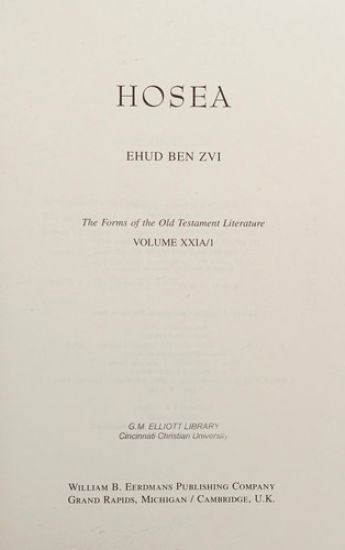
Hosea

Hosea

Ehud Ben Zvi

William B Eerdmans Publishing Co
2005
nidottu
Hosea by Ehud Ben Zvi is Volume XXIA/1of The Forms of the Old Testament Literature, a series that aims to present a form-critical analysis of every book and each unit in the Hebrew Bible. Fundamentally exegetical, the FOTL volumes examine the structure, genre, setting, and intention of the biblical literature in question. They also study the history behind the form-critical discussion of the material, attempt to bring consistency to the terminology for the genres and formulas of the biblical literature, and expose the exegetical process so as to enable students and pastors to engage in their own analysis and interpretation of the Old Testament texts. His second work for the FOTL series, Ehud Ben Zvi's Hosea features a comprehensive introduction and careful commentary with special attention to themes of exile and restoration, as well as extended discussion of didactic prophetic readings. An excellent form-critical interpretation of the book of Hosea, this volume will be a valuable aid to scholars, students, and teachers.
A Historical-Critical Study of the Book of Obadiah
The series Beihefte zur Zeitschrift für die alttestamentliche Wissenschaft (BZAW) covers all areas of research into the Old Testament, focusing on the Hebrew Bible, its early and later forms in Ancient Judaism, as well as its branching into many neighboring cultures of the Ancient Near East and the Greco-Roman world. BZAW welcomes submissions that make an original and significant contribution to the field; demonstrate sophisticated engagement with the relevant secondary literature; and are written in readable, logical, and engaging prose.
Readings in Biblical Hebrew

Readings in Biblical Hebrew

Ehud Ben Zvi; Maxine Hancock; Beinert Richard A.

Yale University Press
1994
sidottu
This textbook will teach students who have completed an introductory course in Hebrew how to read and interpret biblical texts from the Old Testament/Hebrew Bible. It can be used in intermediate-level university or seminary classes or by students working alone. The book presents texts drawn from the complete range of biblical literature, exposing the student to all the major styles of Hebrew found in the Bible. It also provides extensive explanations of the chosen texts, focusing on structure, genre, literary devices, and accents. There are assignments for classroom use, and space is available for student responses. The book includes topics for further thought and suggestions for further reading on specific issues.