
Kirjojen hintavertailu. Mukana 12 390 323 kirjaa ja 12 kauppaa.

Kirjailija

Eileen M. Ahlin

Kirjat ja teokset yhdessä paikassa: 8 kirjaa, julkaisuja vuosilta 2017-2023, suosituimpien joukossa Violence in the Heights. Vertaile teosten hintoja ja tarkista saatavuus suomalaisista kirjakaupoista.

8 kirjaa

Kirjojen julkaisuhaarukka 2017-2023.

Violence in the Heights

Violence in the Heights

Eileen M. Ahlin

TAYLOR FRANCIS LTD
2023
sidottu
Given the media attention and research focus on big cities with large minority populations, people have grown accustomed to associating violence with these attributes. Violence in the Heights counters that narrative to provide a fresh perspective on inner-city violence with a close look at violence and associated social disorder in a cluster of neighborhoods in a mid-sized, predominantly White city. Eileen M. Ahlin studied 42 residents and their perceptions of and responses to violence to give voice to their experiences. Ahlin provides a historical overview of the neighborhoods and highlights a series of pivotal violent events, and discovers how they differentially impacted residents and their perceptions of safety. Residents reveal how institutional and demographic shifts reduced interpersonal connections and weakened the community's social fabric. A unique take on inner-city violence, Violence in the Heights also details why residents move to other communities when violence increases or, if they remain, adapt to changing conditions.This book will interest mainstream readers interested in learning about urban affairs and the human-interest story as it will track why inner-city residents stay in their neighborhoods or move to other communities when violence increases. This book will also serve as an academic text to outline the changes in violence and community disorder in a mid-sized city that is predominantly White, an understudied aspect of urban violence.
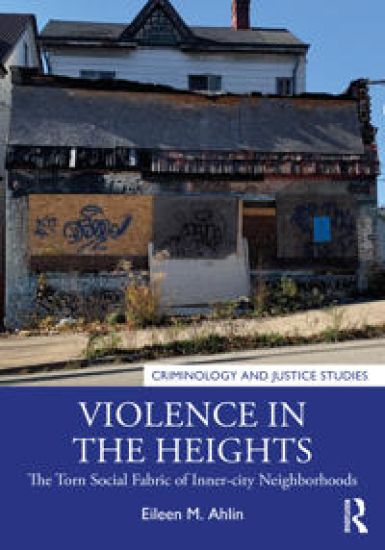
Violence in the Heights

Violence in the Heights

Eileen M. Ahlin

TAYLOR FRANCIS LTD
2023
nidottu
Given the media attention and research focus on big cities with large minority populations, people have grown accustomed to associating violence with these attributes. Violence in the Heights counters that narrative to provide a fresh perspective on inner-city violence with a close look at violence and associated social disorder in a cluster of neighborhoods in a mid-sized, predominantly White city. Eileen M. Ahlin studied 42 residents and their perceptions of and responses to violence to give voice to their experiences. Ahlin provides a historical overview of the neighborhoods and highlights a series of pivotal violent events, and discovers how they differentially impacted residents and their perceptions of safety. Residents reveal how institutional and demographic shifts reduced interpersonal connections and weakened the community's social fabric. A unique take on inner-city violence, Violence in the Heights also details why residents move to other communities when violence increases or, if they remain, adapt to changing conditions.This book will interest mainstream readers interested in learning about urban affairs and the human-interest story as it will track why inner-city residents stay in their neighborhoods or move to other communities when violence increases. This book will also serve as an academic text to outline the changes in violence and community disorder in a mid-sized city that is predominantly White, an understudied aspect of urban violence.

Youth Violence in Context

Youth Violence in Context

Eileen M. Ahlin; Maria João Lobo Antunes

TAYLOR FRANCIS LTD
2023
nidottu
This book places youth violence within a Routine Activity Ecological Framework. Youth violence, specifically youth exposure to community violence and youth perpetration of violent behaviors, occur within various contexts. Ahlin and Antunes situate their discussion of youth violence within an ecological framework, identifying how it is nested within four mesosystem layers: community, family, peers and schools, and youth characteristics. Contextualized using an ecological framework, the Routine Activity Theory and Lifestyles perspective (RAT/LS) are well suited to guide an examination of youth violence risk and protective factors across the four layers. Drawing on scholarship that explores predictors and consequences of youth violence, the authors apply RAT/LS theory to explain how community, family, peers, schools, and youth characteristics influence youth behavior. Each layer of the ecological framework unfolds to reveal the latest scholarship and contextualizes how concepts of RAT/LS, specifically the motivated offender, target suitability, and guardianship, can be applied at each level. This book also highlights the mechanisms and processes that contribute to youth exposure to and involvement in violence by exploring factors examined in the literature as protective and risk factors of youth violence. Youth violence occurs in context, and, as such, the understanding of multilevel predictors and preventive measures against it can be situated within an RAT/LS ecological framework. This work links theory to extant research. Ahlin and Antunes demonstrate how knowledge of youth violence can be used to develop a robust theoretical foundation that can inform policy to improve neighborhoods and youth experiences within their communities, families, and peers and within their schools while acknowledging the importance of individual characteristics. This monograph is essential reading for those interested in youth violence, juvenile delinquency, and juvenile justice research and anyone dedicated to preventing crime among youths.
Youth Violence in Context

Youth Violence in Context

Eileen M. Ahlin; Maria João Lobo Antunes

Routledge
2021
sidottu
This book places youth violence within a Routine Activity Ecological Framework. Youth violence, specifically youth exposure to community violence and youth perpetration of violent behaviors, occur within various contexts. Ahlin and Antunes situate their discussion of youth violence within an ecological framework, identifying how it is nested within four mesosystem layers: community, family, peers and schools, and youth characteristics. Contextualized using an ecological framework, the Routine Activity Theory and Lifestyles perspective (RAT/LS) are well suited to guide an examination of youth violence risk and protective factors across the four layers. Drawing on scholarship that explores predictors and consequences of youth violence, the authors apply RAT/LS theory to explain how community, family, peers, schools, and youth characteristics influence youth behavior. Each layer of the ecological framework unfolds to reveal the latest scholarship and contextualizes how concepts of RAT/LS, specifically the motivated offender, target suitability, and guardianship, can be applied at each level. This book also highlights the mechanisms and processes that contribute to youth exposure to and involvement in violence by exploring factors examined in the literature as protective and risk factors of youth violence. Youth violence occurs in context, and, as such, the understanding of multilevel predictors and preventive measures against it can be situated within an RAT/LS ecological framework. This work links theory to extant research. Ahlin and Antunes demonstrate how knowledge of youth violence can be used to develop a robust theoretical foundation that can inform policy to improve neighborhoods and youth experiences within their communities, families, and peers and within their schools while acknowledging the importance of individual characteristics. This monograph is essential reading for those interested in youth violence, juvenile delinquency, and juvenile justice research and anyone dedicated to preventing crime among youths.
The Veterans Treatment Court Movement

The Veterans Treatment Court Movement

Anne S. Douds; Eileen M. Ahlin

Routledge
2020
nidottu
The Veterans Treatment Court Movement provides a comprehensive, empirical analysis of the burgeoning veteran’s court movement from genesis through to operation, and concluding with comments on its societal relevance. Beginning with the unlikely convergence of therapeutic jurisprudence with the oft-misunderstood warrior ethos that undergirds the entire movement, the text examines every component of veterans courts, weighing the cultural, legal, and practical strengths and limitations of these programs. Each chapter assesses key components of the court, including the participants, law enforcement, judges, prosecution, defense counsel, court administration, data management, the Veterans Justice Outreach Officer (VJO), probation, mentors, and the community. The book concludes with recommendations on how these courts can further integrate with communities, maximize efficiency, and improve.The book shows how veterans courts seek to serve veterans’ legal, social, and psychological needs, and how they serve more than just offending veterans by allowing law-abiding veterans, many of whom suffered greatly when they transitioned out of military service, to exorcize their own demons and integrate their experiences into a socially recognized system of care. Incorporating program evaluation with sociological considerations, this monograph offers a comprehensive, considered examination of how – and why – these courts operate, and provides a foundation for future development. The volume provides essential background for scholars studying law and the criminal courts, as well as policymakers, judges, academics, students, and practitioners concerned with effective jurisprudence.
Rethinking America’s Correctional Policies

Rethinking America’s Correctional Policies

Anne S. Douds; Eileen M. Ahlin

Lexington Books
2019
nidottu
Commonsense Choices from Uncommon Voices: Rethinking America’s Correctional Policies brings together the experiences of men who served time in prison with contemporary research on correctional policy. This work combines a voyeuristic desire to observe “evil” and the consequences of the system of punishment, with detached consideration of what those stories can tell us about who we are as a nation and how we treat those who have betrayed the social trust. The authors simultaneously examine first-person accounts of inmate experiences with the correctional system and what actually, works, in operation, to promote the rehabilitative and restorative models of justice so many of our policymakers espouse. Each chapter opens with a vignette, a recollection of an event or series of events, about an inmate’s experience during the various phases of correctional processing. These first-hand accounts have been collected from men who served time in prison. These men’s stories are examined in their own right, then extrapolated to a broader analysis of the underlying social and policy issues to which that vignette speaks. All chapters follow the same structure: (a) opening vignette about a former inmate; (b) analysis, which includes (i) identification of the underlying issue; (ii) reflection; and (iii) extrapolation to a larger policy issue; and (c) recommendations from the field for enacting practice and crafting policy more responsive to the identified issue.
The Veterans Treatment Court Movement

The Veterans Treatment Court Movement

Anne S. Douds; Eileen M. Ahlin

Routledge
2018
sidottu
The Veterans Treatment Court Movement provides a comprehensive, empirical analysis of the burgeoning veteran’s court movement from genesis through to operation, and concluding with comments on its societal relevance. Beginning with the unlikely convergence of therapeutic jurisprudence with the oft-misunderstood warrior ethos that undergirds the entire movement, the text examines every component of veterans courts, weighing the cultural, legal, and practical strengths and limitations of these programs. Each chapter assesses key components of the court, including the participants, law enforcement, judges, prosecution, defense counsel, court administration, data management, the Veterans Justice Outreach Officer (VJO), probation, mentors, and the community. The book concludes with recommendations on how these courts can further integrate with communities, maximize efficiency, and improve.The book shows how veterans courts seek to serve veterans’ legal, social, and psychological needs, and how they serve more than just offending veterans by allowing law-abiding veterans, many of whom suffered greatly when they transitioned out of military service, to exorcize their own demons and integrate their experiences into a socially recognized system of care. Incorporating program evaluation with sociological considerations, this monograph offers a comprehensive, considered examination of how – and why – these courts operate, and provides a foundation for future development. The volume provides essential background for scholars studying law and the criminal courts, as well as policymakers, judges, academics, students, and practitioners concerned with effective jurisprudence.
Rethinking America’s Correctional Policies

Rethinking America’s Correctional Policies

Anne S. Douds; Eileen M. Ahlin

Lexington Books
2017
sidottu
Commonsense Choices from Uncommon Voices: Rethinking America’s Correctional Policies brings together the experiences of men who served time in prison with contemporary research on correctional policy. This work combines a voyeuristic desire to observe “evil” and the consequences of the system of punishment, with detached consideration of what those stories can tell us about who we are as a nation and how we treat those who have betrayed the social trust. The authors simultaneously examine first-person accounts of inmate experiences with the correctional system and what actually, works, in operation, to promote the rehabilitative and restorative models of justice so many of our policymakers espouse. Each chapter opens with a vignette, a recollection of an event or series of events, about an inmate’s experience during the various phases of correctional processing. These first-hand accounts have been collected from men who served time in prison. These men’s stories are examined in their own right, then extrapolated to a broader analysis of the underlying social and policy issues to which that vignette speaks. All chapters follow the same structure: (a) opening vignette about a former inmate; (b) analysis, which includes (i) identification of the underlying issue; (ii) reflection; and (iii) extrapolation to a larger policy issue; and (c) recommendations from the field for enacting practice and crafting policy more responsive to the identified issue.