Kirjojen hintavertailu. Mukana 12 595 353 kirjaa ja 12 kauppaa.

Kirjailija

Eleanor Dickey

Kirjat ja teokset yhdessä paikassa: 9 kirjaa, julkaisuja vuosilta 1996-2023, suosituimpien joukossa An Introduction to the Composition and Analysis of Greek Prose. Vertaile teosten hintoja ja tarkista saatavuus suomalaisista kirjakaupoista.

9 kirjaa

Kirjojen julkaisuhaarukka 1996-2023.

Latin Loanwords in Ancient Greek

Latin Loanwords in Ancient Greek

Eleanor Dickey

Cambridge University Press
2023
sidottu
Why, when, and how did speakers of ancient Greek borrow words from Latin? Which words did they borrow? Who used Latin loanwords, and how? Who avoided them, and why? How many words were borrowed, and what kind of word? How long did the loanwords survive? Until now, attempts to answer such questions have been based on incomplete and often misleading evidence, but this study offers the first comprehensive collection of evidence from papyri, inscriptions, and literature from the fifth century BC to the sixth century AD. That collection – included in the book as a lexicon of Latin loanwords – is examined using insights from linguistic work on modern languages to provide new answers that often differ strikingly from earlier ones. The analysis is accessibly presented, and the lexicon offers a firm foundation for future work in this area.
Latein Lernen Wie in Der Antike: Latein-Lehrbucher Aus Der Antike
Wie gingen die griechischsprachigen Bewohner des Romischen Reiches vor, wenn sie Latein lernen wollten? Sie benutzten Texte, in denen es um authentische, unterhaltsame Szenen aus dem antiken Alltagsleben ging - um Einkaufe, Bankgeschafte, Thermenbesuche, Streitereien -, ganz ahnlich den Dialogen, die in modernen Fremdsprachenlehrbuchern zu finden sind. Diese kleinen Geschichten, die von Romern in einem fur Anfanger leicht verstandlichen Latein geschrieben wurden, geben einen unschatzbaren Einblick in das Alltagsleben und die Unterrichtspraxis im Romischen Reich. Die Sprachschuler benutzten ausserdem spezielle Anfangerausgaben grosser lateinischer Autoren wie Vergil und Cicero sowie Worterbucher, Grammatiken und Texte in griechischer Transliteration. All diese Texte sind erstmals in diesem Buch zusammengestellt, das moderne Lehrbucher erganzen und damit den Lateinunterricht bereichern kann.
Learn Latin from the Romans

Learn Latin from the Romans

Eleanor Dickey

Cambridge University Press
2018
sidottu
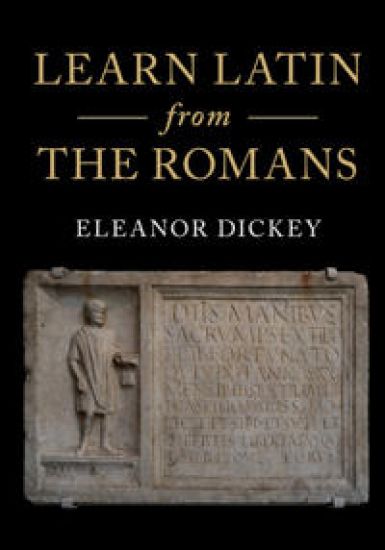
Learn Latin from the Romans is the only introductory Latin textbook to feature texts written by ancient Romans for Latin learners. These texts, the 'colloquia', consist of dialogues and narratives about daily life similar to those found in modern-language textbooks today, introducing learners to Roman culture as well as to Latin in an engaging, accessible, and enjoyable way. Students and instructors will find everything they need in one complete volume, including clear explanations of grammatical concepts and how Latin works, both British and American orders for all noun and adjective paradigms, 5,000 easy practice sentences, and over 150 longer passages (from the colloquia and a diverse range of other sources including inscriptions, graffiti, and Christian texts as well as Catullus, Cicero, and Virgil). Written by a leading Latin linguist with decades of language teaching experience, this textbook is suitable for introductory Latin courses worldwide.
Learn Latin from the Romans

Learn Latin from the Romans

Eleanor Dickey

Cambridge University Press
2018
pokkari
Learn Latin from the Romans is the only introductory Latin textbook to feature texts written by ancient Romans for Latin learners. These texts, the 'colloquia', consist of dialogues and narratives about daily life similar to those found in modern-language textbooks today, introducing learners to Roman culture as well as to Latin in an engaging, accessible, and enjoyable way. Students and instructors will find everything they need in one complete volume, including clear explanations of grammatical concepts and how Latin works, both British and American orders for all noun and adjective paradigms, 5,000 easy practice sentences, and over 150 longer passages (from the colloquia and a diverse range of other sources including inscriptions, graffiti, and Christian texts as well as Catullus, Cicero, and Virgil). Written by a leading Latin linguist with decades of language teaching experience, this textbook is suitable for introductory Latin courses worldwide.
An Introduction to the Composition and Analysis of Greek Prose
Why learn to write in a dead language? Because a really good understanding of a language can only be attained by using it actively. Unlike earlier textbooks aimed at schoolboys, this work addresses modern adults who want to understand concepts fully as they learn. Drawing on recent scholarship where appropriate and assuming no prior background except some reading knowledge of Greek, the course combines a structured review of paradigms and vocabulary with clear and comprehensive explanations of the rules of Greek syntax. Large numbers of exercises are provided, both with and without key: a complete set of cumulative exercises and another set of non-cumulative exercises for those who prefer to dip into specific sections. The exercises include, as well as English sentences and paragraphs for translation, Greek sentences and passages for translation, analysis, and manipulation. A full English-Greek vocabulary and list of principal parts are included.
An Introduction to the Composition and Analysis of Greek Prose
Why learn to write in a dead language? Because a really good understanding of a language can only be attained by using it actively. Unlike earlier textbooks aimed at schoolboys, this work addresses modern adults who want to understand concepts fully as they learn. Drawing on recent scholarship where appropriate and assuming no prior background except some reading knowledge of Greek, the course combines a structured review of paradigms and vocabulary with clear and comprehensive explanations of the rules of Greek syntax. Large numbers of exercises are provided, both with and without key: a complete set of cumulative exercises and another set of non-cumulative exercises for those who prefer to dip into specific sections. The exercises include, as well as English sentences and paragraphs for translation, Greek sentences and passages for translation, analysis, and manipulation. A full English-Greek vocabulary and list of principal parts are included.
Learning Latin the Ancient Way

Learning Latin the Ancient Way

Eleanor Dickey

Cambridge University Press
2016
sidottu
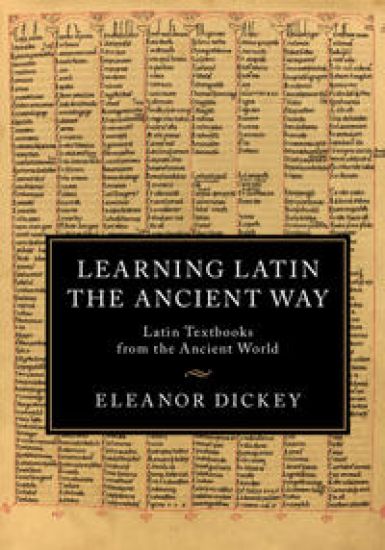
What did Greek speakers in the Roman empire do when they wanted to learn Latin? They used Latin-learning materials containing authentic, enjoyable vignettes about daily life in the ancient world - shopping, banking, going to the baths, having fights, being scolded, making excuses - very much like the dialogues in some of today's foreign-language textbooks. These stories provide priceless insight into daily life in the Roman empire, as well as into how Latin was learned at that period, and they were all written by Romans in Latin that was designed to be easy for beginners to understand. Learners also used special beginners' versions of great Latin authors including Virgil and Cicero, and dictionaries, grammars, texts in Greek transliteration, etc. All these materials are now available for the first time to today's students, in a book designed to complement modern textbooks and enrich the Latin-learning experience.
Ancient Greek Scholarship

Ancient Greek Scholarship

Eleanor Dickey

Oxford University Press Inc
2007
nidottu
Ancient Greek Scholarship is the only introduction to this important and fast-growing field, with information on all aspects of using and reading ancient scholarship. Includes discussions of all major works, explanation of grammarians' Greek, over 200 passages with commentary, glossary of 1500 grammatical terms, and annotated bibliography with more than 1200 works.
Greek Forms of Address

Greek Forms of Address

Eleanor Dickey

Clarendon Press
1996
sidottu
How did an Athenian citizen address his wife? His children, his slaves, and his dog? How did they address him? This book is the first major application of linguistic theories of address to an ancient language. It is based on a corpus of 11,891 vocatives from twenty-five prose authors from Herodotus to Lucian, and on comparative data from Aristophanes, Menander, and other sources; the data are analysed using techniques and evidence from the field of sociolinguistics to shed light on some long-standing problems in Greek. A separate section discusses the theoretical problems which arise from the attempt to reconstruct conversational Greek on the basis of written texts and concludes that this enterprise is indeed possible, provided that the right sources are selected. Analysis of the Greek address system leads to a reconsideration of the meaning of individual addresses and thus of the interpretation of specific passages; it also challenges the validity of some alleged sociolinguistic 'universals'. In particular, Professor Dickey examines some of the idiosyncratic aspects of Socrates' language, offering an exceptionally interesting and novel contribution to to the problems of the `historical Socrates'. Highly original, lucid, and jargon-free, this book offers may significant insights on both the literature and language of ancient Greece,