Kirjojen hintavertailu. Mukana 12 544 417 kirjaa ja 12 kauppaa.

Kirjailija

Eli Ginzberg

Kirjat ja teokset yhdessä paikassa: 54 kirjaa, julkaisuja vuosilta 1970-2024, suosituimpien joukossa Health Manpower & Health Policy. Vertaile teosten hintoja ja tarkista saatavuus suomalaisista kirjakaupoista.

54 kirjaa

Kirjojen julkaisuhaarukka 1970-2024.

The Illusion of Economic Stability

The Illusion of Economic Stability

Eli Ginzberg

Transaction Publishers
2003
nidottu
In one of the foremost critiques of the widespread view that in market-based economics the fluctuations of the marketplace are essentially self-regulating, Eli Ginzberg argues the reverse. He asserts that government regulation or intervention to provide stability in the capitalist marketplace is a necessity. In this classic statement of macroeconomic theory, Ginzberg argues that self-directed stable economies, devoid of an appreciation of social and psychological factors, are essentially illusory.The ability of strong blocs--corporate, labor, and agricultural--to control the market in the hope of bettering their economic position places great difficulties in the path of securing a stable economy. For Ginzberg, economic fluctuations in the decade preceding the Great Depression can largely be explained by the interaction of technological, psychological, and monetary factors. Without these factors being subjected to some sort of control, economic stability must remain an illusion.The current period of a significant fall-off in earnings, profits, and full employment also followed a decade of unparalleled monetary growth. The concerns Ginzberg raised are relevant once again. It may turn out that the "neoliberalism" of the present has something to say in response to the free market/free society premises currently in vogue.In a brilliant introductory essay, Nobel Laureate Robert M. Solow offers an impressive report card on The Illusion of Economic Stability: "The prose is tighter and more aphoristic than late Ginzberg, and the tone is more detached, even sardonic." He concludes by admitting that a volatile stock market is one more reason why automatic economic stability seems as illusory today as it did when the book first appeared.

Tomorrow's Hospital

Tomorrow's Hospital

Eli Ginzberg

Yale University Press
1998
pokkari
Hospital costs and the fees for physicians who treat patients admitted for inpatient care currently account for about half of the annual health care spending in the United States (around one trillion dollars). This situation will soon change, however, as market forces necessitate the downsizing, merging, and closing of acute-care hospitals.In this authoritative book, the dean of health care analysts discusses the future of the American hospital. Eli Ginzberg reviews the institutional structure, function, and operations of hospitals in the United States and explains the factors in the marketplace that are transforming the hospital sector. He assesses the different approaches that hospitals and their physician staffs have developed in order to become part of an integrated health network and provide a more efficient and effective system of health care delivery. And he explores such trends as the growth of managed-care plans; the development of alternative, lower-cost treatment sites for patients requiring prolonged care; efforts by community hospitals to cooperate rather than compete; and the management of each individual's health care services by a primary physician who will provide essential services at a competitive price.
New Deal Days: 1933-1934

New Deal Days: 1933-1934

In K. Hwang; Eli Ginzberg

Transaction Publishers
1997
sidottu
This is an extraordinary, first hand account of how the United States economy weathered the most devastating depression in the nation's history and how it responded to Roosevelt's New Deal initiatives.
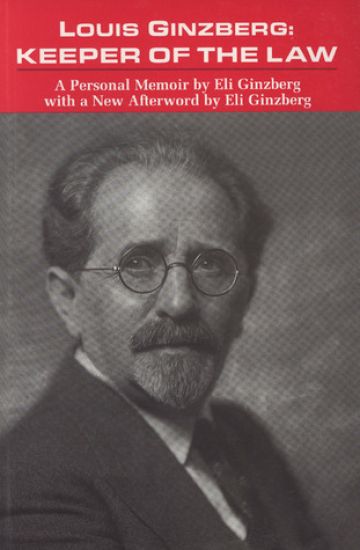
Louis Ginzberg

Louis Ginzberg

Eli Ginzberg

Jewish Publication Society
1996
pokkari
First published in 1966, this book is an unusual biography. It is written by a son about his father, by an interpreter of economics about an interpreter of rabbinics. It is done with obvious charm, with deep affection for the subject, and yet with surprising objectivity. There could not have been many students of Jewish law and legend of the era who did not at one time or another seek guidance from Louis Ginzberg - the remarkable man whose knowledge was vast and whose memory was phenomenal. In a sense, this book is the biography of a man who helped lay the foundations for an American Jewish culture.
The Medical Triangle

The Medical Triangle

Eli Ginzberg

Harvard University Press
1992
nidottu
Runaway medical costs, long-term care, market competition, for-profit medicine, nursing shortages—these are but a few of the issues that swirl around in the late twentieth century’s volatile health care scene. How much of the system do we want to change, and how much do we want to keep? Health policy expert Eli Ginzberg examines such crucial questions in his characteristically broad-gauged perspective. Framing the issues in their historical, political, and professional contexts, the author analyzes how we have arrived at the current crisis.The book focuses on the three sides of the medical triangle that have separate and sometimes conflicting goals: the physicians want to provide the most health care for the most money; the government, which furnishes 40 percent of the system's funding, wants to limit the money it pays out for health care; and the public, with over a billion annual visits to doctors, wants the most health care for the least money.Ginzberg explains how the core components of our health care system—the community hospital and physicians who have long practiced in a fee-for-service mode—are under attack, and he indicates the factors that make it uncertain whether the destabilization will slow down or accelerate. Moreover, can key health care centers maintain their leadership in a time when new dollars for health are scarce? How will the floundering state of foundations affect medical care in local communities?In his final chapters the author zeroes in on the special concerns of the public: high-need patients (including those suffering from cancer, catastrophic illness, and the infirmities of old age, or those who are mentally ill or chronically poor), nursing shortages, unsuccessful cost containment, and lack of consensus within the medical triangle about the major issues on our nation's health agenda.
A World Without Work

A World Without Work

Eli Ginzberg

Transaction Publishers
1991
sidottu
Written just before the beginning of World War II, this is an early example of field research into human resources by one of the pioneers in the area. Ginzberg investigates why so many long-term unemployed coal miners in South Wales remained in their villages rather than relocating to other areas of the United Kingdom where jobs were more plentiful. The results of his work, originally published in 1942, remain of value both as a record of an era, an example of communities in distress, and a model of failed social policy.
Work Decisions in the 1980s

Work Decisions in the 1980s

Eli Ginzberg; Daniel Mills; John Owen; Harold L. Sheppard; Michael L. Wachter

Praeger Publishers Inc
1981
sidottu
What kinds of work will be available in the 1980s? For whom? When should a person retire? Should a retiree find a part-time job? The authors answer such questions by examining a multitude of factors that will affect work decisions in the coming decade. Their findings will alert decision-makers in both private organizations and the government to the employment issues that dominate the 1980s.
The Manpower Connection

The Manpower Connection

Eli Ginzberg

Harvard University Press
1976
sidottu
This volume constitutes an achievement nowhere duplicated in the three related and critical areas of education, work, and manpower policy. It is the mature production of over a dozen years of research-endeavors by the dean of manpower studies.In Part I Eli Ginzberg warns against simplistic reliance on prevailing models—economic, psychological, or political. There is only tenuous evidence that enormous expenditure leads to increased social benefit. Rather, we need a more appropriate framework for analyzing human resources, and we ought to be skeptical of a theory that predicates an underlying rationalism for much, if not all, human behavior. Specifically, the author doubts that education can be a substitute for the family, cure poverty or racism, assure an individual a job, give a person a decent income, or control crime and delinquency. What it can do is help students acquire basic skills and thereby help them to live and manage their lives better. The author suggests that we ought to set realistic goals for our schools and insist on accountability.Part II turns to work and its discontents. Ginzberg examines the changing role of women, the position of blue-collar workers, labor reforms suggested in America and abroad, and the place of the work ethic.Part III focuses mostly on public employment policy, which can improve the manpower system but can only be a minor instrument for promoting economic growth, redistributing income, shifting consumer demand to public services, or eliminating substandard jobs. The discussion will be eagerly read by those seeking to generate jobs for the unemployed.