Kirjojen hintavertailu. Mukana 12 595 353 kirjaa ja 12 kauppaa.

Kirjailija

Elinor Ostrom

Kirjat ja teokset yhdessä paikassa: 17 kirjaa, julkaisuja vuosilta 1994-2022, suosituimpien joukossa The Institutional Economics of Foreign Aid. Vertaile teosten hintoja ja tarkista saatavuus suomalaisista kirjakaupoista.

17 kirjaa

Kirjojen julkaisuhaarukka 1994-2022.

The Institutional Economics of Foreign Aid

The Institutional Economics of Foreign Aid

Bertin Martens; Uwe Mummert; Peter Murrell; Paul Seabright; Elinor Ostrom

Cambridge University Press
2008
pokkari
This book is about the institutions, incentives and constraints that guide the behaviour of people and organizations involved in the implementation of foreign aid programmes. While traditional performance studies tend to focus almost exclusively on the policies and institutions in recipient countries, this book looks at incentives in the entire chain of organizations involved in the delivery of foreign aid, from donor governments and agencies to consultants, experts and other intermediaries. Four aspects of foreign aid delivery are examined in detail: incentives inside donor agencies, the interaction of subcontractors with recipient organizations, incentives inside recipient country institutions, and biases in aid performance monitoring systems.
The Institutional Economics of Foreign Aid

The Institutional Economics of Foreign Aid

Bertin Martens; Uwe Mummert; Peter Murrell; Paul Seabright; Elinor Ostrom

Cambridge University Press
2002
sidottu
This book is about the institutions, incentives and constraints that guide the behaviour of people and organizations involved in the implementation of foreign aid programmes. While traditional performance studies tend to focus almost exclusively on the policies and institutions in recipient countries, this book looks at incentives in the entire chain of organizations involved in the delivery of foreign aid, from donor governments and agencies to consultants, experts and other intermediaries. Four aspects of foreign aid delivery are examined in detail: incentives inside donor agencies, the interaction of subcontractors with recipient organizations, incentives inside recipient country institutions, and biases in aid performance monitoring systems.
Allmänningen som samhällsinstitution

Allmänningen som samhällsinstitution

Elinor Ostrom

Arkiv förlag/A-Z förlag
2019
nidottu
Hur ska vi gemensamt kunna använda och samtidigt vårda världens resurser på ett för framtiden hållbart sätt? Det framstår allt mer som mänsklighetens verkliga ödesfråga. I sin epokgörande bok Allmänningen som samhällsinstitution (Governing the Commons) analyserar Elinor Ostrom de situationer där människor gemensamt använder resurser. Ostrom utmanar de uppfattningar som bara ser två lösningar på "allmänningens tragedi": privatisering eller statlig reglering. Hon visar att människor genom frivillig organisering kan skapa livskraftiga institutioner som förmår att förvalta ömtåliga och knappa resurser. Ostroms teori har räckvidd och relevans långt utöver de sammanhang hon studerar. Allmänningen som samhällsinstitution har sedan den publicerades 1990 blivit ett standardverk för samhälls­vetare och fått allt större spridning bland miljöintresserade forskare i alla discipliner. Samtidigt med att boken för första gången gavs ut på svenska 2009 blev Elinor Ostrom historisk när hon som första kvinna fick priset i ekonomisk vetenskap till Alfred Nobels minne. I bokens inledning presenterar professor Lennart J. Lundqvist Ostroms bidrag till den hållbara utvecklingens problem.
Governing the Commons

Governing the Commons

Elinor Ostrom

Cambridge University Press
2015
pokkari
The governance of natural resources used by many individuals in common is an issue of increasing concern to policy analysts. Both state control and privatization of resources have been advocated, but neither the state nor the market have been uniformly successful in solving common pool resource problems. After critiquing the foundations of policy analysis as applied to natural resources, Elinor Ostrom here provides a unique body of empirical data to explore conditions under which common pool resource problems have been satisfactorily or unsatisfactorily solved. Dr Ostrom uses institutional analysis to explore different ways - both successful and unsuccessful - of governing the commons. In contrast to the proposition of the 'tragedy of the commons' argument, common pool problems sometimes are solved by voluntary organizations rather than by a coercive state. Among the cases considered are communal tenure in meadows and forests, irrigation communities and other water rights, and fisheries.
Choice, Rules and Collective Action

Choice, Rules and Collective Action

Elinor Ostrom; Vincent Ostrom

ECPR Press
2014
nidottu
This volume brings a set of key works by Elinor Ostrom, co-recipient of the Nobel Prize in Economic Sciences, together with those of Vincent Ostrom, one of the originators of Public Choice political economy. The two scholars introduce and expound their approaches and analytical perspectives on the study of institutions and governance. The book puts together works representing the main analytical and conceptual vehicles articulated by the Ostroms to create the Bloomington School of public choice and institutional theory. Their endeavours sought to ‘re-establish the priority of theory over data collection and analysis’, and to better integrate theory and practice. These efforts are illustrated via selected texts, organised around three themes: the political economy and public choice roots of their work in creating a distinct branch of political economy; the evolutionary nature of their work that led them to go beyond mainstream public choice, thereby enriching the public choice tradition itself; and, finally, the foundational and epistemological dimensions and implications of their work
Improving Irrigation in Asia

Improving Irrigation in Asia

Elinor Ostrom; Wai Fung Lam; Prachanda Pradhan; Ganesh P. Shivakoti

Edward Elgar Publishing Ltd
2013
nidottu
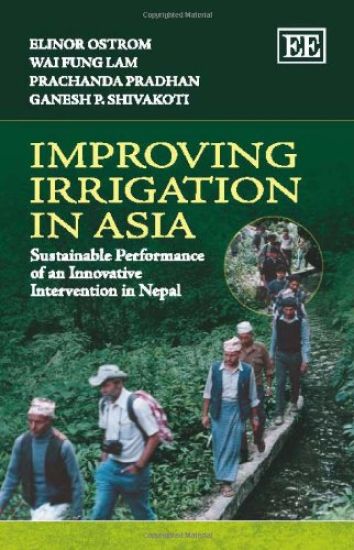
Improving Irrigation in Asia is based on a longitudinal study over two decades on innovative intervention for sustained performance of irrigation systems. The work identifies key factors that can help explain the performance of interventions, and explicates lessons for resource management and the management of development assistance. In 1985, the Water and Energy Commission Secretariat of Nepal and the International Irrigation Management Institute developed an ingenious intervention program for nineteen irrigation systems located in the middle hills of Nepal in an attempt to overcome the prevailing 'best-practices' traps, in regard to assisting irrigation systems. This book highlights the innovativeness of the project lay in its provision of ample opportunities for farmers to make decisions regarding the operation of the irrigation system based on their local knowledge and creativity. The authors of this work, Elinor Ostrom, Wai Fung Lam, Prachanda Pradhan and Ganesh P. Shivakoti provide detailed analysis of these interventions and support the conclusion that farmers can build on an innovative intervention that not only provides physical improvements but also enhances farmers' problem-solving capacity. They argue that to achieve sustainable improvements in performance, the farmers themselves need to engage in collective action over time and support local entrepreneurs who provide leadership and stimulate adjustments to change. Providing practical policy solutions, this study will prove a fascinating and invaluable read for academics and scholars of development studies, resource management, and irrigation studies, as well as development specialists in international agencies, policy makers in governments and international donor agencies.
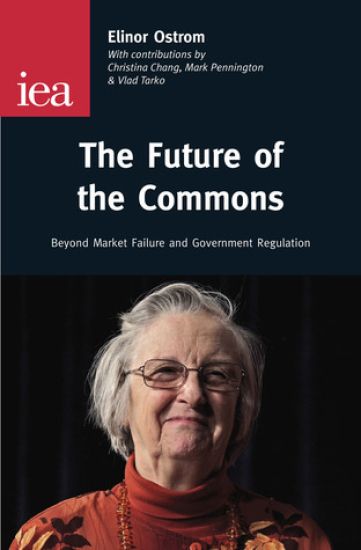
The Future of the Commons

The Future of the Commons

Elinor Ostrom

Institute of Economic Affairs
2012
nidottu
Traditional economic models of how to manage environmental problems relating to renewable natural resources, such as fisheries, have tended to recommend either government regulation or privatisation and the explicit definition of property rights. These traditional models ignore the practical reality of natural resource management. Many communities are?able to spontaneously develop their own approaches to managing such common-pool resources. In the words of Mark Pennington: '[Professor Ostrom's] book Governing the Commons is a superb testament to the understanding that can be gained when economists observe in close-up detail how people craft arrangements to solve problems in ways often beyond the imagination of textbook theorists.' In particular, communities are often able to find stable and effective ways to define the boundaries of a common-pool resource, define the rules for its use and effectively enforce those rules. The effective management of a natural resource often requires 'polycentric' systems of governance where various entities have some role in the process. Government may play a role?in some circumstances, perhaps by providing information to resource users or by assisting enforcement processes through court systems. Elinor Ostrom's work in this field, for which she won the ?Nobel Prize in economics in 2009, was grounded in the detailed empirical study of how communities managed common-pool resources in practice. It is essential that we avoid the 'panacea problem'. There is no correct way to manage common-pool resources that will always be effective. Different ways of managing resources will be appropriate in different contexts - for example within different cultures or where there are different physical characteristics of a natural resource. Nevertheless, there are principles that we can draw from?the detailed study of the salient features of different cases to help us understand how different common-pool resources might be best managed; which rules systems and systems of organisation have the best chance of success or failure; and so on. Elinor Ostrom's approach has been praised by the left, who often see it as being opposed to free-market privatisation initiatives. In fact, her approach sits firmly within the classical liberal tradition of political economy. She observes communities freely choosing their own mechanisms to manage natural resource problems without government coercion or planning. In developing a viable approach to the management of?the commons, it is important, among other things, that a resource can be clearly defined and that the rules governing the use of the resource are adapted to local conditions. This suggests that rules imposed from outside, such as by government agencies, are unlikely to be successful. There are important areas of natural resource management where Elinor Ostrom's ideas should be adopted to avoid environmental catastrophe. Perhaps the most obvious example relevant to the UK is in European Union fisheries policy. Here, there is one centralised model for the management of the resource that is applied right across the European Union, ignoring all the evidence about the failure of that approach.
Improving Irrigation in Asia

Improving Irrigation in Asia

Elinor Ostrom; Wai Fung Lam; Prachanda Pradhan; Ganesh P. Shivakoti

Edward Elgar Publishing Ltd
2011
sidottu
Improving Irrigation in Asia is based on a longitudinal study over two decades on innovative intervention for sustained performance of irrigation systems. The work identifies key factors that can help explain the performance of interventions, and explicates lessons for resource management and the management of development assistance. In 1985, the Water and Energy Commission Secretariat of Nepal and the International Irrigation Management Institute developed an ingenious intervention program for nineteen irrigation systems located in the middle hills of Nepal in an attempt to overcome the prevailing 'best-practices' traps, in regard to assisting irrigation systems. This book highlights the innovativeness of the project lay in its provision of ample opportunities for farmers to make decisions regarding the operation of the irrigation system based on their local knowledge and creativity. The authors of this work, Elinor Ostrom, Wai Fung Lam, Prachanda Pradhan and Ganesh P. Shivakoti provide detailed analysis of these interventions and support the conclusion that farmers can build on an innovative intervention that not only provides physical improvements but also enhances farmers' problem-solving capacity. They argue that to achieve sustainable improvements in performance, the farmers themselves need to engage in collective action over time and support local entrepreneurs who provide leadership and stimulate adjustments to change. Providing practical policy solutions, this study will prove a fascinating and invaluable read for academics and scholars of development studies, resource management, and irrigation studies, as well as development specialists in international agencies, policy makers in governments and international donor agencies.
The Quest to Understand Human Affairs

The Quest to Understand Human Affairs

Vincent Ostrom; Elinor Ostrom

Lexington Books
2010
sidottu
The Quest to Understand Human Affairs presents fifty previously unpublished essays by Vincent Ostrom on the U.S. Government's environmental problems and resource governance and span the six decades of Ostrom's career in political science and public administration. Including everything from a 1947 essay on Western (U.S) issues in national politics to ending with a 2004 manuscript on Constitutional foundations and federal institutional forms, these essays examine significant developments in administration, constitutional design, and the evolution of theory and practice in the field of institutional analysis and development during the second half of the twentieth century and first decade of the new millennium. Political theorist, Barbara Allen, has edited the work and provided extensive notes that provide context and identify key events and persons cited in the works. These remarkable works not only offer specialists insight into developments in the fields of institutional analysis, resource governance, policy and administration, but also speak to general readers about worldwide transformations in democracies and human and environmental relations as well as the enduring challenge of sustaining just, productive political orders.
The Quest to Understand Human Affairs

The Quest to Understand Human Affairs

Vincent Ostrom; Elinor Ostrom

Lexington Books
2010
nidottu
The Quest to Understand Human Affairs presents fifty previously unpublished essays by Vincent Ostrom on the U.S. Government's environmental problems and resource governance and span the six decades of Ostrom's career in political science and public administration. Including everything from a 1947 essay on Western (U.S) issues in national politics to ending with a 2004 manuscript on Constitutional foundations and federal institutional forms, these essays examine significant developments in administration, constitutional design, and the evolution of theory and practice in the field of institutional analysis and development during the second half of the twentieth century and first decade of the new millennium. Political theorist, Barbara Allen, has edited the work and provided extensive notes that provide context and identify key events and persons cited in the works. These remarkable works not only offer specialists insight into developments in the fields of institutional analysis, resource governance, policy and administration, but also speak to general readers about worldwide transformations in democracies and human and environmental relations as well as the enduring challenge of sustaining just, productive political orders.
Working Together

Working Together

Amy R. Poteete; Marco A. Janssen; Elinor Ostrom

Princeton University Press
2010
pokkari
Advances in the social sciences have emerged through a variety of research methods: field-based research, laboratory and field experiments, and agent-based models. However, which research method or approach is best suited to a particular inquiry is frequently debated and discussed. Working Together examines how different methods have promoted various theoretical developments related to collective action and the commons, and demonstrates the importance of cross-fertilization involving multimethod research across traditional boundaries. The authors look at why cross-fertilization is difficult to achieve, and they show ways to overcome these challenges through collaboration. The authors provide numerous examples of collaborative, multimethod research related to collective action and the commons. They examine the pros and cons of case studies, meta-analyses, large-N field research, experiments and modeling, and empirically grounded agent-based models, and they consider how these methods contribute to research on collective action for the management of natural resources. Using their findings, the authors outline a revised theory of collective action that includes three elements: individual decision making, microsituational conditions, and features of the broader social-ecological context. Acknowledging the academic incentives that influence and constrain how research is conducted, Working Together reworks the theory of collective action and offers practical solutions for researchers and students across a spectrum of disciplines.
Conversations with Tocqueville

Conversations with Tocqueville

Elinor Ostrom; Vincent Ostrom

Lexington Books
2009
nidottu
The questions and issues raised by Tocqueville in his monumental studies of France and America are just as crucial for understanding the evolution of democracy in the West and the development of democracy in the non-western world. They clearly show the breadth of Tocqueville's contributions to the development of modern social sciences. Among the questions addressed by Tocqueville were: How does the weight of the past affect the evolution of political institutions and political behavior? What impact do differences in physical environment have on the organization of society? What are the relationships between social equality, freedom, and democracy? To what extent does centralization destroy the capacity for local initiative and self-governance? What conditions are needed to nurture the flourishing of self-governing communities? What safeguards are needed to preserve freedom and to prevent incipient democracies from becoming dictatorships? Why has democracy had such a problem taking hold in many parts of the non-western world? How should one study democracy in non-western settings? Tocquevillian analytics can help us provide answers. Addressed to a wider audience than Tocqueville scholars, the book argues that Tocquevillian analytics can be used to understand developments in non-western as well as western societies and be updated to address such issues as globalization, ethnicity, New World-Old World comparisons, and East-West dynamics. The first part of the book examines the basic components of Tocquevillian analytics, outlining its stepwise, interdisciplinary approach to understanding societies and nations. The second part applies the Tocquevillian conceptual framework to the contemporary world and contains individual chapters on various regions of the worldDNorth America, Russia, Western Europe, Asia, Africa, and Latin America. Unlike previous collective works on Tocqueville,Conversations with Tocqueville does not offer a survey of the authors' views, but instead focuses on presenting a cohesive theoretical framework of analysis that can then be applied and adjusted to fit a multitude of settings.
Conversations with Tocqueville

Conversations with Tocqueville

Elinor Ostrom; Vincent Ostrom

Lexington Books
2009
sidottu
The questions and issues raised by Tocqueville in his monumental studies of France and America are just as crucial for understanding the evolution of democracy in the West and the development of democracy in the non-western world. They clearly show the breadth of Tocqueville's contributions to the development of modern social sciences. Among the questions addressed by Tocqueville were: How does the weight of the past affect the evolution of political institutions and political behavior? What impact do differences in physical environment have on the organization of society? What are the relationships between social equality, freedom, and democracy? To what extent does centralization destroy the capacity for local initiative and self-governance? What conditions are needed to nurture the flourishing of self-governing communities? What safeguards are needed to preserve freedom and to prevent incipient democracies from becoming dictatorships? Why has democracy had such a problem taking hold in many parts of the non-western world? How should one study democracy in non-western settings? Tocquevillian analytics can help us provide answers. Addressed to a wider audience than Tocqueville scholars, the book argues that Tocquevillian analytics can be used to understand developments in non-western as well as western societies and be updated to address such issues as globalization, ethnicity, New World-Old World comparisons, and East-West dynamics. The first part of the book examines the basic components of Tocquevillian analytics, outlining its stepwise, interdisciplinary approach to understanding societies and nations. The second part applies the Tocquevillian conceptual framework to the contemporary world and contains individual chapters on various regions of the world–North America, Russia, Western Europe, Asia, Africa, and Latin America. Unlike previous collective works on Tocqueville,Conversations with Tocqueville does not offer a survey of the authors' views, but instead focuses on presenting a cohesive
Understanding Institutional Diversity

Understanding Institutional Diversity

Elinor Ostrom

Princeton University Press
2005
pokkari
The analysis of how institutions are formed, how they operate and change, and how they influence behavior in society has become a major subject of inquiry in politics, sociology, and economics. A leader in applying game theory to the understanding of institutional analysis, Elinor Ostrom provides in this book a coherent method for undertaking the analysis of diverse economic, political, and social institutions. Understanding Institutional Diversity explains the Institutional Analysis and Development (IAD) framework, which enables a scholar to choose the most relevant level of interaction for a particular question. This framework examines the arena within which interactions occur, the rules employed by participants to order relationships, the attributes of a biophysical world that structures and is structured by interactions, and the attributes of a community in which a particular arena is placed. The book explains and illustrates how to use the IAD in the context of both field and experimental studies. Concentrating primarily on the rules aspect of the IAD framework, it provides empirical evidence about the diversity of rules, the calculation process used by participants in changing rules, and the design principles that characterize robust, self-organized resource governance institutions.