Kirjojen hintavertailu. Mukana 12 378 358 kirjaa ja 12 kauppaa.
Kirjailija
Eliot Weinberger
Kirjat ja teokset yhdessä paikassa: 33 kirjaa, julkaisuja vuosilta 1987-2025, suosituimpien joukossa Muhammad. Vertaile teosten hintoja ja tarkista saatavuus suomalaisista kirjakaupoista.
Der New Yorker Eliot Weinberger ist einer der engagiertesten Publizisten in den USA. Sein Lieblingsfeind ist George W. Bush, seine Liebe aber gehört dem babylonischen Gewirr der kulturellen Zeichen aus aller Welt und allen Zeiten. Darüber schreibt er seit Jahren seine Essays genannten Prosastücke. Es sind Texte von großer poetischer Schönheit. Scheinbar unverbunden handeln diese Bruchstücke aus 4000 Jahren Natur- und Menschheitsgeschichte vom Wind, von Strudeln, von Menschen die Chang heißen, von Mohammed und den Sternen, von William Blakes Tiger, von Noahs Nachkommen im Irak und Iran, von Zaunkönigen, von mathematischer Musik in der peruanischen Wüste. Zusammengelesen ergeben sie ein großartiges, weltumspannendes Bild, in dem das Wort Globalisierung plötzlich einen ganz anderen, fremderen und zugleich wärmeren Sinn bekommt.
This rich compendium of translations is the first to look at Chinese poetry through its enormous influence on American poetry. Starting with Ezra Pound's "Cathay" (1915), it includes translations by three other American poets (William Carlos Williams, Kenneth Rexroth, Gary Snyder) and a translator-scholar-poet (David Hinton), all long associated with "New Directions", the great New York literary publishing house founded just over 70 years ago.The collection gathers some 200 poems by nearly 40 poets, from the anonymous early poetry to the great masters of the T'ang and Sung dynasties. Also included are previously uncollected translations by Pound, a selection of essays (some also not previously collected) by all five translators and biographical notes that are a collage of poems and comments by both the American translators and the Chinese poets themselves. "New Directions" was founded by James Laughlin, then a Harvard undergraduate, in 1936 after Ezra Pound told him to do something more "useful" than write poetry. Ever since "New Directions" has been dedicated to publishing (and keeping in print) the writers who are experimental, challenging, offbeat, and curiously classic both in English and in translation. Every day ND tries to keep language "new".
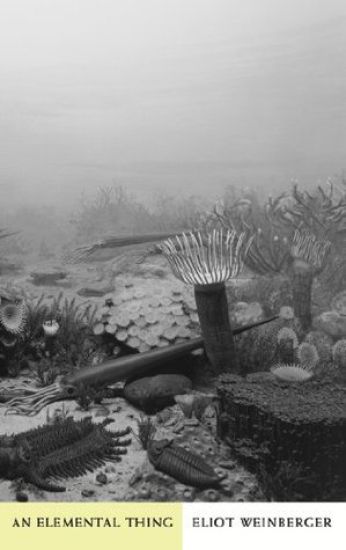
With An Elemental Thing, Weinberger turns from his celebrated political chronicles to the timelessness of the subjects of his literary essays. With the wisdom of a literary archaeologist-astronomer-anthropologist-zookeeper, he leads us through histories, fables, and meditations about the ten thousand things in the universe: the wind and the rhinoceros, Catholic saints and people named Chang, the Mandaeans on the Iran-Iraq border and the Kaluli in the mountains of New Guinea. Among the thirty-five essays included are a poetic biography of the prophet Muhammad, which was praised by the London Times for its "great beauty and grace," and "The Stars," a reverie on what's up there that has already been translated into Arabic, Chinese, Hindi, and Maori.
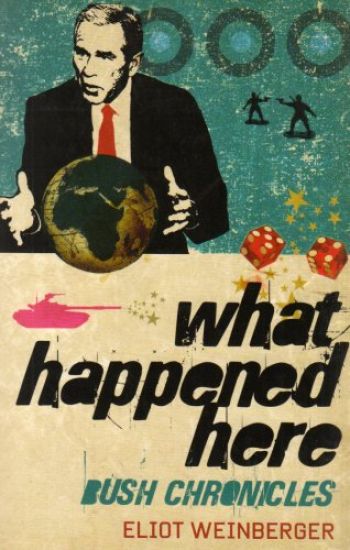
With wit and anger, the author of the blackly comic What I Heard About Iraq takes us through the administration of the 'Bush junta'. Eliot Weinberger begins with the inauguration of George W. Bush and the actions and policies that presaged an invasion of Iraq even before the terrorist attack of 9/11. Giving a moving account of downtown Manhattan, where he lives, on the day after the attack, he accounts for the feeling of lost innocence in the United States. On the aftermath of 9/11, Weinberger goes on to excoriate the Bush administration for its panic peddling and massive and secret arrests of 'suspects', as well as the contrived 'intelligence' that led to the war on Iraq. Ranging from personal journalism to political analysis, Eliot Weinberger traces the nightmarish absurdities of the Bush administration with incisive elegance. Includes What I Heard About Iraq in 2005, the sequel to his earlier work. What Happened Here was nominated for a 2006 National Book Critics Circle Award for Criticism.
New York artist, Vija Celmins, made many images of the night sky - paintings, drawings, and prints of gorgeous richness. Here, she and her collaborator, the essayist and translator Eliot Weinberger, devote an artist's book to the theme.
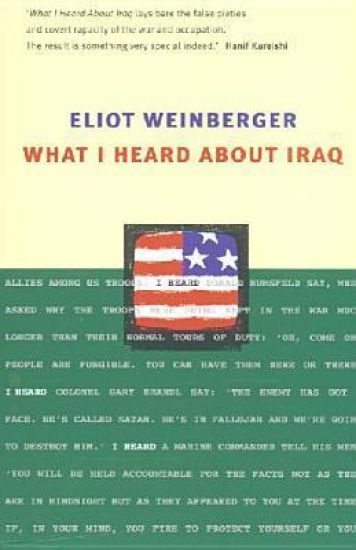
The Iraq War has unleashed such a torrent of opinion - impassioned polemic, neo-con apologia, world-weary cynicism - that it feels like the important truths are being lost in a media feeding-frenzy. Eliot Weinberger eschews the rehtoric of the soapbox in an extraordinary montage of facts, sound bites and testimonies. He assembles an uncompromising and blackly comic narrative, which permits the voices of the war to speak for themselves, and allows the protagonists to damn themselves in their own words.This pocket-sized volume is vast in scope, a work unlike any other you have read on Iraq, which finds an unexpected eloquence in its refusal to join in the facile grand-standing and selective amnesia of so much contemporary commentary.
In a series of snapshots written after the attack on the World Trade Centre -from a day, to a week, up to a year and beyond - Eliot Weinberger offers thoughtful and provocative reflections on his city, the country and the state of the world. Originally published only outside the United States, these essays are now available together, and for the first time in English. Taken as a whole, they constitute a remarkable "archive of the moment", way-markers for a story that is still unfolding.
A beautiful collaboration between husband and wife. His poems to her collages, call and response from Mexico's greatest poet. "Marie Jose's constructions and boxes are three-dimensional objects transfigured by her imagination and her sensibility into visual ideas, mental enigmas, bearers of bizarre and disturbing images, or of ironic perceptions. More than things to be seen, they are wings for traveling, sails for wandering and wondering, mirrors through which to cross." Octavio Paz Figures & Figurations, one of the last books completed by the late Mexican poet Octavio Paz before his death in 1998, is a collaborative effort with his wife of thirty years, the artist Marie Jose Paz. In response to ten of her collage-constructions, he wrote ten new short poems; she in turn created two new artworks in response to two of his earlier poems. Twelve poems, twelve pieces of art reproduced in full color, in a book first published in Spanish in 1999 and now appearing in a bilingual edition. In addition to the poems and collage-constructions, Figures & Figurations includes an essay by Octavio Paz on Marie Jose Paz's work, "The Whitecaps of Time," in which he relates how her friendship with Joseph Cornell became a stimulus for her assemblages and how she was further spurred on by other friends, such as Roman Jakobson and Elizabeth Bishop. "These objects sometime surprise us," he writes, "sometimes make us laugh or dream. Signs that invite us to a motionless voyage of fantasy, bridges to the infinitely small or galactic distances, windows that open on to nowhere. The art of Marie Jose is a dialogue between here and there."
For the past twenty years, Eliot Weinberger has been taking the essay far beyond the borders of literary criticism or personal journalism and into the realm of poetry and narrative. Full of stories, yet written in a condensed, imagistic language, his essays are works of the imagination where all the facts are verifiable. As entertaining as fiction and as vivid as poems, making unexpected stops in odd corners of the globe or forgotten moments in human history, erudite, politically engaged, and acerbically witty, there is nothing quite like his work in contemporary writing. In Karmic Traces, his third collection with New Directions, twenty-four essays take the reader along on the author’s personal travels from the Atacama Desert to Iceland to Hong Kong on the verge of the hand-over to China, as well as on imagined voyages on a 17th-century Danish ship bound for India and among strange religious cults or even stranger small animals. One never knows what will appear next: Viking dreams, Aztec rituals, Hindu memory, laughing fish, or prophetic dogs. And in “The Falls,” the long tour-de-force that closes the book, Weinberger recapitulates 3,000 years of history in a cascade of telling facts to uncovering the deep roots of contemporary racism and violence.
Unpredictable and uncanonical, Eliot Weinberger’s essays are the “outside stories” of cultural migrations. The fifteen pieces collected here range from the history of the Salman Rushdie affair to the dream of Atlantis, from the turf wars among ethnographic filmmakers to the unlikely romance between poetry and espionage, from the pilgrims in Plymouth to the students in Tiananmen Square. Above all, Weinberger’s concern is poetry––whether written in medieval Baghdad or by Mexicans in Japan––and the perennially underground yet global network through which it travels. With his modernist sensibility and internationalist perspective, Weinberger’s inventive prose transports old myths and texts to the strange realities of contemporary life.
During the past several years, Eliot Weinberger’s inventive prose has earned him a reputation as a candid social observer and penetrating essayist. Works on Paper is the first collection of his writings, twenty-one pieces that juxtapose the world as it is and the world as it is imagined-by artists, poets, historical figures, and ordinary people. “Inventions of Asia,” the first section, deals primarily with how the West reinvents the East (and how the East invents itself): images of India circa 1492 (where Columbus thought he was going); Christian missionaries in sixteenth-century China; Bombay prostitutes as seen by a New York photojournalist; Tibetan theocracy transplanted to the Rockies; a Confucian bureaucrat’s address to crocodiles; the shifting iconography of the “tyger”; looking for an answer to an ancient Chinese poem of questions; how the children of Mao have reinvented Imagism; Kampuchea Under Pol Pot. “Extensions of Poetry” explores the ways in which the world affects the imaginations of individual poets (George Oppen, Langston Hughes, Charles Reznikoff, Octavio Paz, Clayton Eshleman) and indeed entire movements, leading at times to unexpected incarnations and transformations. Weinberger ponders such strange conjunctions as Whittaker Chambers and Objectivism, anti-Semitism among American Modernists, bourgeois poets––present-day wards of the academy and the state––confronting the issues of peace, American foreign policy, and The Bomb.
Written for publication in magazines abroad, translated into sixteen languages, and collected here for the first time, Eliot Weinberger’s chronicles of the Bush era range from first-person journalism to political analysis to a kind of documentary prose poetry. The book begins with the inauguration of George W. Bush in January 2001—and an eerie prediction of the invasion of Iraq—and picks up on September 12, with an account of downtown Manhattan, where Weinberger lives, on the “day after.” With wit and anger, and sometimes startling prescience, What Happened Here takes us through the first term of the “Bush junta”: the deep history of the neoconservative “sleeper cell,” the invention of the War on Terror, the real wars in Afghanistan and Iraq, and the often bizarre behavior of the Republican Party. For twenty-five years, Eliot Weinberger has been taking the essay form into unexplored territory. In What Happened Here, truth proves stranger than poetry.