Kirjojen hintavertailu. Mukana 12 390 323 kirjaa ja 12 kauppaa.

Kirjailija

Eliza McGraw

Kirjat ja teokset yhdessä paikassa: 5 kirjaa, julkaisuja vuosilta 2005-2025, suosituimpien joukossa E.D.E.N. Southworth's Hidden Hand. Vertaile teosten hintoja ja tarkista saatavuus suomalaisista kirjakaupoista.

5 kirjaa

Kirjojen julkaisuhaarukka 2005-2025.

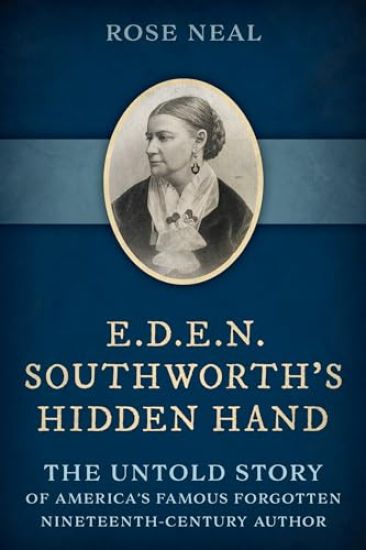
E.D.E.N. Southworth's Hidden Hand

E.D.E.N. Southworth's Hidden Hand

Rose Neal; Eliza McGraw

ROWMAN LITTLEFIELD
2025
sidottu
E.D.E.N. Southworth (Emma Dorothy Eliza Nevitte) was one of the nineteenth century’s most prolific and successful authors, with more novels to her credit than Nathaniel Hawthorne, Herman Melville, and Mark Twain combined. She was widely beloved by readers for her feisty heroines who rode horses, shot pistols or bows and arrows, captured notorious villains, became sea captains, and had other such grand adventures. Readers named their daughters, their boats, and their racehorses Capitola after their new favorite character in Emma’s bestselling 1859 novel The Hidden Hand, which sold 10,000 copies in the first print run.In her fifty novels, Southworth wrote about unspeakable topics for the time: alcoholism, domestic violence, poverty, capital punishment, and other social issues—many of which readers still grapple with today—all nicely tucked away within the pages of her “domestic fiction.” Despite being raised in a slave-owning family, her first works appeared in The National Era, a known abolitionist magazine. She supported emancipation and encouraged her longtime friend Harriet Beecher Stowe to publish Uncle Tom’s Cabin. In a bold and daring life that spanned almost the entirety of the century, Emma advocated for better education for girls and better living conditions for the poor, nursed Union soldiers during the Civil War, and joined the early women’s rights movement.Emma helped encourage generations of women readers to question and challenge the status quo. Yet although she achieved international fame in her lifetime, knowledge of Southworth and her novels virtually disappeared in the 1940s as readers were drawn to the new Modernism literary movement. For Emma, it was also partly because she had done so well at hiding her progressive ideas in the biographical pieces written during her life. This hidden-in-plain-sight approach worked for a single mother who needed to make money by her pen—her main means of providing for herself and her children after her husband abandoned them—but it helped incorrectly categorize Southworth well into the twentieth century as being against many of the causes she in fact supported in her novels.By meticulously combining details from Southworth’s novels, partial biographies, newspapers, and hundreds of personal letters, Rose Neal has written the first-ever biography of E.D.E.N. and pieced together the fascinating life of a woman who was as determined as any of the heroines she created.

Edna Ferber's America

Edna Ferber's America

Eliza McGraw

Louisiana State University Press
2014
sidottu
From the 1910s to the 1950s, Edna Ferber (1885--1968) published a series of bestselling novels that made her one of Doubleday's highest-paid authors, earned her a Pulitzer Prize for Fiction in 1925, and transformed her into a literary celebrity. She hosted dinner parties covered by the New York Times, lunched at the Algonquin Round Table with Dorothy Parker and Alexander Woollcott, and collaborated with George S. Kaufman on hit plays such as Dinner at Eight and Stage Door. In Edna Ferber's America, Eliza McGraw provides the first in-depth critical study of the author's novels, exploring their innovative portrayals of characters from a diverse range of ethnicities and social classes.Best remembered today for the movies and musicals adapted from her works -- including classics like Giant and Show Boat -- Ferber attracted a devoted readership during her lifetime with engaging storylines focused on strong-willed individuals reshaping their lives, set amid a panorama of regional landscapes. McGraw reveals that Ferber's novels convey a broad, nuanced vision of the United States as a multiethnic country.Framing her study with the theme of ethnic unease and insecurity, McGraw performs close readings of twelve Ferber novels: Dawn O'Hara (1911), Fanny Herself (1917), The Girls (1921), So Big (1924), Show Boat (1926), Cimarron (1929), American Beauty (1931), Come and Get It (1935), Saratoga Trunk (1941), Great Son (1945), Giant (1952), and Ice Palace (1958). McGraw explores the entwined topics of racial mixing and class as she argues that in Ferber's America, ethnic and social mobility challenge the reigning order, creating places that foster vitality and promise hope for the future.
Two Covenants

Two Covenants

Eliza McGraw

Louisiana State University Press
2005
sidottu
Jews have long occupied visible roles in the South. Jewish families have owned establishments ranging from dry-goods stores to Thomas Jefferson's Monticello, and some of the region's most important writers and scholars have been Jewish. Yet surveys of southern culture rarely assess the contributions of Jews, while histories of Jews in America virtually exclude those living in the South. Eliza R. L. McGraw's multifaceted study fills both gaps and in doing so expands how we define the South.In Two Covenants, McGraw mines eclectic representations of Southern Jewishness as varied as the Carolina Israelite newspaper, the Mardi Gras Krewe du Jieux, southern Baptist conversion-instruction pamphlets, and the film Driving Miss Daisy. She also considers literary representations of southern Jews in the works of both Jewish and non-Jewish writers, including Thomas Wolfe, Robert Penn Warren, Walker Percy, Lillian Hellman, David Cohn, Louis Rubin, Jr., Eli Evans, James Weldon Johnson, Jean Toomer, and Charles Chesnutt.While concerned with established concepts such as ethnicity and region, McGraw raises many questions that illustrate the complexity of southern Jewishness. Can one individual straddle two identities? How do race, class, and gender influence southern Jewishness? What are the differences between southern Jews and other southerners, or between southern Jews and other Jews? Does anti-Semitism manifest itself differently or with unique effects in the South?In suggesting answers to these and other questions, McGraw ranges widely over the southern cultural landscape and reveals that although southern Jewishness remains a marginal identity due to the small size of its constituency it nevertheless inhabits and helps to form the South at large. The very presence and vitality of southern Jewishness demonstrate that southern identity, like national identity, is a fluid cultural experience.