

Kirjailija
Elizabeth A. Wilson
Kirjat ja teokset yhdessä paikassa: 15 kirjaa, julkaisuja vuosilta 1998-2025, suosituimpien joukossa Maschinenaffekte. Vertaile teosten hintoja ja tarkista saatavuus suomalaisista kirjakaupoista.
Mukana myös kirjoitusasut: Elizabeth a Wilson
15 kirjaa
Kirjojen julkaisuhaarukka 1998-2025.



A Silvan Tomkins Handbook
Adam J. Frank; Elizabeth A. Wilson
University of Minnesota Press
2020
sidottu
An accessible guide to the work of American psychologist and affect theorist Silvan Tomkins The brilliant and complex theories of psychologist Silvan Tomkins (1911–1991) have inspired the turn to affect in the humanities, social sciences, and elsewhere. Nevertheless, these theories are not well understood. A Silvan Tomkins Handbook makes his theories portable across a range of interdisciplinary contexts and accessible to a wide variety of contemporary scholars and students of affect. A Silvan Tomkins Handbook provides readers with a clear outline of Tomkins’s affect theory as he developed it in his four-volume masterwork Affect Imagery Consciousness. It shows how his key terms and conceptual innovations can be used to build robust frameworks for theorizing affect and emotion. In addition to clarifying his affect theory, the Handbook emphasizes Tomkins’s other significant contributions, from his broad theories of imagery and consciousness to more focused concepts of scenes and scripts. With their extensive experience engaging and teaching Tomkins’s work, Adam J. Frank and Elizabeth A. Wilson provide a user-friendly guide for readers who want to know more about the foundations of affect studies.
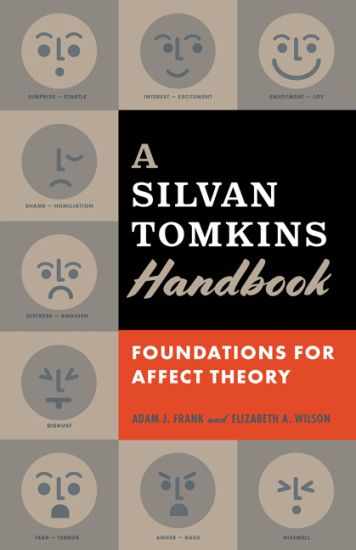
A Silvan Tomkins Handbook
Adam J. Frank; Elizabeth A. Wilson
University of Minnesota Press
2020
nidottu
An accessible guide to the work of American psychologist and affect theorist Silvan Tomkins The brilliant and complex theories of psychologist Silvan Tomkins (1911–1991) have inspired the turn to affect in the humanities, social sciences, and elsewhere. Nevertheless, these theories are not well understood. A Silvan Tomkins Handbook makes his theories portable across a range of interdisciplinary contexts and accessible to a wide variety of contemporary scholars and students of affect. A Silvan Tomkins Handbook provides readers with a clear outline of Tomkins’s affect theory as he developed it in his four-volume masterwork Affect Imagery Consciousness. It shows how his key terms and conceptual innovations can be used to build robust frameworks for theorizing affect and emotion. In addition to clarifying his affect theory, the Handbook emphasizes Tomkins’s other significant contributions, from his broad theories of imagery and consciousness to more focused concepts of scenes and scripts. With their extensive experience engaging and teaching Tomkins’s work, Adam J. Frank and Elizabeth A. Wilson provide a user-friendly guide for readers who want to know more about the foundations of affect studies.

Sovereign: A Handbook for Maintaining Personal Mastery in all Affairs
Sylvia R. Swann; Elizabeth a. Wilson
Independently Published
2019
nidottu
The practice of Sovereignty is the gentle and serene art of overseeing the activity of the mind, the flow of the energy field and the state of being, so that one can experience anew from a wiser vantage point. It may take certain tools to begin with. With metacognition - the art of thinking about thinking - we can consciously guide our thought systems into revitalizing and empowering patterns. With simple energy work we can attune our biofields and refine our point of attraction with precision. With essential oils - the remarkable life force and consciousness of our botanical cousins - we can help transition the brain chemistry, the blood chemistry, the subtle energy body, and our environment into a frequency that supports our intention to relax deeper and deeper into the Kingdom of Heaven - the peaceful bliss of here and now. Mastering these tools, or rather, using these tools to master our response to our external environment, is what makes us truly Sovereign. When it becomes your nature, you'll no longer need any tools. Until then, this little handbook is your daily companion to offer simple techniques, comfort, guidance, and attunement to your highest awareness.

People Power Movements and International Human Rights
Elizabeth a Wilson
International Center on Nonviolent Conflict
2017
pokkari

In Gut Feminism Elizabeth A. Wilson urges feminists to rethink their resistance to biological and pharmaceutical data. Turning her attention to the gut and depression, she asks what conceptual and methodological innovations become possible when feminist theory isn’t so instinctively antibiological. She examines research on anti-depressants, placebos, transference, phantasy, eating disorders and suicidality with two goals in mind: to show how pharmaceutical data can be useful for feminist theory, and to address the necessary role of aggression in feminist politics. Gut Feminism’s provocative challenge to feminist theory is that it would be more powerful if it could attend to biological data and tolerate its own capacity for harm.

In Gut Feminism Elizabeth A. Wilson urges feminists to rethink their resistance to biological and pharmaceutical data. Turning her attention to the gut and depression, she asks what conceptual and methodological innovations become possible when feminist theory isn’t so instinctively antibiological. She examines research on anti-depressants, placebos, transference, phantasy, eating disorders and suicidality with two goals in mind: to show how pharmaceutical data can be useful for feminist theory, and to address the necessary role of aggression in feminist politics. Gut Feminism’s provocative challenge to feminist theory is that it would be more powerful if it could attend to biological data and tolerate its own capacity for harm.

In 1950, Alan Turing, the British mathematician, cryptographer, and computer pioneer, looked to the future: now that the conceptual and technical parameters for electronic brains had been established, what kind of intelligence could be built? Should machine intelligence mimic the abstract thinking of a chess player or should it be more like the developing mind of a child? Should an intelligent agent only think, or should it also learn, feel, and grow?Affect and Artificial Intelligence is the first in-depth analysis of affect and intersubjectivity in the computational sciences. Elizabeth Wilson makes use of archival and unpublished material from the early years of AI (1945–70) until the present to show that early researchers were more engaged with questions of emotion than many commentators have assumed. She documents how affectivity was managed in the canonical works of Walter Pitts in the 1940s and Turing in the 1950s, in projects from the 1960s that injected artificial agents into psychotherapeutic encounters, in chess-playing machines from the 1940s to the present, and in the Kismet (sociable robotics) project at MIT in the 1990s.

In 1950, Alan Turing, the British mathematician, cryptographer, and computer pioneer, looked to the future: now that the conceptual and technical parameters for electronic brains had been established, what kind of intelligence could be built? Should machine intelligence mimic the abstract thinking of a chess player or should it be more like the developing mind of a child? Should an intelligent agent only think, or should it also learn, feel, and grow?Affect and Artificial Intelligence is the first in-depth analysis of affect and intersubjectivity in the computational sciences. Elizabeth Wilson makes use of archival and unpublished material from the early years of AI (1945–70) until the present to show that early researchers were more engaged with questions of emotion than many commentators have assumed. She documents how affectivity was managed in the canonical works of Walter Pitts in the 1940s and Turing in the 1950s, in projects from the 1960s that injected artificial agents into psychotherapeutic encounters, in chess-playing machines from the 1940s to the present, and in the Kismet (sociable robotics) project at MIT in the 1990s.

How can scientific theories contribute to contemporary accounts of embodiment in the humanities and social sciences? In particular, how does neuroscientific research facilitate new approaches to theories of mind and body? Feminists have frequently criticized the neurosciences for biological reductionism, yet, Elizabeth A. Wilson argues, neurological theories-especially certain accounts of depression, sexuality, and emotion-are useful to feminist theories of the body. Rather than pointing toward the conventionalizing tendencies of the neurosciences, Wilson emphasizes their capacity for reinvention and transformation. Focusing on the details of neuronal connections, subcortical pathways, and reflex actions, she suggests that the central and peripheral nervous systems are powerfully allied with sexuality, the affects, emotional states, cognitive appetites, and other organs and bodies in ways not fully appreciated in the feminist literature. Whether reflecting on Simon LeVay’s hypothesis about the brains of gay men, Peter Kramer’s model of depression, or Charles Darwin’s account of trembling and blushing, Wilson is able to show how the neurosciences can be used to reinvigorate feminist theories of the body.

How can scientific theories contribute to contemporary accounts of embodiment in the humanities and social sciences? In particular, how does neuroscientific research facilitate new approaches to theories of mind and body? Feminists have frequently criticized the neurosciences for biological reductionism, yet, Elizabeth A. Wilson argues, neurological theories-especially certain accounts of depression, sexuality, and emotion-are useful to feminist theories of the body. Rather than pointing toward the conventionalizing tendencies of the neurosciences, Wilson emphasizes their capacity for reinvention and transformation. Focusing on the details of neuronal connections, subcortical pathways, and reflex actions, she suggests that the central and peripheral nervous systems are powerfully allied with sexuality, the affects, emotional states, cognitive appetites, and other organs and bodies in ways not fully appreciated in the feminist literature. Whether reflecting on Simon LeVay’s hypothesis about the brains of gay men, Peter Kramer’s model of depression, or Charles Darwin’s account of trembling and blushing, Wilson is able to show how the neurosciences can be used to reinvigorate feminist theories of the body.

Neural Geographies draws together recent feminist and deconstructive theories, early Freudian neurology and contemporary connectionist theories of cognition. In this original work, Elizabeth A. Wilson explores the convergence between Derrida, Freud and recent cognitive theory to pursue two important issues: the nature of cognition and neurology, and the politics of feminist and critical interventions into contemporary scientific psychology. This book seeks to reorient the usual presumptions of critical studies of the sciences by addressing the divisions between the static and the changeable; the natural and the political; the neuro-cognitive and the cultural that have been traditional to both scientific and critical accounts of neurology and cognition.

Neural Geographies draws together recent feminist and deconstructive theories, early Freudian neurology and contemporary connectionist theories of cognition. In this original work, Elizabeth A. Wilson explores the convergence between Derrida, Freud and recent cognitive theory to pursue two important issues: the nature of cognition and neurology, and the politics of feminist and critical interventions into contemporary scientific psychology. This book seeks to reorient the usual presumptions of critical studies of the sciences by addressing the divisions between the static and the changeable; the natural and the political; the neuro-cognitive and the cultural that have been traditional to both scientific and critical accounts of neurology and cognition.