Kirjojen hintavertailu. Mukana 12 595 353 kirjaa ja 12 kauppaa.

Kirjailija

Elizabeth A. Winston

Kirjat ja teokset yhdessä paikassa: 4 kirjaa, julkaisuja vuosilta 2011-2023, suosituimpien joukossa Beyond Equivalence: Reconceptualizing Interpreting Performance Assessment. Vertaile teosten hintoja ja tarkista saatavuus suomalaisista kirjakaupoista.

4 kirjaa

Kirjojen julkaisuhaarukka 2011-2023.

Beyond Equivalence: Reconceptualizing Interpreting Performance Assessment

Beyond Equivalence: Reconceptualizing Interpreting Performance Assessment

Elizabeth A. Winston; Robert G. Lee; Christine Monikowski

GALLAUDET UNIVERSITY PRESS
2023
nidottu
There is a longstanding need for valid, reliable measurements of interpreting competence. Although rubrics and checklists are commonly used in both academic and employment settings, a review of available rubrics indicates that many do not focus on interpreting performance. Traditional metrics for sign language interpreting often conflate language proficiency with interpreting proficiency. Conflating fundamental aspects of language in use--vocabulary, grammar, and prosody-- with fundamental aspects of interpretation--content, intent, and monitoring--compromises the valid assessment of interpreting proficiency. Beyond Equivalence: Reconceptualizing Interpreting Performance Assessment argues for a shift toward more nuanced and evidence-based conceptualizations of interpreting, communication, and meaning to improve the creation and use of rubrics for assessment in interpreter education, certification, and professional development. This inaugural volume in the Currents series introduces a rubric and accompanying scale, which can be used to assess both simultaneous and consecutive interpreting performance in terms of both process and product, in both signed and spoken language interpreting, and in a variety of settings. Beyond Equivalence offers an appreciation of the multivarious nature of meaning in the interpreting process and presents a new paradigm for the measurement of interpreting proficiency.
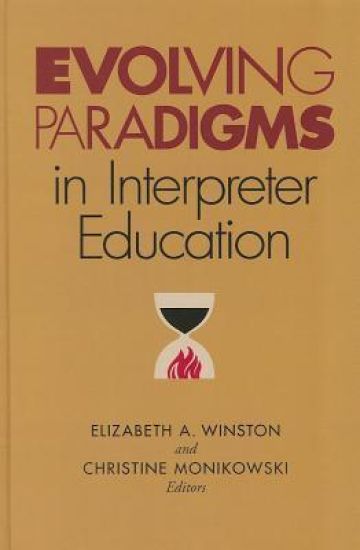
Evolving Paradigms in Interpreter Education

Evolving Paradigms in Interpreter Education

Elizabeth A. Winston

Gallaudet University Press,U.S.
2013
sidottu
Evolving Paradigms in Interpreter Education brings together a cadre of world-renowned educators and researchers who conduct a rich exploration of paradigms, both old and new, in interpreter education. They review existing research, explicate past and current practices, and call for a fresh examination of the roots of interpreter education. Expert commentary accompanies each chapter to provide a starting point for reflection on and discussion of the growing needs in this discipline.
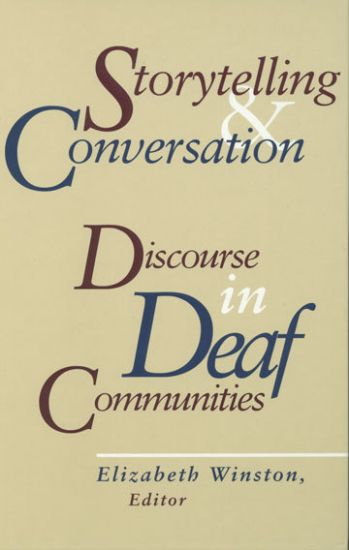
Storytelling and Conversation - Discourse in Deaf Communities

Storytelling and Conversation - Discourse in Deaf Communities

Elizabeth A. Winston

Gallaudet University Press,U.S.
2011
nidottu
In this intriguing book, renowned sociolinguistics experts explore the importance of discourse analysis, a process that examines patterns of language to understand how users build cooperative understanding in dialogues. It presents discourse analyses of sign languages native to Bali, Italy, England, and the United States. Studies of internal context review the use of space in ASL to discuss space, how space in BSL is used to "package" complex narrative tasks, how signers choose linguistic tools to structure storytelling, and how affect, emphasis, and comment are added in text telephone conversations. Inquiries into external contexts observe the integration of deaf people and sign language into language communities in Bali, and the language mixing that occurs between deaf parents and their hearing children. Both external and internal contexts are viewed together, first in an examination of applying internal ASL text styles to teaching written English to Deaf students and then in a consideration of the language choices of interpreters who must shift footing to manage the "interpreter's paradox." Storytelling and Conversation casts new light on discourse analysis, which will make it a welcome addition to the sociolinguistics canon.