Kirjojen hintavertailu. Mukana 12 595 353 kirjaa ja 12 kauppaa.

Kirjailija

Elizabeth Comack

Kirjat ja teokset yhdessä paikassa: 7 kirjaa, julkaisuja vuosilta 1996-2023, suosituimpien joukossa Out There/In Here. Vertaile teosten hintoja ja tarkista saatavuus suomalaisista kirjakaupoista.

7 kirjaa

Kirjojen julkaisuhaarukka 1996-2023.

Realizing a Good Life

Realizing a Good Life

Elizabeth Comack

FERNWOOD PUBLISHING CO LTD
2023
nidottu
Realizing a good life is almost always defined in material terms, typified by individuals (usually men) who have considerable wealth. But classed, gendered, and racialized social supports enable the "self-made man." Instead, this book turns to Indigenous knowledge about realizing a good life to explore how marginalized men endeavour to overcome systemic inequalities in their efforts to achieve wholeness, balance, connection, harmony, and healing.Twenty-three men, most of whom are Indigenous, share their stories of this journey. For most, the pathway started in challenging circumstances - intergenerational trauma, disrupted families and child welfare interventions, racism and bullying, and physical and sexual abuse. Most coped with the pain through drugging and drinking or joining a street gang, setting many on a trajectory to jail. Caught in the criminal justice net, realizing a good life was even more daunting as their identities and life chances became barriers.Some of the men, however, have made great strides to realize a good life. They tell us how they got out of "the problem," with insights on how to maintain sobriety, navigate systemic barriers, and forge connections and circles of support. Ultimately, it comes down to social supports - and caring. As one man put it, change happened when he "had to care for somebody else" in a way he wanted to be cared for.
Coming Back to Jail

Coming Back to Jail

Elizabeth Comack

Fernwood Publishing Co Ltd
2018
pokkari
Published some two decades ago, Elizabeth Comack’s Women in Trouble explored the connections between the women’s abuse histories and their law violations as well as their experience of imprisonment in an aged facility. What has changed for incarcerated women in those twenty years? Are experiences of abuse continuing to have an impact on the lives of criminalized women? How do women find the experience of imprisonment in a new facility? Drawing on the stories of forty-two incarcerated women, Coming Back to Jail broadens the focus to examine the role of trauma in the women’s lives. Resisting the popular move to understand trauma in psychiatric terms — as post-traumatic stress disorder (ptsd) — the book frames trauma as “lived experience” and locates the women’s lives within the context of a settler-colonial, capitalist, patriarchal society. Doing so enables a better appreciation of the social conditions that produce trauma and the problems, conflicts and dilemmas that bring women into the criminal justice net. In Coming Back to Jail, Comack shows how — despite recent moves to be more “gender responsive” — the prisoning of women is ultimately more punishing than empowering. What is more, because the sources of the women’s trauma reside in the systemic processes that have contoured their lives and their communities, true healing will require changing women’s social circumstances on the outside so they no longer keep coming back to jail.
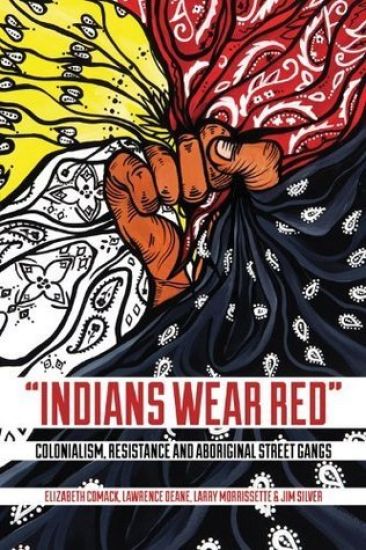
Indians Wear Red

Indians Wear Red

Elizabeth Comack; Lawrence Deane; Larry Morrissette; Jim Silver

Fernwood Publishing Co Ltd
2013
nidottu
With the advent of Aboriginal street gangs such as Indian Posse, Manitoba Warriors, and Native Syndicate, Winnipeg garnered a reputation as the “gang capital of Canada.” Yet beyond the stereotypes of outsiders, little is known about these street gangs and the factors and conditions that have produced them. “Indians Wear Red” locates Aboriginal street gangs in the context of the racialized poverty that has become entrenched in the colonized space of Winnipeg’s North End. Drawing upon extensive interviews with Aboriginal street gang members as well as with Aboriginal women and elders, the authors develop an understanding from “inside” the inner city and through the voices of Aboriginal people – especially street gang members themselves.While economic restructuring and neo-liberal state responses can account for the global proliferation of street gangs, the authors argue that colonialism is a crucial factor in the Canadian context, particularly in western Canadian urban centres. Young Aboriginal people have resisted their social and economic exclusion by acting collectively as “Indians.” But just as colonialism is destructive, so too are street gang activities, including the illegal trade in drugs. Solutions lie not in “quick fixes” or “getting tough on crime” but in decolonization: re-connecting Aboriginal people with their cultures and building communities in which they can safely live and work.
Racialized Policing

Racialized Policing

Elizabeth Comack

Fernwood Publishing Co Ltd
2012
nidottu
Policing is a controversial subject, generating considerable debate. One issue of concern has been "racial profiling" by police, that is, the alleged practice of targeting individuals and groups on the basis of "race." Racialized Policing argues that the debate has been limited by its individualized frame. As well, the concen- tration on police relations with people of colour means that Aboriginal people's encounters with police receive far less scrutiny. Going beyond the interpersonal level and broadening our gaze to explore how race and racism play out in institutional practices and systemic processes, this book exposes the ways in which policing is racialized.Situating the police in their role as "reproducers of order," Elizabeth Comack draws on the historical record and contemporary cases of Aboriginal-police relations - the shooting of J.J. Harper by a Winnipeg police officer in 1988, the "Starlight Tours" in Saskatoon, and the shooting of Matthew Dumas by a Winnipeg police officer in 2005 - as well as interviews conducted with Aboriginal people in Winnipeg's inner-city communities to explore how race and racism inform the routine practices of police officers and define the cultural frames of reference that officers adopt in their encounters with Aboriginal people. In short, having defined Aboriginal people as "troublesome," police respond with troublesome practices of their own. Arguing that resolution requires a fundamental transformation in the structure and organization of policing, Racialized Policing makes suggestions for re-framing the role of police and the "order" they reproduce.
Out There/In Here

Out There/In Here

Elizabeth Comack

Fernwood Publishing Co Ltd
2008
nidottu
Moving between the spaces of the outside community and prison-"out there" and "in here"-this study explores the complicated connections between masculinity and violence in the lives of men incarcerated at a provincial prison. The discussion traces the men`s lives and highlights their understanding of their own violence, while looking at the ways in which prison perpetuates the violence inherent in dominant masculinity. By revealing the voices of the jailed men, this analysis is able to show that prison is a gendered space that is not a solution to the public`s concerns about crime and violence. Rather, it is a place in which masculine pressures encourage marginalized men to take part in aggression, dominance, and the exercise of brute power as legitimate social practices.
The Power to Criminalize

The Power to Criminalize

Elizabeth Comack; Gillian Balfour

Fernwood Publishing Co Ltd
2004
nidottu
The tension between traditionalist legal theories that maintain that the law dispenses justice in an impartial fashion and critical theories that maintain that the law reproduces gender, race, and class inequalities provides a context for this investigation into law`s complicity in perpetuating disparities. Police reports, prosecuting lawyer reports, memos, interviews with defense lawyers, sentencing reports, and other primary sources from Canadian violent crime cases illustrate the prejudicial strategies used in litigation. Linguistic nuances that describe a neighborhood celebration as a "birthday party" or a "drinking binge" are among the ways stereotypes are perpetuated. This analysis raises questions about how the law can be applied to realize a more just society.
Women in Trouble

Women in Trouble

Elizabeth Comack

Fernwood Publishing Co Ltd
1996
nidottu
This book addresses two areas of feminist scholarship?the recognition of violence against women and the endeavor to make visible the lives of women in prison. Beginning with personal accounts of trouble with the law and using a combination of socialist and standpoint feminism, the collection presents the stories of 24 incarcerated women.