

Kirjailija
Elizabeth Evans
Kirjat ja teokset yhdessä paikassa: 24 kirjaa, julkaisuja vuosilta 2000-2026, suosituimpien joukossa Sanakhou. Vertaile teosten hintoja ja tarkista saatavuus suomalaisista kirjakaupoista.
24 kirjaa
Kirjojen julkaisuhaarukka 2000-2026.

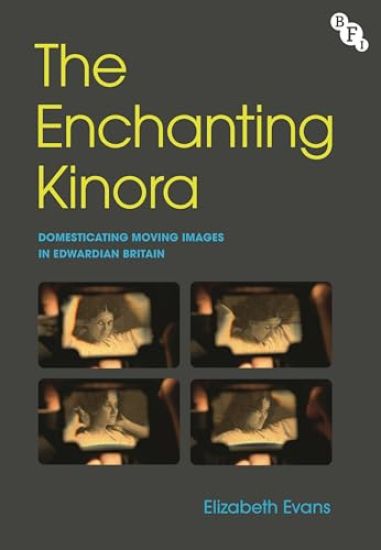
Marketed as more affordable and safer than film cameras, the Kinora system, launched in 1903, was one of the first amateur filmmaking devices and represents one of the earliest attempts to create a domestic market for moving images. In The Enchanting Kinora, Elizabeth Evans examines the Kinora in its technological, industrial and socio-cultural context to explore how early attempts to domesticate moving images were configured. She closely analyses 84 previously unexamined Kinora reels, filmed using the early motion picture device between 1908-1913 and held by the Smedley Collection. These include 23 reels that were produced for public consumption and others that were meant solely for private viewing by the Smedley family. She goes on to consider the reels as material objects, examining not only their content, but also how the collection was preserved and catalogued by members of the family. Finally, she reflects on her own connection to the reels as the Smedleys’ great-granddaughter. In doing so, Evans expands our understanding of moving images’ emergence as part of a wider network of cultural practices in Edwardian Britain that featured within domestic as well as public and professional spaces.
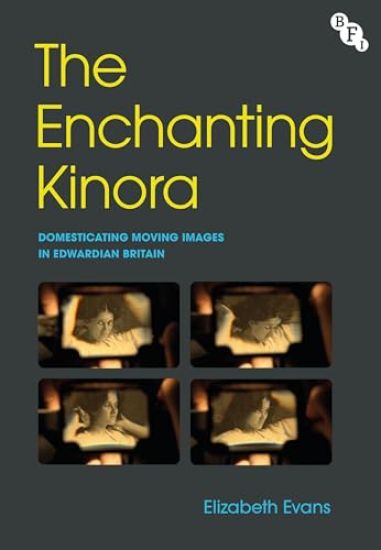
Marketed as more affordable and safer than film cameras, the Kinora system, launched in 1903, was one of the first amateur filmmaking devices and represents one of the earliest attempts to create a domestic market for moving images. In The Enchanting Kinora, Elizabeth Evans examines the Kinora in its technological, industrial and socio-cultural context to explore how early attempts to domesticate moving images were configured. She closely analyses 84 previously unexamined Kinora reels, filmed using the early motion picture device between 1908-1913 and held by the Smedley Collection. These include 23 reels that were produced for public consumption and others that were meant solely for private viewing by the Smedley family. She goes on to consider the reels as material objects, examining not only their content, but also how the collection was preserved and catalogued by members of the family. Finally, she reflects on her own connection to the reels as the Smedleys’ great-granddaughter.In doing so, Evans expands our understanding of moving images’ emergence as part of a wider network of cultural practices in Edwardian Britain that featured within domestic as well as public and professional spaces.
Disability and Political Representation
Elizabeth Evans; Stefanie Reher
Oxford University Press
2024
sidottu
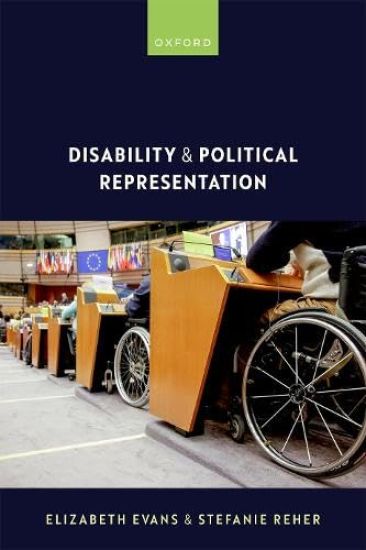
Disability and Political Representation explores how disabled people experience the various stages and aspects of the representation process, drawing upon extensive empirical research and a variety of qualitative and quantitative data. It discusses why increasing the number of disabled politicians matters, not only as a matter of justice and equality but also to better represent the issues and interests of importance to disabled people. Evans and Reher identify a variety of ableist barriers prevent disabled people from fully participating in the political process, from disenfranchisement and inaccessible polling stations to prejudice within parties and a lack of financial support for candidates who require adjustments. The work shows that while the preferences of disabled citizens are currently under-represented in parliament, disabled representatives often draw on their lived experience to advocate for their interests. The concept of experiential representation is developed to help scholars and practitioners better navigate the concept of political representation, specifically as it relates to disability. Thus, the book explores how disability can help us think about the contours of political representation. It presents and analyses a range of diverse and original data, including qualitative data generated from interviews with disabled politicians and activists in the UK, quantitative survey data on the political attitudes and participation of disabled citizens from across Europe, and data from survey experiments examining voter perceptions of disabled politicians in the UK and the US.
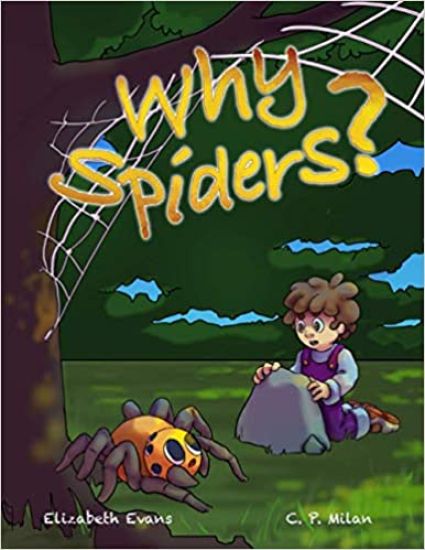
A metaphor for many things in our lives, "Why Spiders?" is a comic tale of two characters living under the same roof - a child, and a spider. The child starts by questioning its fear, and approaching the spider directly, but makes a snap decision to simply give up and remove the spider from its life altogether. Was this a good approach for resolving the situation? Find out in this fun, rhythmical rhyming story. The common fear of spiders was used to promote conversations between adults and children. Unlock their concerns and let them speak out. Some areas to consider; What am I scared of? Why am I scared? Is it a fear with a genuine threat to me, or is it something I can overcome? Is there something I can learn from my object of fear? Can I find a way to tolerate/understand/appreciate my object of fear? Can we find compromise, and support for one another? Can I completely change my perspective and learn to embrace the differences between us? Tolerance, compromise, learning, questioning, having the strength to confront fears; it's a point to consider for children of all ages and beyond. "Why Spiders?" helps us to reflect on our actions, our thoughts, our fears, and can allow us to embrace the differences in our societies. What are you afraid of? "Why Spiders?"
This book offers a new, interdisciplinary model for understanding audience engagement as a type of behaviour, a form of response and a cost to audiences that, combined, offer value to the screen industries.Audience ‘engagement’ has become the key priority of the screen industries. Understanding Engagement in Transmedia Culture explicitly asks what audiences and screen practitioners mean when they say content is ‘engaging’ and uses audience focus groups and practitioner interviews to offer a model for understanding the relationship between the screen industry, the content it produces and its audiences. In particular, the model addresses engagement within transmedia culture. As digital screen technologies proliferate, audiences move seamlessly across and between different devices, content formats and distribution platforms, blurring the boundaries between film, television and videogames. This book offers a way of understanding audience engagement that is not restricted to a single media but instead accounts for and adapts to the various ways in which screen content is experienced.Offering a unique approach by presenting practitioner and audience perspectives, it is perfect for students and scholars working in film and television studies, as well as media industries and audience studies.
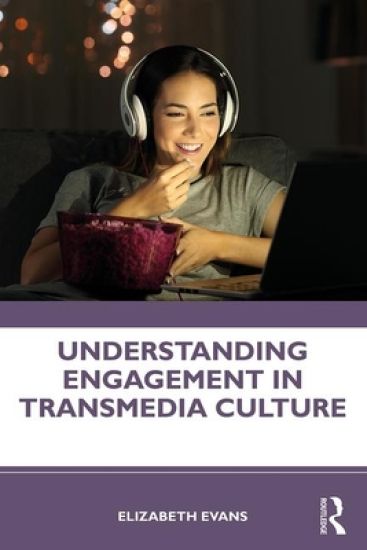
This book offers a new, interdisciplinary model for understanding audience engagement as a type of behaviour, a form of response and a cost to audiences that, combined, offer value to the screen industries.Audience ‘engagement’ has become the key priority of the screen industries. Understanding Engagement in Transmedia Culture explicitly asks what audiences and screen practitioners mean when they say content is ‘engaging’ and uses audience focus groups and practitioner interviews to offer a model for understanding the relationship between the screen industry, the content it produces and its audiences. In particular, the model addresses engagement within transmedia culture. As digital screen technologies proliferate, audiences move seamlessly across and between different devices, content formats and distribution platforms, blurring the boundaries between film, television and videogames. This book offers a way of understanding audience engagement that is not restricted to a single media but instead accounts for and adapts to the various ways in which screen content is experienced.Offering a unique approach by presenting practitioner and audience perspectives, it is perfect for students and scholars working in film and television studies, as well as media industries and audience studies.


This is the story and the events behind a young teenage girl who dates a guy that she thinks is the love of her life. As the story unravels the reader watches how the guy she thought was the love her life becomes her nemesis. The trials and tribulations of a young woman going through domestic violence, the triumphs in her life, the defeats, and the survival after the trauma was over.
You will spend on average six years of your life dreaming. This is more than a simple mental process. It is clear from the Bible that dreams and visions are important ways in which God chooses to speak to people. This book teaches you how to understand the language of dreams and visions so that you can hear what God is saying to you at night, and during your prayer times. Love has a Voice and He wants to speak to His modern-day people. Everybody dreams, and there is great interest in dreams. Interpreting dreams for non-Christian people can help them to receive God.

Greater Than a Tourist - Atlanta Georgia USA
Greater Than a Tourist; Elizabeth Evans
Independently Published
2017
pokkari
Are you excited about planning your next trip?Do you want to try something new?Would you like some guidance from a local?If you answered yes to any of these questions, then this Greater Than a Tourist book is for you.Greater Than A Tourist by Elizabeth Evans offers the inside scoop on Atlanta Georgia. Most travel books tell you how to travel like a tourist. Although there is nothing wrong with that, as part of the Greater Than a Tourist series, this book will give you travel tips from someone who has lived at your next travel destination.In these pages you'll discover advice that will help you throughout your stay. This book will not tell you exact addresses or store hours but instead will give you excitement and knowledge from a local that you may not find in other smaller print travel books.Travel like a local. Low down, stay in one place, and get to know the people and the culture. By the time you finish this book, you will be eager and prepared to travel to your next destination.

At the high-octane Iowa Writers’ Workshop, small-town Charlotte is thrilled and confounded by her relationship with charismatic and sophisticated Esmé: One moment, Esmé appears to be Charlotte’s most intimate friend; the next, her rival. After a tumultuous weekend, Charlotte’s insecurities and her resentment toward Esmé reach a fever pitch. Blindly, Charlotte strikes out--in an act of betrayal that ultimately unleashes a cascade of calamities on her own head.Twenty years later, Charlotte is a successful novelist. A much-changed Esmé appears, bringing the past that Charlotte grieved over, and believed buried, to the doorstep of Charlotte and her beloved husband. Charlotte finds herself both frightened and charmed. Though she yearns to redeem the old friendship and her transgression, she is wary--and rightly so.As Good As Dead performs an exquisitely tuned psychological high-wire act as it explores the dangers that lie in wait when trust is poisoned by secrets and fears.

Wanderings: Cape Henlopen 2012
Maria Masington; Elizabeth Evans; Phil Linz
Createspace Independent Publishing Platform
2013
nidottu

The early years of the twenty-first century have seen dramatic changes within the television industry. The development of the internet and mobile phone as platforms for content directly linked to television programming has offered a challenge to the television set’s status as the sole domestic access point to audio-visual dramatic content. Viewers can engage with ‘television’ without ever turning a television set on.Whilst there has already been some exploration of these changes, little attention has been paid to the audience and the extent to which these technologies are being integrated into their daily lives. Focusing on a particular period of rapid change and using case studies including Spooks, 24 and Doctor Who, Transmedia Television considers how the television industry has exploited emergent technologies and the extent to which audiences have embraced them. How has television content been transformed by shifts towards multiplatform strategies? What is the appeal of using game formats to lose oneself within a narrative world? How can television, with its ever larger screens and association with domesticity, be reconciled with the small portable, public technology of the mobile phone? What does the shift from television schedules to online downloading mean for our understanding of ‘the television audience’? Transmedia Television will consider how the relationship between television and daily life has been altered as a result of the industry’s development of emerging new media technologies, and what ‘television’ now means for its audiences.

Determined Hope: Living Proof of How Love Creates HOPE Where There is None
Elizabeth Evans; David Evans
Living Grace Press
2013
nidottu
Women and the Liberal Democrats is a timely and original exploration of women's representation and the third party in UK politics. Based on extensive research, it is the first comprehensive gendered analysis of the Liberal Democrats and the research highlights specific institutional factors within the Liberal Democrats that directly impact upon the party's low number of women MPs. It explores the extent to which the party's ideology, culture and organisation are dominated by a prevailing masculine bias and questions why the Liberal Democrats continue to overwhelmingly return white, middle-aged, male MPs to Westminster.The book highlights a number of important findings: the Liberal Democrats' low number of women MPs is due to demand rather than supply; the party have not selected a sufficient number of women in winnable or target seats; the lack of women MPs undermines the party's pro-women policies; and women's interests have not been mainstreamed within the party. Together, these conclusions address substantive questions regarding the Liberal Democrats' numerical under-representation of women MPs and the extent to which they can act for and symbolically represent women.The book demonstrates the importance of using gender as a tool for analysing the culture, organisation and political recruitment of British political parties. Its originality and contribution lie in the empirical findings and its ability to address wider conceptual debates.
The early years of the twenty-first century have seen dramatic changes within the television industry. The development of the internet and mobile phone as platforms for content directly linked to television programming has offered a challenge to the television set’s status as the sole domestic access point to audio-visual dramatic content. Viewers can engage with ‘television’ without ever turning a television set on.Whilst there has already been some exploration of these changes, little attention has been paid to the audience and the extent to which these technologies are being integrated into their daily lives. Focusing on a particular period of rapid change and using case studies including Spooks, 24 and Doctor Who, Transmedia Television considers how the television industry has exploited emergent technologies and the extent to which audiences have embraced them. How has television content been transformed by shifts towards multiplatform strategies? What is the appeal of using game formats to lose oneself within a narrative world? How can television, with its ever larger screens and association with domesticity, be reconciled with the small portable, public technology of the mobile phone? What does the shift from television schedules to online downloading mean for our understanding of ‘the television audience’? Transmedia Television will consider how the relationship between television and daily life has been altered as a result of the industry’s development of emerging new media technologies, and what ‘television’ now means for its audiences.