Kirjojen hintavertailu. Mukana 12 390 323 kirjaa ja 12 kauppaa.

Kirjailija

Elizabeth Rata

Kirjat ja teokset yhdessä paikassa: 6 kirjaa, julkaisuja vuosilta 2000-2025, suosituimpien joukossa Developing Curriculum for Deep Thinking. Vertaile teosten hintoja ja tarkista saatavuus suomalaisista kirjakaupoista.

6 kirjaa

Kirjojen julkaisuhaarukka 2000-2025.

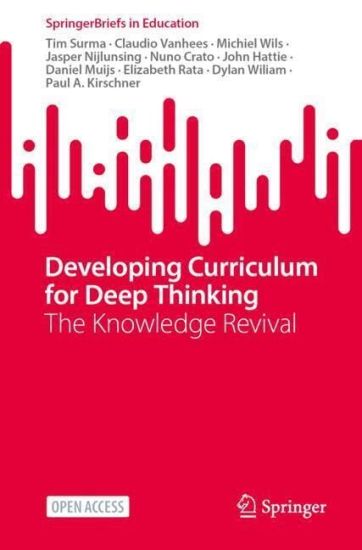
Developing Curriculum for Deep Thinking

Developing Curriculum for Deep Thinking

Tim Surma; Claudio Vanhees; Michiel Wils; Jasper Nijlunsing; Nuno Crato; John Hattie; Daniel Muijs; Elizabeth Rata; Dylan Wiliam; Paul A. Kirschner

Springer International Publishing AG
2025
nidottu
This open access book discusses why the seemingly straightforward strategy of teaching children how to think deeply does not work and offers an alternative way forward for the curriculum to achieve these objectives. Over the years, the role of knowledge in the curriculum has, like a pendulum, shifted between two extremes, from highly visible to virtually invisible knowledge elements. Insights from cognitive and educational psychology, sociology, and curriculum studies are used to underpin the current knowledge revival that is widely being observed in education. A knowledge-rich curriculum is proposed by the authors as not only the soundest way forward to both effectively acquire knowledge and complex cognitive skills in school, but also as a crucial lever to achieve equitable opportunities for all students. In understanding how a knowledge-rich curriculum can enhance learning, three overarching principles are discussed: (1) content-richness, (2) coherence, and (3) clarity. These principles are illustrated through practical examples from schools and educators who have effectively integrated knowledge-rich curricula.
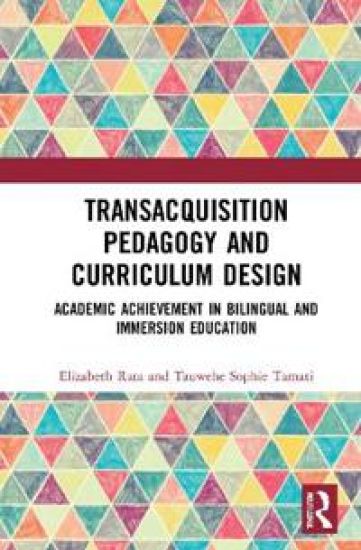
Academic Achievement in Bilingual and Immersion Education

Academic Achievement in Bilingual and Immersion Education

Elizabeth Rata; Tauwehe Sophie Tamati

TAYLOR FRANCIS LTD
2024
nidottu
This book is about two innovative methods for teachers of bilingual students to use in improving their academic achievement. Transacquisition Pedagogy or TAP developed by Tauwehe Sophie Tamati is the method described in the book’s first part. It uses principles of flexible bilingualism and a task sequenced approach. The success of TAP in an intervention study in two of New Zealand’s Maori schools illustrates how cognitive and linguistic processes can be used to increase student conceptual understanding and to improve their academic biliteracy. Part two is about the Curriculum Design Coherence Model (CDC Model) created by Elizabeth Rata. It shows teachers how to design concepts, content and competencies to connect academic knowledge and thinking processes. The CDC Model has proved its success in the Knowledge-Rich School Project in New Zealand and England. TransAcquistion Pedagogy and the CDC Model are aligned. TAP works by putting the CDC design method into practice. The separate usefulness of TAP and the CDC Model and the added value of their alignment provides an innovative approach to education. Used together or separately they provide invaluable teaching methods for bilingual, immersion and mainstream education.
Academic Achievement in Bilingual and Immersion Education

Academic Achievement in Bilingual and Immersion Education

Elizabeth Rata; Tauwehe Sophie Tamati

TAYLOR FRANCIS LTD
2021
sidottu
This book is about two innovative methods for teachers of bilingual students to use in improving their academic achievement. Transacquisition Pedagogy or TAP developed by Tauwehe Sophie Tamati is the method described in the book’s first part. It uses principles of flexible bilingualism and a task sequenced approach. The success of TAP in an intervention study in two of New Zealand’s Maori schools illustrates how cognitive and linguistic processes can be used to increase student conceptual understanding and to improve their academic biliteracy. Part two is about the Curriculum Design Coherence Model (CDC Model) created by Elizabeth Rata. It shows teachers how to design concepts, content and competencies to connect academic knowledge and thinking processes. The CDC Model has proved its success in the Knowledge-Rich School Project in New Zealand and England. TransAcquistion Pedagogy and the CDC Model are aligned. TAP works by putting the CDC design method into practice. The separate usefulness of TAP and the CDC Model and the added value of their alignment provides an innovative approach to education. Used together or separately they provide invaluable teaching methods for bilingual, immersion and mainstream education.
The Politics of Knowledge in Education
This book explores the decline of the teaching of epistemic, conceptual knowledge in schools, its replacement with everyday social knowledge, and its relation to changes in the division of labor within the global economy. It argues that the emphasis on social knowledge in postmodern and social constructionist pedagogy compounds the problem, and examines the consequences of these changes for educational opportunity and democracy itself.
The Politics of Knowledge in Education
This book explores the decline of the teaching of epistemic, conceptual knowledge in schools, its replacement with everyday social knowledge, and its relation to changes in the division of labor within the global economy. It argues that the emphasis on social knowledge in postmodern and social constructionist pedagogy compounds the problem, and examines the consequences of these changes for educational opportunity and democracy itself.
A Political Economy of Neotribal Capitalism

A Political Economy of Neotribal Capitalism

Elizabeth Rata

Lexington Books
2000
sidottu
Among the unintended and largely unforeseen consequences of globalization are the fundamental transformations of local relationships, both economic and cultural, that occur within communities drawn into the predominantly capitalist world economy. Democracy, once considered the essential political mode of regulation for successful capitalist economies, is being replaced by nondemocratic modes of social organization as localized responses to global forces, such as Maori tribalization in New Zealand, are subverted and transformed. A Political Economy of Neotribal Capitalism looks at the past three decades in New Zealand and the shifts in the relationship between the indigenous Maori people and the dominant Pakeha (white) society to illustrate these fundamental changes to national political, social, and economic structures. The book includes a case study of a Maori family, a theoretical exploration of the concept of "neotribal capitalism," and discussions of themes such as changing socioeconomic relations; new social movements; the indigenization of ethnicity; dominant group-ethnic group realignment; and the antidemocratic ideologies of late capitalism—themes of interest to students of world political economics, international relations, and anthropology.