Kirjojen hintavertailu. Mukana 12 595 353 kirjaa ja 12 kauppaa.

Kirjailija

Ellen Winner

Kirjat ja teokset yhdessä paikassa: 16 kirjaa, julkaisuja vuosilta 1985-2024, suosituimpien joukossa Ein (inzwischen) unbequemer Gast in der Schule. Vertaile teosten hintoja ja tarkista saatavuus suomalaisista kirjakaupoista.

16 kirjaa

Kirjojen julkaisuhaarukka 1985-2024.

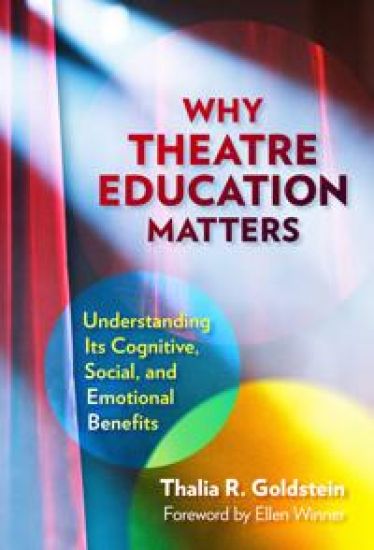
Why Theatre Education Matters

Why Theatre Education Matters

Thalia R. Goldstein; Ellen Winner

TEACHERS' COLLEGE PRESS
2024
sidottu
Discover the cognitive, social, emotional, and other psychological benefits of learning how to act and perform. This book looks behind the curtain of theatre education to see how thinking on stage happens in real secondary classrooms. Reporting on the first large scale systematic qualitative analyses of acting classes for adolescents, the author introduces the eight Acting Habits of Mind--thinking strategies to solve problems and creatively complete tasks. Each Habit is tied to current scientific research findings for related psychological constructs, including creativity, self-esteem, empathy, emotion regulation, and well-being. Connections are then made to individual student needs, future research, and the complexity of theatre education. Based in the science of development and actual theatre education in a variety of setting and with a diversity of students, this book provides an answer to the question, "What, psychologically, is an acting class?" Every educator, administrator, and arts lover can use this book to not only better understand and advocate for their art forms, but also to demonstrate why theatre should be included in schools.Book Features:A go-to text for any theatre educator challenged to justify the teaching of acting in schools--uses systematic empirical evidence to show the psychological foundations of acting classes and how students learn to think on stage.A reference text for graduate study--discusses the cognitive, emotional, and behavioral techniques underlying acting exercises and moments in teaching.A summary of current knowledge in the transfer effects of theatre--offers a full exploration of the psychological underpinnings of acting classrooms across contexts, student type, and community.Exercises and techniques from acting classes across a variety of contexts--showing how they are tied to research-based psychosocial constructs, skills, and abilities.A foundation from which future tests of the effects of theatre education can be built--includes studies relevant to constructing policy and practice of arts education and developing interventions that use techniques and theories from theatre education.
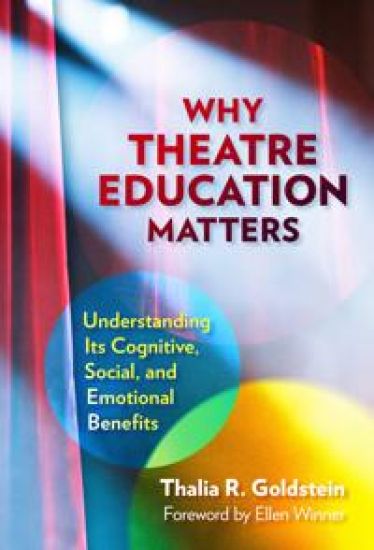
Why Theatre Education Matters

Why Theatre Education Matters

Thalia R. Goldstein; Ellen Winner

TEACHERS' COLLEGE PRESS
2024
nidottu
Discover the cognitive, social, emotional, and other psychological benefits of learning how to act and perform. This book looks behind the curtain of theatre education to see how thinking on stage happens in real secondary classrooms. Reporting on the first large scale systematic qualitative analyses of acting classes for adolescents, the author introduces the eight Acting Habits of Mind--thinking strategies to solve problems and creatively complete tasks. Each Habit is tied to current scientific research findings for related psychological constructs, including creativity, self-esteem, empathy, emotion regulation, and well-being. Connections are then made to individual student needs, future research, and the complexity of theatre education. Based in the science of development and actual theatre education in a variety of setting and with a diversity of students, this book provides an answer to the question, "What, psychologically, is an acting class?" Every educator, administrator, and arts lover can use this book to not only better understand and advocate for their art forms, but also to demonstrate why theatre should be included in schools.Book Features:A go-to text for any theatre educator challenged to justify the teaching of acting in schools--uses systematic empirical evidence to show the psychological foundations of acting classes and how students learn to think on stage.A reference text for graduate study--discusses the cognitive, emotional, and behavioral techniques underlying acting exercises and moments in teaching.A summary of current knowledge in the transfer effects of theatre--offers a full exploration of the psychological underpinnings of acting classrooms across contexts, student type, and community.Exercises and techniques from acting classes across a variety of contexts--showing how they are tied to research-based psychosocial constructs, skills, and abilities.A foundation from which future tests of the effects of theatre education can be built--includes studies relevant to constructing policy and practice of arts education and developing interventions that use techniques and theories from theatre education.

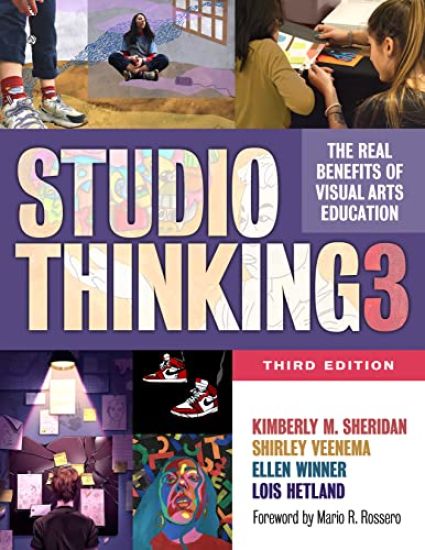
Studio Thinking 3

Studio Thinking 3

Kimberly M. Sheridan; Shirley Veenema; Ellen Winner; Lois Hetland; Mario R. Rossero

TEACHERS' COLLEGE PRESS
2022
sidottu
Studio Thinking 3 is a new edition of a now-classic text, a research-based account of teaching and learning in high school studio arts classes. It poses a framework that identifies eight habits of mind taught in visual arts and four studio structures by which they are taught. This edition includes new material about how the framework has been used since the original study, with new perspectives from artist-teachers who currently apply the Studio Thinking Framework in their own practice. It also reviews how contemporary organizations, educators, and researchers outside the arts have utilized the framework, highlighting its flexibility to inform teaching and learning. The authors have added a new chapter on assessment to introduce the practical and thoughtful ways that teachers are using Studio Thinking to assess and evaluate students' work, working processes, and thinking in the arts.The first edition of this bestseller was featured in The New York Times and The Boston Globe for its groundbreaking research on the positive effects of art education on student learning across the curriculum. Studio Thinking 3 will help advocates explain arts education to policymakers, support art teachers in developing and refining their teaching and assessment practices, and assist educators in other disciplines to learn from existing practices in arts education.Book Features:An explanation of "art as thinking" that unpacks and clarifies how teaching art is the process of teaching thinking.An account of what Studio Thinking looks like in diverse contemporary settings.Models of studio arts instruction that illuminate what educators are doing to support students' learning in the arts and why they are doing it that way. A new chapter with rich examples of approaches to assessment.New analyses on how studio art teachers support learner agency. Updated examples from practice showing how artist-teachers are using the Studio Thinking Framework.Full-color images with examples of student art.
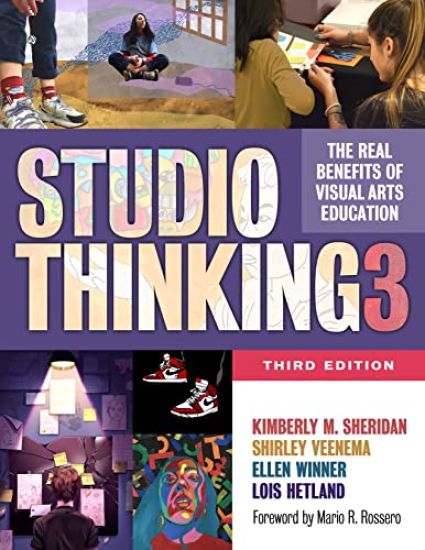
Studio Thinking 3

Studio Thinking 3

Kimberly M. Sheridan; Shirley Veenema; Ellen Winner; Lois Hetland; Mario R. Rossero

TEACHERS' COLLEGE PRESS
2022
nidottu
Studio Thinking 3 is a new edition of a now-classic text, a research-based account of teaching and learning in high school studio arts classes. It poses a framework that identifies eight habits of mind taught in visual arts and four studio structures by which they are taught. This edition includes new material about how the framework has been used since the original study, with new perspectives from artist-teachers who currently apply the Studio Thinking Framework in their own practice. It also reviews how contemporary organizations, educators, and researchers outside the arts have utilized the framework, highlighting its flexibility to inform teaching and learning. The authors have added a new chapter on assessment to introduce the practical and thoughtful ways that teachers are using Studio Thinking to assess and evaluate students' work, working processes, and thinking in the arts.The first edition of this bestseller was featured in The New York Times and The Boston Globe for its groundbreaking research on the positive effects of art education on student learning across the curriculum. Studio Thinking 3 will help advocates explain arts education to policymakers, support art teachers in developing and refining their teaching and assessment practices, and assist educators in other disciplines to learn from existing practices in arts education.Book Features:An explanation of "art as thinking" that unpacks and clarifies how teaching art is the process of teaching thinking.An account of what Studio Thinking looks like in diverse contemporary settings.Models of studio arts instruction that illuminate what educators are doing to support students' learning in the arts and why they are doing it that way. A new chapter with rich examples of approaches to assessment.New analyses on how studio art teachers support learner agency. Updated examples from practice showing how artist-teachers are using the Studio Thinking Framework.Full-color images with examples of student art.
The Child as Visual Artist

The Child as Visual Artist

Ellen Winner; Jennifer E. Drake

Cambridge University Press
2022
pokkari
This Element focuses on the development of drawing (and painting) in childhood. The author begins by examining children's representational drawing, a topic that has received quite wide attention from the nineteenth century on. The author then turns to issues that have received far less attention and discusses the aesthetic property of expression, weighing the claim that young children's highly expressive drawings bear an affinity to twentieth century modernist art. The author then examines the function of drawing for children's emotional development. Next, looking at art prodigies, the author turns to the how of drawing, considering the relation of drawing talent to IQ and to visual-spatial skills. Finally, the author considers the relation between development and education in art and how educators can best nurture children's artistic development.
An Uneasy Guest in the Schoolhouse

An Uneasy Guest in the Schoolhouse

Ellen Winner

OXFORD UNIVERSITY PRESS INC
2022
sidottu
An Uneasy Guest in the Schoolhouse recounts how art education has been conceptualized, taught, and advocated for in the United States in the face of its persistent marginalization in the education system. Tracing various rationales offered from the 19th century onward, Winner argues that art education has failed to be justified as a good in and of itself--and this failure has affected both the status of visual art education in our schools and the quality of its teaching. Winner's comprehensive book maps recurrent pendulum swings between "traditional" and "progressive" approaches to art education in the United States, supplemented by her firsthand experiences observing art teaching in schools in China and Italy. Despite this problematic and uncertain past, 21st century art education in the United States and abroad has exploded with a wealth of new ideas aligned with the progressivism of the early 20th century and informed by the practices of contemporary art. As Winner details, an understanding of the history of art education, along with a focus on current challenges and opportunities, is essential for arts researchers, educators, and advocates, as well as anyone in the general public who cares about quality education in the 21st century.
How Art Works

How Art Works

Ellen Winner

Oxford University Press Inc
2018
sidottu
There is no end of talk and of wondering about 'art' and 'the arts.' This book examines a number of questions about the arts (broadly defined to include all of the arts). Some of these questions come from philosophy. Examples include: · What makes something art? · Can anything be art? · Do we experience "real" emotions from the arts? · Why do we seek out and even cherish sorrow and fear from art when we go out of our way to avoid these very emotions in real life? · How do we decide what is good art? Do aesthetic judgments have any objective truth value? · Why do we devalue fakes even if we -- indeed, even the experts--- can't tell them apart from originals? · Does fiction enhance our empathy and understanding of others? Is art-making therapeutic? Others are "common sense" questions that laypersons wonder about. Examples include: · Does learning to play music raise a child's IQ? · Is modern art something my kid could do? · Is talent a matter of nature or nurture? This book examines puzzles about the arts wherever their provenance - as long as there is empirical research using the methods of social science (interviews, experimentation, data collection, statistical analysis) that can shed light on these questions. The examined research reveals how ordinary people think about these questions, and why they think the way they do - an inquiry referred to as intuitive aesthetics. The book shows how psychological research on the arts has shed light on and often offered surprising answers to such questions.
Studio Thinking from the Start

Studio Thinking from the Start

Jillian Hogan; Lois Hetland; Diane B. Jacquith; Ellen Winner

Teachers' College Press
2018
nidottu
Students of all ages can learn to think like artists! Studio Thinking: The Real Benefits of Visual Arts Education changed the conversation about quality arts education. Now, a decade later, this new publication shows how the eight Studio Habits of Mind and four Studio Structures can be used successfully with younger students in a range of socioeconomic contexts and school environments.Book Features:Habit-by-habit definitions, classroom examples, and related visual artist exemplars emphasizing contemporary artists.Full color mini-posters teachers can hang in their classrooms to illustrate each of the eight Studio Habits of Mind.Sample templates for students to use as they plan, reflect upon, and talk about works of art.Innovative approaches to assessment and strategies for implementation.Photos throughout the book of Studio Thinking signage and activities, students making art, and student artworks.Suggestions for using Studio Thinking for arts education advocacy.COMPANION VOLUME? Studio Thinking 2: The Real Benefits of Visual Arts Education, Second Edition, Lois Hetland, Ellen Winner, Shirley Veenema, and Kimberly M. Sheridan.
World Shaman

World Shaman

Mohan Rai; Ellen Winner

Createspace Independent Publishing Platform
2013
pokkari
Supporting three wives, twelve children, and assorted relatives, Mohan Rai is a thoroughly modern man, convinced he's escaped an outmoded duty to follow his father as shaman to his Bhutanese village. But the gods and spirits, ancient protectors of the tribe, have other ideas.Dishonored and vengeful, they enter his dreams and haunt his days, destroying his business, his health, his sanity, and finally, his freedom.Based on Mohan's letters from prison, this true account by his first Western initiate will transform your worldview."Ellen's retelling of Mohan Rai's first-hand account of his shamanic apprenticeship in Bhutan is a valuable contribution to the preservation of this ancient knowledge." -- Michael Harner, Ph.D., author, The Way of the Shaman, and Founder, Foundation for Shamanic Studies."I was fascinated. Like Autobiography of a Yogi, Mohan Rai's story shares much wisdom. Portraying his training from childhood in the ancient, mystical traditions of the shaman, this book brings a hopeful vision I will carry into my everyday life forever...a reminder of the mysteries that sustain our lives and how little we know." -- Hal Zina Bennett, Ph.D., author, Spirit Animals and the Wheel of Life; Earth-Centered Practices for Everyday Living.Ellen Winner is an initiate into the Himalayan Rai and Tamang shamanic traditions, a Foundation for Shamanic Studies Three-year graduate, and a Harner Method certified shamanic counselor. At her day job she is a patent attorney. She lives with her husband, Joe O'Laughlin, in Boulder, Colorado.
Gifted Children

Gifted Children

Ellen Winner

Basic Books
1997
pokkari
In this fascinating book, Ellen Winner uncovers and explores nine myths about giftedness, and shows us what gifted children are really like.Using vivid case studies, Winner paints a complex picture of the gifted child. Here we meet David, a three-year-old who learned to read in two weeks KyLee, a five-year-old who mastered on his own all of the math concepts expected by the end of elementary school and Nadia, an autistic and retarded savant" who nevertheless could draw like a Renaissance master.Winner uses her research with these and several other extraordinary children, as well as the latest biological and psychological evidence, to debunk the many myths about academic, musical, and artistic giftedness. Gifted Children also looks at the role played by schools in fostering exceptional abilities. Winner castigates schools for wasting resources on weak educational programs for the moderately gifted. Instead, she advocates elevating standards for all children, and focusing our resources for gifted education on those with extreme abilities,children who are left untouched by the kinds of minimal programs we have today.
The Point of Words

The Point of Words

Ellen Winner

Harvard University Press
1997
nidottu
A small child looks at a dripping faucet and says that it is drooling." Another calls a centipede a "comb." An older child notices the mess in his younger brother's room and says, "Wow, it sure is neat in here." Children's spontaneous speech is rich in such creative, nonliteral discourse. How do children's abilities to use and interpret figurative language change as they grow older? What does such language show us about the changing features of children's minds?In this absorbing book, psychologist Ellen Winner examines the development of the child's ability to use and understand metaphor and irony. These, she argues, are the two major forms of figurative language and are, moreover, complementary. Metaphor, which describes and sometimes explains, highlights attributes of a topic. As such, it serves primarily a cognitive function. Irony highlights the speaker's attitude toward the subject arid presupposes an appreciation of that attitude by the listener. In contrast to metaphor, irony serves primarily a social function. Winner looks in detail at the ways these forms of language differ structurally and at the cognitive and social capacities required for each.The book not only draws on the author's own empirical studies but also offers a valuable synthesis of research in the area: it is the first account that spans the realm of figurative language. Winner writes clearly and engagingly and enlivens her account with many vivid examples from children's speech. The book will appeal to developmental psychologists, educators, psychologists of language, early-language specialists, students of literature, indeed, anyone who is delighted by the fanciful utterances of young children.
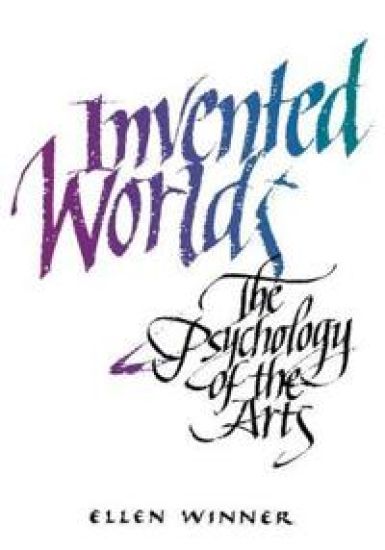
Invented Worlds

Invented Worlds

Ellen Winner

Harvard University Press
1985
nidottu
Cave paintings of our prehistoric ancestors, elaborate ritual dances of preliterate tribesmen, long lines at the movies, earnest scribbles of the three-year-old next door—evidence of human preoccupation with art is everywhere, and it is overwhelming. But unlike other human universals—language, tool use, the family—art makes no material contribution to mankind’s survival. What impels the artist to the lonely effort at self-expression? What moves the audience to resonate to the work of a master? What accounts for the child’s inherent fascination with pictures and stories and songs?These questions are among the deepest we can ask about human nature. Freud deemed some of them forever unanswerable, but modern psychology has made new inroads into these old mysteries. Invented Worlds provides a complete, authoritative account of this progress. Dealing with the three major art forms—painting, music, and literature—Ellen Winner shows how the artist fashions a symbolic world that transforms the experience of the observer. She probes the adult’s ability to create and respond to works of art. In addition, she examines children’s art for what it can reveal about the artistic impulse before adult convention becomes a shaping force. Finally, in order to reach a better understanding of the biological bases of artistry, Winner discusses the art of the mentally disturbed and the neurologically impaired patient.The sum of these discussions is more than an up-to-date handbook to the field; it is nothing less than a new synthesis of our understanding of man’s artistic nature. Written with admirable clarity, Invented Worlds is a book that can be used by professionals and students in psychology, education, and the arts, as well as anyone with reason to be curious about the processes that underlie the creation and enjoyment of art.