Kirjojen hintavertailu. Mukana 12 595 353 kirjaa ja 12 kauppaa.

Kirjailija

Elli Kohen

Kirjat ja teokset yhdessä paikassa: 9 kirjaa, julkaisuja vuosilta 1995-2007, suosituimpien joukossa History of the Turkish Jews and Sephardim. Vertaile teosten hintoja ja tarkista saatavuus suomalaisista kirjakaupoista.

9 kirjaa

Kirjojen julkaisuhaarukka 1995-2007.

History of the Byzantine Jews

History of the Byzantine Jews

Elli Kohen

University Press of America
2007
sidottu
The History of the Byzantine Jews explores the Jewish microcosmos in Byzantium. Under the Romans, Jews enjoyed the privileges of knighthood and nobility. Although these luxuries were significantly diminished under Theodosius II- whose wife, Eudoxia, was a judaizing Empress- and the Codex Justinianus, they remained a powerful entity in Byzantium. In comparison to the irredentist Samaritans and Paulicians, the Jews remained areligio licita (permitted religion) that tolerated and even protected by Imperial and Church authority. Their position in society even enabled the Jews to vie for increased power. The Byzantine Jews tried to play the game of power politics through their affiliation with Yemen's Jewish Himyarites, and ill-fated alliance with the Persian Sassanides, and finally through the colossal power of the Jewish Khazar Empire. In this living history of the Byzantine Jews, Author Elli Kohen attempts to revive the spirit of Moses of Crete, Procopius, Eusebius, Theophanes Continuatus, and medieval chroniclers such as Liutbrand, Villehardouin, and Benjamin of Tudela. Intended as a complementary text to other classics on Byzantine Jews, this new work emphasizes multicultural cooperation in the study of this time period. Some of the events and individuals profiled in The History of the Byzantine Jews include: -Byzantine and Jewish polemists- the "Hagiographic Bibliotheca" -Historiography of a Jewish family in Byzantine Apulia -The Jerusalem Karaites finding a safe haven in Byzantium -The rerouting of the fourth Crusade through the Juiverie of Constantinople -The return of the Paleologues -Byzantine-Jewish coexistence under Symeon, Archbishop of Salonica
History of the Byzantine Jews

History of the Byzantine Jews

Elli Kohen

University Press of America
2007
nidottu
The History of the Byzantine Jews explores the Jewish microcosmos in Byzantium. Under the Romans, Jews enjoyed the privileges of knighthood and nobility. Although these luxuries were significantly diminished under Theodosius II- whose wife, Eudoxia, was a judaizing Empress- and the Codex Justinianus, they remained a powerful entity in Byzantium. In comparison to the irredentist Samaritans and Paulicians, the Jews remained areligio licita (permitted religion) that tolerated and even protected by Imperial and Church authority. Their position in society even enabled the Jews to vie for increased power. The Byzantine Jews tried to play the game of power politics through their affiliation with Yemen's Jewish Himyarites, and ill-fated alliance with the Persian Sassanides, and finally through the colossal power of the Jewish Khazar Empire. In this living history of the Byzantine Jews, Author Elli Kohen attempts to revive the spirit of Moses of Crete, Procopius, Eusebius, Theophanes Continuatus, and medieval chroniclers such as Liutbrand, Villehardouin, and Benjamin of Tudela. Intended as a complementary text to other classics on Byzantine Jews, this new work emphasizes multicultural cooperation in the study of this time period. Some of the events and individuals profiled in The History of the Byzantine Jews include: -Byzantine and Jewish polemists- the 'Hagiographic Bibliotheca' -Historiography of a Jewish family in Byzantine Apulia -The Jerusalem Karaites finding a safe haven in Byzantium -The rerouting of the fourth Crusade through the Juiverie of Constantinople -The return of the Paleologues -Byzantine-Jewish coexistence under Symeon, Archbishop of Salonica
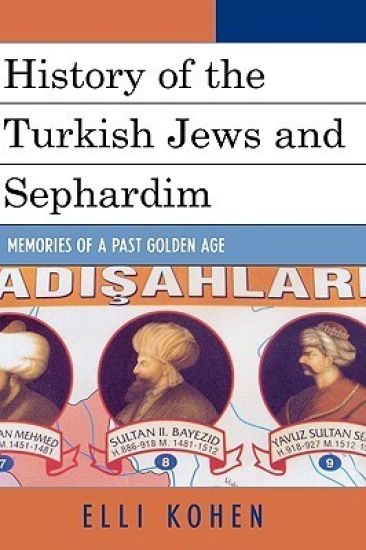
History of the Turkish Jews and Sephardim

History of the Turkish Jews and Sephardim

Elli Kohen

University Press of America
2006
nidottu
This book presents aliving history of the Turkish Jews. Despite numerous historical studies of this time period and its people, includingFarewell to Salonica by Leon Sciaky, the works of the Bulgarian Sephardic author Canetti,History of the Israelites of Salonica by Joseph Nehama,Salonica by Mark Mazower, and the works of Abraham Galante, there are few livinghistories. InHistory of the Turkish Jews and Sephardim author Elli Kohen attempts to combine the patience of the chronicler with the folksy humor of the storyteller, without undermining the presentation of the Sephardic Jews cultural history. It is a book of love for all the cultures that have come to coexist on the shores of the Bosphorus. This comprehensive work explores the early Ottomon period, the Sephardi period, and concludes on the eve of the Sabbastian upheaval. Unique in tone and purpose,History of the Turkish Jews and Sephardim explores the cultural synthesis resulting from the interaction of the various elements co-existing near the shores of the Bosphorus. In style and breadth, this new work complements the existing literature on this historical period. Below are some of the events and stories chronicled in the History of the Turkish Jew and Sephardim: - The mysterious sect of Judaizing Chiones -
History of the Turkish Jews and Sephardim

History of the Turkish Jews and Sephardim

Elli Kohen

University Press of America
2006
sidottu
This book presents aliving history of the Turkish Jews. Despite numerous historical studies of this time period and its people, includingFarewell to Salonica by Leon Sciaky, the works of the Bulgarian Sephardic author Canetti,History of the Israelites of Salonica by Joseph Nehama,Salonica by Mark Mazower, and the works of Abraham Galante, there are few livinghistories. InHistory of the Turkish Jews and Sephardim author Elli Kohen attempts to combine the patience of the chronicler with the folksy humor of the storyteller, without undermining the presentation of the Sephardic Jews cultural history. It is a book of love for all the cultures that have come to coexist on the shores of the Bosphorus. This comprehensive work explores the early Ottomon period, the Sephardi period, and concludes on the eve of the Sabbastian upheaval. Unique in tone and purpose,History of the Turkish Jews and Sephardim explores the cultural synthesis resulting from the interaction of the various elements co-existing near the shores of the Bosphorus. In style and breadth, this new work complements the existing literature on this historical period. Below are some of the events and stories chronicled in the History of the Turkish Jew and Sephardim: - The mysterious sect of Judaizing Chiones - The enigmatic Torlak and the Anatolian syncretistic-communist revolution - The Jewish doctors of Sultan Mehmed II and Suleyman the Magnificent - The circular letter of the Sarfati calling the Ashkenazes to Turkey - The lives of the Iberian Jews in the Turkish Paradise - The rise of Joseph Nasi, the Duke of Naxos - The charter for the quasi-autonomous Jewish mini-state, Muselemlik, in Salonica - The monetary crisis of coinage (Jew money) - The rise and fall of Esther Kyra, Court Jewess - Murad IV and the Salonica textile crisis
Atlas of Cell Organelles Fluorescence

Atlas of Cell Organelles Fluorescence

Elli Kohen; Rene Santus; Joseph G. Hirschberg; Nuri Ozkutuk

CRC Press Inc
2003
sidottu
Containing over 150 original photomicrographs accompanied by protocol information, Atlas of Cell Organelles Fluorescence delineates organelles’ structures, interaction, and organization into complexes. It provides a collection that shows living cells under physiopathological conditions and in the context of treatment with carcinogens, xenobiotics, and chemotherapeutic drugs as well as photosensitizers. A guide for therapeutic, diagnostic, or prognostic interpretation of images, and for further research, the atlas helps you identify critical points of attack and suggests possible strategies for investigation.Each section provides a brief introduction and the technical details of the staining methods used. The text identifies the organelles and gives explanations of unusual appearances and the cytochemical reactions when necessary. Additional text is provided where appropriate for extension and implementation of methods being utilized to generate similar results. In all cases the normal and pathological markers and content are presented. The atlas includes a color insert that illustrates characteristic organelle features, microcompartmentalization, and alterations as investigated by one or more probes simultaneously. The book, an exhaustive list of cellular events observed using microfluorometry, supplies a compilation of information spread throughout the literature of the last 30 years. Atlas of Cell Organelles Fluorescence brings the information together and puts it in an easily accessible format.
Photobiology

Photobiology

Elli Kohen; Rene Santus; Joseph G. Hirschberg

Academic Press Inc
1995
sidottu
Photobiology integrates a wide variety of scientific disciplines. As more people become aware of the many ways light interacts with chemical and biological systems, the need for a concise treatment of photobiology has become more critical. Kohen et al. Have written just such a book, intended both as a textbook and as a reference.The authors begin by providing a brief description of the nature of light, how it affects matter, and the means and methods of measuring it. A major section of the book is devoted to how light influences living systems, including discussions of photosynthesis, bioluminescence, regulatory mechanisms, and visual transduction of light. The last half of the book is devoted to the biomedical aspects of light, including photoimmunology, photoallergic reactions and other forms of light sensitivity, the optical properties of skin, and various ways that light can be used in therapy treatments.Useful to photobiologists as a comprehensive overview, this book should also appeal to biomedical researchers and advanced students of photobiology.