Kirjojen hintavertailu. Mukana 12 595 353 kirjaa ja 12 kauppaa.

Kirjailija

Emiko Todoroki

Kirjat ja teokset yhdessä paikassa: 2 kirjaa, julkaisuja vuosilta 2009-2014, suosituimpien joukossa The Canada-Caribbean Remittance Corridor. Vertaile teosten hintoja ja tarkista saatavuus suomalaisista kirjakaupoista.

2 kirjaa

Kirjojen julkaisuhaarukka 2009-2014.

Making Remittances Work

Making Remittances Work

Emiko Todoroki; Wameek Noor; Kuntay Celik; Anoma Kulathunga

World Bank Publications
2014
nidottu
H.M. Queen Máxima of the Netherlands, United Nations Secretary-General's Special Advocate for Inclusive Finance for Development stated that 'the impact of helping migrants and their families will be lasting and global if we link remittances to other financial services and make them more affordable and more relevant to their needs.'Remittances are a critical source of financing for most developing countries. The importance of remittances goes beyond numbers. For many households in developing countries, they are probably the most stable source of primary or additional income.At the same time, the September 11, 2001, terrorist attacks exposed the use and abuse of remittance channels for financing terrorism. In response to this threat, the international community issued new international anti-money laundering/combating the financing of terrorism (AML/CFT) standards on remittance transfers and their service providers. For the first time, remittance service providers were required to be brought under the government oversight and either registered with or licensed by a competent authority, and to be subject to AML/CFT obligations.While the FATF Recommendations appear straightforward on paper, regulating and supervising in practice the money transfer business has proved to be a very challenging task in both developed and developing countries.This book assists policy makers, regulators, and supervisors of money transfer businesses to craft effective regulatory and supervisory frameworks governing remittances that meet international AML/CFT standards, while at the same time ensuring that the neediest have access to these crucial services.
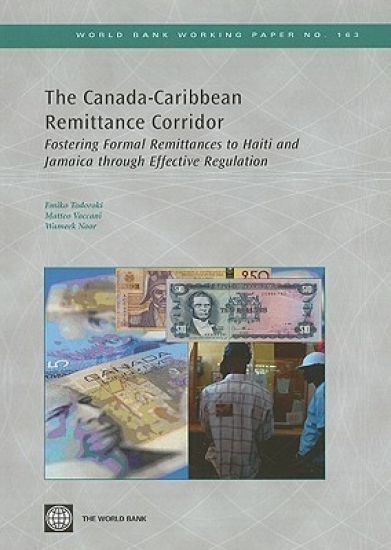
The Canada-Caribbean Remittance Corridor

The Canada-Caribbean Remittance Corridor

Emiko Todoroki; Matteo Vaccani; Wameek Noor

World Bank Publications
2009
nidottu
Several economies in the Caribbean region, especially from the lower-income group, are highly dependent on remittances. Between 1991 and 2006, the combined flows of total remittances reaching the Caribbean have averaged almost 17 per cent annual growth, surpassing US$6 billion in 2005 and overtaking the region's total ODA and FDI inflows. In addition, remittances represent more than 20 percent of the domestic gross domestic product (GDP) in some Caribbean countries and have played a significant role in lessening both balance of payment deficits and the impact of natural disasters to which the region is particularly vulnerable. This study undertakes an analysis of the various dynamics underlying the Canada-Caribbean remittance corridor, including Caribbean migration issues and diaspora dynamics, remittance market landscapes, and regulatory frameworks. The study is intended to assist Canadian and Caribbean national authorities to sustain the continued growth and competitiveness of their remittance industries, while protecting them abuse by criminals. The study particularly emphasizes continued policy improvements in each country's regulatory framework to improve financial sector development and to enhance poverty reduction.