Kirjojen hintavertailu. Mukana 12 595 353 kirjaa ja 12 kauppaa.

Kirjailija

Emile van der Does de Willebois

Kirjat ja teokset yhdessä paikassa: 3 kirjaa, julkaisuja vuosilta 2011-2022, suosituimpien joukossa The Puppet Masters. Vertaile teosten hintoja ja tarkista saatavuus suomalaisista kirjakaupoista.

3 kirjaa

Kirjojen julkaisuhaarukka 2011-2022.

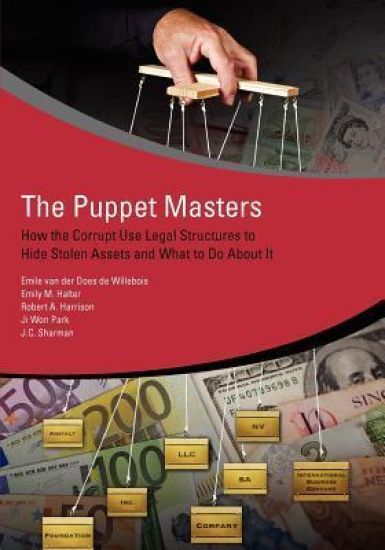
The Puppet Masters

The Puppet Masters

Emile van der Does de Willebois; J.C. Sharman; Robert Harrison; Ji Won Park; Emily Halter

World Bank Publications
2011
nidottu
Billions in corrupt assets, complex money trails, strings of shell companies and other spurious legal structures. These form the complex web of subterfuge in corruption cases, behind which hides the beneficial owner-the puppet master and beneficiary of it all. Linking the beneficial owner to the proceeds of corruption is notoriously hard. With sizeable wealth and resources on their side, they exploit transnational constructions that are hard to penetrate and stay aggressively ahead of the game.Nearly all cases of grand corruption have one thing in common. They rely on corporate vehicles - legal structures such as companies, foundations, and trusts-to conceal ownership and control of tainted assets.The Puppet Masters: How the Corrupt Use Legal Structures to Hide Stolen Assets and What to Do About It takes these corporate vehicles as its angle of investigation. It builds upon cases, interviews with investigators, corporate registries and financial institutions, as well as a “mystery shopping” exercise that provide factual evidence of a criminal practice. This approach is used to understand the nature of the problem and design policy recommendations to facilitate the investigative process by unravelling the complex world of corporate vehicles.This report is solidly built on step-by-step arguments and designed to deliver practical, applicable, and well substantiated recommendations. It is intended for use by policy makers in developing national legislation and regulation as well as international standard setters. It also provides helpful information for practitioners engaged in investigating corrupt officials and academics involved in the study of financial crime.
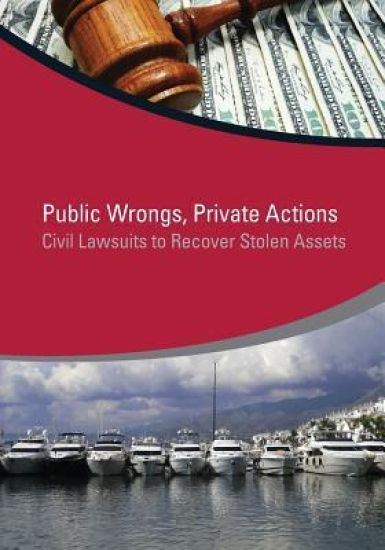
Public Wrongs, Private Actions

Public Wrongs, Private Actions

Jean-Pierre Brun; Emile Van Der Does De Willebois; Pascale Helene Dubois; Jeanne Hauch; Sarah Jais; Yannis Mekki; Anastasia Sotiropoulou; Katherine Rose Sylvester

World Bank Publications
2014
nidottu
Corruption and thefts of public assets harm a diffuse set of victims, weakens confidence in public institutions, damages the private investment climate, and threatens the foundations of the society as a whole. In developing countries with scarce public resources, the cost of corruption is an impediment to development: developing countries lose between US$20 to US$40 billion each year through bribery, misappropriation of funds, and other corrupt practices. Corruption is by no means a "victimless crime." This study aims to explore the standing of States and Government entities as victims and the possible recourse to private actions to redress public wrongs. States and Government entities may act as private litigants and bring civil suits to recover assets lost to corruption. The goal of this work is to promote knowledge and understanding as well as to increase the use of civil remedies and private lawsuits to recover stolen assets in the context of the United Nations Convention against Corruption (UNCAC) offences. The UNCAC, the global standard for the fight against corruption, does not contain a legal definition of corruption itself but lists an array of offences, including public and private sector bribery and the embezzlement of public and private sector funds. The study will mainly focus on these two types of corruption, namely bribery and embezzlement of funds. This study is not intended in any way to minimize the importance of criminal proceedings and confiscation in addressing acts of corruption. Rather, it will show that civil law remedies can effectively complement criminal penalties by attacking the economic base of corrupt activities both in the public and the private sectors. In fact, given the magnitude of the challenges, all avenues of asset recovery, be they criminal or civil, should be explored simultaneously in order to tackle corruption from each and every angle and achieve the goals of deterrence and enforcement. Hence, while criminal law expresses society's disapproval of the corrupt acts and aims at dissuasion, punishment, and confiscation of illicit proceeds, civil law focuses on victims' interests and aims at compensation and restitution. These procedures may occur sometimes in parallel, sometimes sequentially. An effective response to corruption very often requires concomitant use of both criminal and civil law remedies to achieve the desired result.