

Kirjailija
Emma Hunter
Kirjat ja teokset yhdessä paikassa: 7 kirjaa, julkaisuja vuosilta 2015-2023, suosituimpien joukossa Verführung und Verrat. Die Somerset-Saga (2). Vertaile teosten hintoja ja tarkista saatavuus suomalaisista kirjakaupoista.
7 kirjaa
Kirjojen julkaisuhaarukka 2015-2023.



Political Thought and the Public Sphere in Tanzania
Emma Hunter
Cambridge University Press
2017
pokkari
Political Thought and the Public Sphere in Tanzania is a study of the interplay of vernacular and global languages of politics in the era of decolonization in Africa. Decolonization is often understood as a moment when Western forms of political order were imposed on non-Western societies, but this book draws attention instead to debates over universal questions about the nature of politics, concept of freedom and the meaning of citizenship. These debates generated political narratives that were formed in dialogue with both global discourses and local political arguments. The United Nations Trusteeship Territory of Tanganyika, now mainland Tanzania, serves as a compelling example of these processes. Starting in 1945 and culminating with the Arusha Declaration of 1967, Emma Hunter explores political argument in Tanzania's public sphere to show how political narratives succeeded when they managed to combine promises of freedom with new forms of belonging at local and national level.
African Print Cultures
Derek Peterson; Steph Newell; Emma Hunter
The University of Michigan Press
2016
sidottu
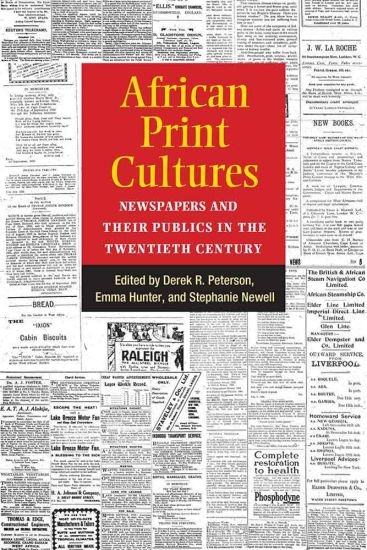
The essays collected in African Print Cultures claim African newspapers as subjects of historical and literary study. Newspapers were not only vehicles for anticolonial nationalism. They were also incubators of literary experimentation and networks by which new solidarities came into being. By focusing on the creative work that African editors and contributors did, this volume brings an infrastructure of African public culture into view. The first of four thematic sections, “African Newspaper Networks,” considers the work that newspaper editors did to relate events within their locality to happenings in far-off places. This work of correlation and juxtaposition made it possible for distant people to see themselves as fellow travellers. “Experiments with Genre” explores how newspapers nurtured the development of new literary genres, such as poetry, realist fiction, photoplays, and travel writing in African languages and in English. “Newspapers and Their Publics” looks at the ways in which African newspapers fostered the creation of new kinds of communities and served as networks for public interaction, political and otherwise. The final section, “Afterlives, ” is about the longue durée of history that newspapers helped to structure, and how, throughout the twentieth century, print allowed contributors to view their writing as material meant for posterity.
African Print Cultures
Derek Peterson; Steph Newell; Emma Hunter
The University of Michigan Press
2016
nidottu
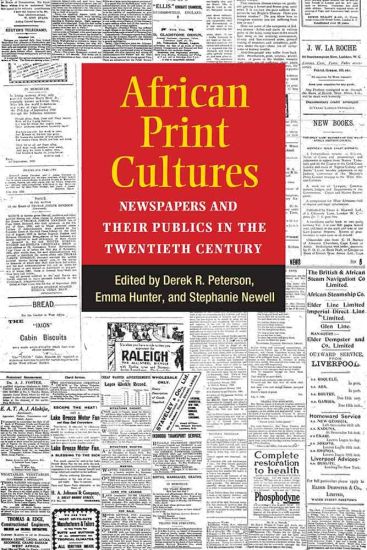
The essays collected in African Print Cultures claim African newspapers as subjects of historical and literary study. Newspapers were not only vehicles for anticolonial nationalism. They were also incubators of literary experimentation and networks by which new solidarities came into being. By focusing on the creative work that African editors and contributors did, this volume brings an infrastructure of African public culture into view. The first of four thematic sections, “African Newspaper Networks,” considers the work that newspaper editors did to relate events within their locality to happenings in far-off places. This work of correlation and juxtaposition made it possible for distant people to see themselves as fellow travellers. “Experiments with Genre” explores how newspapers nurtured the development of new literary genres, such as poetry, realist fiction, photoplays, and travel writing in African languages and in English. “Newspapers and Their Publics” looks at the ways in which African newspapers fostered the creation of new kinds of communities and served as networks for public interaction, political and otherwise. The final section, “Afterlives, ” is about the longue durée of history that newspapers helped to structure, and how, throughout the twentieth century, print allowed contributors to view their writing as material meant for posterity.

Political Thought and the Public Sphere in Tanzania
Emma Hunter
Cambridge University Press
2015
sidottu
Political Thought and the Public Sphere in Tanzania is a study of the interplay of vernacular and global languages of politics in the era of decolonization in Africa. Decolonization is often understood as a moment when Western forms of political order were imposed on non-Western societies, but this book draws attention instead to debates over universal questions about the nature of politics, concept of freedom and the meaning of citizenship. These debates generated political narratives that were formed in dialogue with both global discourses and local political arguments. The United Nations Trusteeship Territory of Tanganyika, now mainland Tanzania, serves as a compelling example of these processes. Starting in 1945 and culminating with the Arusha Declaration of 1967, Emma Hunter explores political argument in Tanzania's public sphere to show how political narratives succeeded when they managed to combine promises of freedom with new forms of belonging at local and national level.