Kirjojen hintavertailu. Mukana 12 595 353 kirjaa ja 12 kauppaa.

Kirjailija

Enrique Vidal

Kirjat ja teokset yhdessä paikassa: 5 kirjaa, julkaisuja vuosilta 2011-2025, suosituimpien joukossa Multimodal Interactive Handwritten Text Transcription. Vertaile teosten hintoja ja tarkista saatavuus suomalaisista kirjakaupoista.

5 kirjaa

Kirjojen julkaisuhaarukka 2011-2025.

Probabilistic Indexing for Information Search and Retrieval in Large Collections of Handwritten Text Images

Probabilistic Indexing for Information Search and Retrieval in Large Collections of Handwritten Text Images

Alejandro Héctor Toselli; Joan Puigcerver; Enrique Vidal

Springer International Publishing AG
2025
nidottu
This book provides a comprehensive presentation of a recently introduced framework, named "probabilistic indexing" (PrIx), for searching text in large collections of document images and other related applications. It fosters the development of new search engines for effective information retrieval from manuscripts which, however, lack the electronic text (transcripts) that would typically be required for such search and retrieval tasks. The book is structured into 11 chapters and three appendices. The first two chapters briefly outline the necessary fundamentals and state of the art in pattern recognition, statistical decision theory, and handwritten text recognition. Chapter 3 presents approaches for indexing (as opposed to “spotting”) each region of a handwritten text image which is likely to contain a word. Next, Chapter 4 describes models adopted for handwritten text in images, namely hidden Markov models, convolutional and recurrent neural networks and language models, and provides full details of weighted finite-state transducer (WFST) concepts and methods, needed in further chapters of the book. Chapter 5 explains the set of techniques and algorithms developed to generate image probabilistic indexes which allow for fast search and retrieval of textual information in the indexed images. Chapter 6 then presents experimental evaluations of the proposed framework and algorithms on different traditional benchmark datasets and compares them with other approaches, while Chapter 7 reviews the most popular keyword-spotting approaches. Chapter 8 explains how PrIx can support classical free-text search tools, while Chapter 9 presents new methods that use PrIx not only for searching, but also to deal with text analytics and other related natural language processing and information extraction tasks. Chapter 10 shows how the proposed solutions can be used to effectively index very large collections of handwritten document images, before Chapter 11 eventually summarizes the book and suggests promising lines of future research. The appendices detail the necessary mathematical foundations for the work and presents details of the text image collections and datasets used in the experiments throughout the book. This book is written for researchers and (post-)graduate students in pattern recognition and information retrieval. It will also be of interest to people in areas like history, criminology, or psychology who need technical support to evaluate, understand or decode historical or contemporary handwritten text.
Probabilistic Indexing for Information Search and Retrieval in Large Collections of Handwritten Text Images

Probabilistic Indexing for Information Search and Retrieval in Large Collections of Handwritten Text Images

Alejandro Héctor Toselli; Joan Puigcerver; Enrique Vidal

Springer International Publishing AG
2024
sidottu
This book provides a comprehensive presentation of a recently introduced framework, named "probabilistic indexing" (PrIx), for searching text in large collections of document images and other related applications. It fosters the development of new search engines for effective information retrieval from manuscripts which, however, lack the electronic text (transcripts) that would typically be required for such search and retrieval tasks. The book is structured into 11 chapters and three appendices. The first two chapters briefly outline the necessary fundamentals and state of the art in pattern recognition, statistical decision theory, and handwritten text recognition. Chapter 3 presents approaches for indexing (as opposed to “spotting”) each region of a handwritten text image which is likely to contain a word. Next, Chapter 4 describes models adopted for handwritten text in images, namely hidden Markov models, convolutional and recurrent neural networks and language models, and provides full details of weighted finite-state transducer (WFST) concepts and methods, needed in further chapters of the book. Chapter 5 explains the set of techniques and algorithms developed to generate image probabilistic indexes which allow for fast search and retrieval of textual information in the indexed images. Chapter 6 then presents experimental evaluations of the proposed framework and algorithms on different traditional benchmark datasets and compares them with other approaches, while Chapter 7 reviews the most popular keyword-spotting approaches. Chapter 8 explains how PrIx can support classical free-text search tools, while Chapter 9 presents new methods that use PrIx not only for searching, but also to deal with text analytics and other related natural language processing and information extraction tasks. Chapter 10 shows how the proposed solutions can be used to effectively index very large collections of handwritten document images, before Chapter 11 eventually summarizes the book and suggests promising lines of future research. The appendices detail the necessary mathematical foundations for the work and presents details of the text image collections and datasets used in the experiments throughout the book. This book is written for researchers and (post-)graduate students in pattern recognition and information retrieval. It will also be of interest to people in areas like history, criminology, or psychology who need technical support to evaluate, understand or decode historical or contemporary handwritten text.
Multimodal Interactive Pattern Recognition and Applications

Multimodal Interactive Pattern Recognition and Applications

Alejandro Héctor Toselli; Enrique Vidal; Francisco Casacuberta

Springer London Ltd
2014
nidottu
This book presents a different approach to pattern recognition (PR) systems, in which users of a system are involved during the recognition process. This can help to avoid later errors and reduce the costs associated with post-processing. The book also examines a range of advanced multimodal interactions between the machine and the users, including handwriting, speech and gestures. Features: presents an introduction to the fundamental concepts and general PR approaches for multimodal interaction modeling and search (or inference); provides numerous examples and a helpful Glossary; discusses approaches for computer-assisted transcription of handwritten and spoken documents; examines systems for computer-assisted language translation, interactive text generation and parsing, relevance-based image retrieval, and interactive document layout analysis; reviews several full working prototypes of multimodal interactive PR applications, including live demonstrations that can be publicly accessed on the Internet.
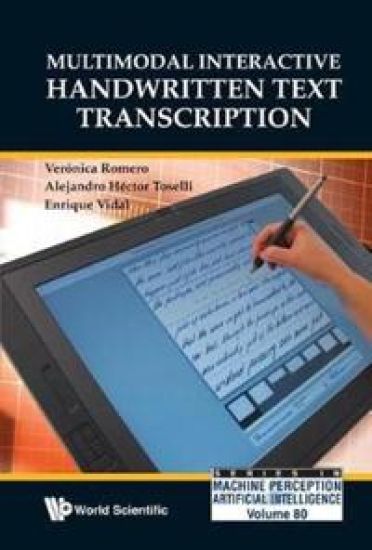
Multimodal Interactive Handwritten Text Transcription

Multimodal Interactive Handwritten Text Transcription

Veronica Romero; Alejandro Hector Toselli; Enrique Vidal

World Scientific Publishing Co Pte Ltd
2012
sidottu
This book presents an interactive multimodal approach for efficient transcription of handwritten text images. This approach, rather than full automation, assists the expert in the recognition and transcription process.Until now, handwritten text recognition (HTR) systems are far from being perfect and heavy human intervention is often required to check and correct the results of such systems. The interactive scenario studied in this book combines the efficiency of automatic handwriting recognition systems with the accuracy of the experts, leading to a cost-effective perfect transcription of the handwritten text images.The interactive system here allows the user to repeatedly interact with the system. Hence, the quality and ergonomy of the interactive process is crucial for the success of the system. Moreover, more ergonomic multimodal interfaces are used to obtain an easier and more comfortable human-machine interaction.
Multimodal Interactive Pattern Recognition and Applications

Multimodal Interactive Pattern Recognition and Applications

Alejandro Héctor Toselli; Enrique Vidal; Francisco Casacuberta

Springer London Ltd
2011
sidottu
This book presents a different approach to pattern recognition (PR) systems, in which users of a system are involved during the recognition process. This can help to avoid later errors and reduce the costs associated with post-processing. The book also examines a range of advanced multimodal interactions between the machine and the users, including handwriting, speech and gestures. Features: presents an introduction to the fundamental concepts and general PR approaches for multimodal interaction modeling and search (or inference); provides numerous examples and a helpful Glossary; discusses approaches for computer-assisted transcription of handwritten and spoken documents; examines systems for computer-assisted language translation, interactive text generation and parsing, relevance-based image retrieval, and interactive document layout analysis; reviews several full working prototypes of multimodal interactive PR applications, including live demonstrations that can be publicly accessed on the Internet.