Kirjojen hintavertailu. Mukana 12 595 353 kirjaa ja 12 kauppaa.

Kirjailija

Éric Bélanger

Kirjat ja teokset yhdessä paikassa: 8 kirjaa, julkaisuja vuosilta 2014-2020, suosituimpien joukossa Elecciones Latinoamericanas. Vertaile teosten hintoja ja tarkista saatavuus suomalaisista kirjakaupoista.

Mukana myös kirjoitusasut: Eric Belanger, Eric Bélanger

8 kirjaa

Kirjojen julkaisuhaarukka 2014-2020.

Framing Risky Choices

Framing Risky Choices

Ece Özlem Atikcan; Richard Nadeau; Éric Bélanger

McGill-Queen's University Press
2020
nidottu
The majority of policymakers, academics, and members of the general public expected British citizens to vote to remain in the European Union in the 2016 referendum. This perception was based on the well-established idea that voters don't like change or uncertainty. So why did the British public vote to take such a major economic risk? Framing Risky Choices addresses this question by placing the Brexit vote in the bigger picture of EU and Scottish independence referendums. Drawing from extensive interviews and survey data, it asserts that the framing effect – mobilizing voters by encouraging them to think along particular lines – matters, but not every argument is equally effective. Simple, evocative, and emotionally compelling frames that offer negativity are especially effective in changing people's minds. In the Brexit case, the Leave side neutralized the economic risks of Brexit and proposed other risks relating to remaining in the EU, such as losing control of immigration policy and a lack of funding for the National Health Service. These concrete, impassioned arguments struck an immediate and familiar chord with voters. Most intriguingly, the Remain side was silent on these issues, without an emotional case to present. Framing Risky Choices presents a multi-method, comparative, state-of-the-art analysis of how the Brexit campaign contributed to the outcome. Uncovering the core mechanism behind post-truth politics, it shows that the strength of an argument is not its empirical validity but its public appeal.

Framing Risky Choices

Framing Risky Choices

Ece Özlem Atikcan; Richard Nadeau; Éric Bélanger

McGill-Queen's University Press
2020
sidottu
The majority of policymakers, academics, and members of the general public expected British citizens to vote to remain in the European Union in the 2016 referendum. This perception was based on the well-established idea that voters don't like change or uncertainty. So why did the British public vote to take such a major economic risk? Framing Risky Choices addresses this question by placing the Brexit vote in the bigger picture of EU and Scottish independence referendums. Drawing from extensive interviews and survey data, it asserts that the framing effect – mobilizing voters by encouraging them to think along particular lines – matters, but not every argument is equally effective. Simple, evocative, and emotionally compelling frames that offer negativity are especially effective in changing people's minds. In the Brexit case, the Leave side neutralized the economic risks of Brexit and proposed other risks relating to remaining in the EU, such as losing control of immigration policy and a lack of funding for the National Health Service. These concrete, impassioned arguments struck an immediate and familiar chord with voters. Most intriguingly, the Remain side was silent on these issues, without an emotional case to present. Framing Risky Choices presents a multi-method, comparative, state-of-the-art analysis of how the Brexit campaign contributed to the outcome. Uncovering the core mechanism behind post-truth politics, it shows that the strength of an argument is not its empirical validity but its public appeal.

The National Question and Electoral Politics in Quebec and Scotland

The National Question and Electoral Politics in Quebec and Scotland

Éric Bélanger; Richard Nadeau; Ailsa Henderson; Eve Hepburn

McGill-Queen's University Press
2018
sidottu
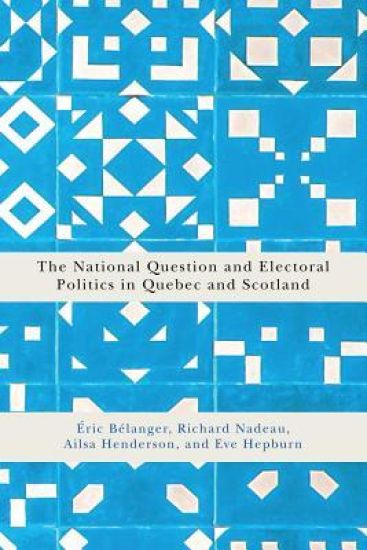
In Quebec and Scotland, questions of constitutional change, national identity, and national grievance play an important role in the electoral calculations of political parties and voters. Taking a strong stance on the national question can have strategic benefits both for parties pushing for greater autonomy and for those endorsing the status quo. In this in-depth look at issue voting, authors Éric Bélanger, Richard Nadeau, Ailsa Henderson, and Eve Hepburn examine how the national question affects political parties and voter behaviour in both substate nations. Through party manifestos, interviews with legislators, and opinion survey data, this book demonstrates that calls for constitutional change influence political debate, competition, voter choice, and the outcome of elections not only within Quebec and Scotland but also across Canada and the United Kingdom. Minority nationalist parties, the authors show, can gain support by claiming ownership of issues with widespread public agreement, such as self-determination and protecting the identity and interests of the nation. A comprehensive analysis of recent electoral politics, The National Question and Electoral Politics in Quebec and Scotland greatly enhances our understanding of the electoral impact of substate nationalism.
The National Question and Electoral Politics in Quebec and Scotland

The National Question and Electoral Politics in Quebec and Scotland

Éric Bélanger; Richard Nadeau; Ailsa Henderson; Eve Hepburn

McGill-Queen's University Press
2018
nidottu
In Quebec and Scotland, questions of constitutional change, national identity, and national grievance play an important role in the electoral calculations of political parties and voters. Taking a strong stance on the national question can have strategic benefits both for parties pushing for greater autonomy and for those endorsing the status quo. In this in-depth look at issue voting, authors Éric Bélanger, Richard Nadeau, Ailsa Henderson, and Eve Hepburn examine how the national question affects political parties and voter behaviour in both substate nations. Through party manifestos, interviews with legislators, and opinion survey data, this book demonstrates that calls for constitutional change influence political debate, competition, voter choice, and the outcome of elections not only within Quebec and Scotland but also across Canada and the United Kingdom. Minority nationalist parties, the authors show, can gain support by claiming ownership of issues with widespread public agreement, such as self-determination and protecting the identity and interests of the nation. A comprehensive analysis of recent electoral politics, The National Question and Electoral Politics in Quebec and Scotland greatly enhances our understanding of the electoral impact of substate nationalism.
Latin American Elections

Latin American Elections

Richard Nadeau; Eric Belanger; Michael S. Lewis-Beck; Mathieu Turgeon; Francois Gelineau

The University of Michigan Press
2017
sidottu
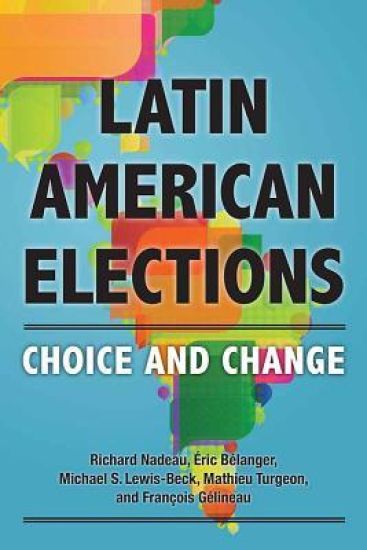
The Michigan model, named after the institution where it was first articulated, has been used to explain voting behavior in North American and Western European democracies. In Latin American Elections, experts on Latin America join with experts on electoral studies to evaluate the model’s applicability in this region. Analyzing data from the AmericasBarometer, a scientific public opinion survey carried out in 18 Latin American nations from 2008 to 2012, the authors find that, like democratic voters elsewhere, Latin Americans respond to long-term forces, such as social class, political party ties, and political ideology while also paying attention to short-term issues, such as the economy, crime, corruption. Of course, Latin Americans differ from other Americans, and among themselves. Voters who have experienced left-wing populism may favor government curbs on freedom of expression, for example, while voters enduring high levels of economic deprivation or instability tend to vote against the party in power. The authors thus conclude that, to a surprising extent, the Michigan model offers a powerful explanatory model for voting behavior in Latin America.
Health Care Policy and Opinion in the United States and Canada

Health Care Policy and Opinion in the United States and Canada

Richard Nadeau; Éric Bélanger; François Pétry; Stuart N Soroka; Antonia Maioni

Routledge
2016
nidottu
Heated debate surrounds the topic of health care in both the US and in Canada. In each country, these debates are based in some measure on perceptions about health care in their neighboring country. The perceptions held by Canadians about the US health care system, or those held by Americans about Canada, end up having significant impact on health policy makers in both countries. Health Care Policy and Opinion in the United States and Canada examines these perceptions and their effects using an extensive cross-national survey made up of two public opinion polls of over 3,500 respondents from the US and Canada. The book first develops a rigorous and detailed explanation of the factors that contribute to levels of satisfaction among Americans and Canadians with respect to their health care systems. It then attempts to study the perceptions of Canadians vis-à-vis the US health care system as well as the perception of Americans toward Canada’s health care system. The authors examine how these perceptions impact health policy makers, and show how the survey results indicate remarkable similarities in the opinions expressed by Americans and Canadians toward the problems in the health care system, heralding perhaps a measure of convergence in the future.The authors present how perceptions on health care indicate elements of convergence or divergence between the views of Canadians and Americans, and discuss how these citizen opinions should inform health care policy change in both countries in the near future. This book should generate interest in scholars of health care, public opinion, and comparative studies of social policies and public opinion.
Health Care Policy and Opinion in the United States and Canada

Health Care Policy and Opinion in the United States and Canada

Richard Nadeau; Éric Bélanger; François Pétry; Stuart N Soroka; Antonia Maioni

Routledge
2014
sidottu
Heated debate surrounds the topic of health care in both the US and in Canada. In each country, these debates are based in some measure on perceptions about health care in their neighboring country. The perceptions held by Canadians about the US health care system, or those held by Americans about Canada, end up having significant impact on health policy makers in both countries. Health Care Policy and Opinion in the United States and Canada examines these perceptions and their effects using an extensive cross-national survey made up of two public opinion polls of over 3,500 respondents from the US and Canada. The book first develops a rigorous and detailed explanation of the factors that contribute to levels of satisfaction among Americans and Canadians with respect to their health care systems. It then attempts to study the perceptions of Canadians vis-à-vis the US health care system as well as the perception of Americans toward Canada’s health care system. The authors examine how these perceptions impact health policy makers, and show how the survey results indicate remarkable similarities in the opinions expressed by Americans and Canadians toward the problems in the health care system, heralding perhaps a measure of convergence in the future.The authors present how perceptions on health care indicate elements of convergence or divergence between the views of Canadians and Americans, and discuss how these citizen opinions should inform health care policy change in both countries in the near future. This book should generate interest in scholars of health care, public opinion, and comparative studies of social policies and public opinion.