Kirjojen hintavertailu. Mukana 12 390 323 kirjaa ja 12 kauppaa.

Kirjailija

Eric Flamholtz

Kirjat ja teokset yhdessä paikassa: 3 kirjaa, julkaisuja vuosilta 2008-2020, suosituimpien joukossa Leading Strategic Change. Vertaile teosten hintoja ja tarkista saatavuus suomalaisista kirjakaupoista.

3 kirjaa

Kirjojen julkaisuhaarukka 2008-2020.

Leading Strategic Change

Leading Strategic Change

Eric Flamholtz; Yvonne Randle

Cambridge University Press
2008
sidottu
Why do some companies continue to be successful while others experience difficulties and even failure? In Leading Strategic Change, Eric Flamholtz and Yvonne Randle demonstrate that the key to long-term organizational success is the ability to adapt to and manage different types of change. Drawing on over 30 years' consultancy experience within major firms, they combine theoretical and practical models of organizational change, together with a new theory of leadership, to build a framework for understanding, planning, and leading change. The scope and value of this framework is then shown in relation to nine real-world case studies, ranging from relatively small companies (IndyMac Bank, Infogix) to large multinationals (Starbucks, Westfield). The focus throughout is to provide practical guidance to those concerned with managing and leading change in organizations. This book is an excellent guide to the many lessons to be learned about successful organizational change.
The Crisis Leadership Playbook

The Crisis Leadership Playbook

Eric Flamholtz; Yvonne Randle

Vandeplas Pub.
2020
pokkari
"Black Swan events" are supposed to be rare. However, during the past 20 years there have been several so-called "Black Swan events," occurring just about every ten years, including the Covid-19 Pandemic of 2020; The Great Recession of 2008-9; The attack on the World Trade Center, 2001; and the "Dot. Com" Bust of 1999-2000.The challenge to leadership of all types of organizations (businesses, not-for-profit, and governmental) from the crises caused by so-called "Black Swan events" is typically vast and almost always unprecedented. These crises require quick, thoughtful, and decisive responses.This book provides a "playbook" to help leaders facing crises understand and successfully address crises. Specific examples of organizations that have experienced a variety of crisis are presented and analyzed to help the reader understand different types of organizational crises and how leaders actually dealt with them. The organizations experiencing crises that are examined include American Express, Chrysler, Disney, Kodak, International Harvester/Navistar, Osborne Computer, Sears, UAL, and Westfield. Some of these case examples illustrate success in addressing a crisis, while others illustrate failures. Although all crises are unique, our research shows they have certain things in common. From the analysis of these actual case examples, we develop a "playbook" that includes key lessons, general principles, and tools for successfully leading and managing crises.As described in this book, each crisis requires a different "leadership playbook" or set of initiatives. Successful implementation of each set of initiatives, in turn, requires the use of a set of key tools. The book includes specific tools for identifying an organization's susceptibility to a crisis, tools for "crisis planning," as well as tools for identifying and effectively managing aspects of the organization's culture that may be contributing to or inhibiting its ability to address the crisis.The overall goal of this book is to provide the perspective, insights, lessons and tools that will enable leaders to create their own playbook that will help overcome crises and position their organization's for continuing success.
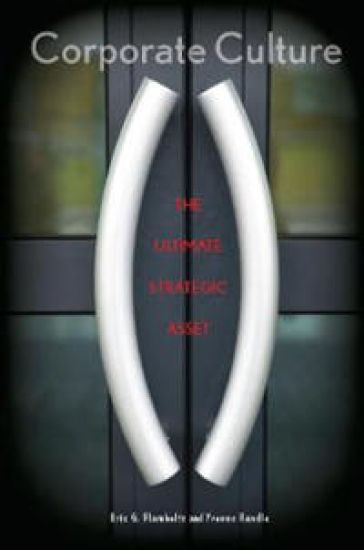
Corporate Culture

Corporate Culture

Eric Flamholtz; Yvonne Randle

Stanford University Press
2011
sidottu
Organizational culture is a quiet, but driving, influence on our perception of a company, whether as a consumer or as an employee. For instance, we know Southwest Airlines as laid back and friendly. We think of Google as innovative. To almost every well-known company we can assign a character. It is now well recognized that corporate culture has a significant impact on organizational health and performance. Yet, the concept of corporate culture and culture management is too often tantalizingly elusive. In this book, Flamholtz and Randle define culture, identifying and explaining the five key dimensions that determine it: a customer orientation; a people orientation; a process orientation; strong standards of performance and accountability; innovation and openness to change. They explain why culture is a critical factor in organizational success and failure—a key determinant of financial performance. Then, they provide a theoretically sound, highly practical, and field-tested method for managing corporate culture—presenting a set of international and domestic cases that show how actual companies have leveraged culture as the ultimate source of sustainable competitive advantage. In addition to well-known companies such as Starbucks, Ritz-Carlton, American Express, IBM, and Toyota, the text presents lesser known culture stars, such as Smartmatic and Infogix. While other titles on culture have focused too heavily on the organization as a psychological being, or on academic studies of culture as a business lever, Corporate Culture draws on empirics to present a go-to, must-read guide for leveraging corporate culture as a source of competitive advantage and as a means of impacting the bottom line.