Kirjailija
Eric Flint
Kirjat ja teokset yhdessä paikassa: 60 kirjaa, julkaisuja vuosilta 1997-2026, suosituimpien joukossa All the Plagues of Hell. Vertaile teosten hintoja ja tarkista saatavuus suomalaisista kirjakaupoista.
60 kirjaa
Kirjojen julkaisuhaarukka 1997-2026.
Captain Pausert just can’t catch a break! First, he became the mortal enemy of his fiancée, his home planet, the Empire—and even the Worm World, the darkest threat to mankind in all of space. All because he helped rescue three slave children from their masters. Of course, these three young women were the universally feared witches of Karres—but how was he to know that?! And after he defeated the Worm World (with the help of the witches, of course), the Empress herself had sent him on a secret mission to stop a nanite plague that was raging across the galaxy. But an enemy had somehow convinced the Imperial Fleet that he was actually a wanted criminal, so after a battle leaving his ship in urgent need of repairs, Pausert and the witches of Karres joined an interstellar traveling circus in order to save the galaxy. Now Pausert and the witches of Karres roam the spaceways again, this time dealing with a slaver-culture that somehow makes slaves happy to be in servitude, and a quest for a long-lost alien pet, during which the youngest witch, the Leewit, begins to come to her full powers as a healer—and of course generates chaos in her wake. For Pausert, it’s all in a day’s work. But would it be too much to ask for a vacation? About The Shaman of Karres: “This latest adventure of Pausert and the witches is full of all the whimsy, derring-do, and absurd hijinks that you’d expect. I dare any reader to get through ten pages without smiling.”—Analog About the Witches of Karres series: "This sequel [to The Witches of Karres] does honor to the original. . . a rolilicking ride. . . a rousing conclusion. . . "—Asimov's Science Fiction Magazine "Matches Schmitz's narrative style and high standard of humor, imagination, and absurdity. . . . Fans of humorous science fiction will enjoy this outing.”—School Library Journal on The Wizard of Karres About All the Plagues of Hell by Eric Flint & Dave Freer: “. . . a compelling tale of political, military, and magical conflict . . .”—Booklist About Eric Flint: “A master of the genre.”—Booklist “An SF author of particular note . . . one who can entertain and edify in equal, and major, measure.” —Publishers Weekly About Dave Freer: “Dave Freer always delivers compelling, fast-moving and addictive fantasy adventures.”—Garth Nix

Captain Pausert just can’t catch a break! First, he became the mortal enemy of his fiancée, his home planet, the Empire—and even the Worm World, the darkest threat to mankind in all of space. All because he helped rescue three slave children from their masters. Of course, these three young women were the universally feared Witches of Karres—but how was he to know that?! And after he defeated the Worm World (with the help of the witches, of course), the Empress herself had sent him on a secret mission to stop a nanite plague that was raging across the galaxy. But an enemy had somehow convinced the Imperial Fleet that he was actually a wanted criminal, so after a battle leaving his ship in urgent need of repairs, Puasert and the witches of Karres joined an interstellar traveling circus in order to save the galaxy. Now Pausert and the witches of Karres roam the spaceways again, this time dealing with a slaver-culture that somehow makes slaves happy to be in servitude, and a quest for a long-lost alien pet, during which the youngest witch, The Leewit, begins to come to her full powers as a healer—and of course generates chaos in her wake. For Pausert, it’s all in a day’s work. But would it be too much to ask for a vacation? About the Witches of Karres series: "This sequel [to The Witches of Karres] does honor to the original. . . a rolilicking ride. . . a rousing conclusion. . . "—Asimov's Science Fiction Magazine Fans of humorous science fiction will enjoy this outing.”—School Library Journal on The Wizard of Karres "This sequel does honor to the original. . . a rolilicking ride. . . matches Schmitz's narrative style and high standard of humor, imagination, and absurdity. . . . About All the Plagues of Hell by Eric Flint & Dave Freer: “. . . a compelling tale of political, military, and magical conflict . . .”—Booklist About Eric Flint: “A master of the genre.”—Booklist “An SF author of particular note . . . one who can entertain and edify in equal, and major, measure.” —Publishers Weekly About Dave Freer: “Dave Freer always delivers compelling, fast-moving and addictive fantasy adventures.”—Garth Nix
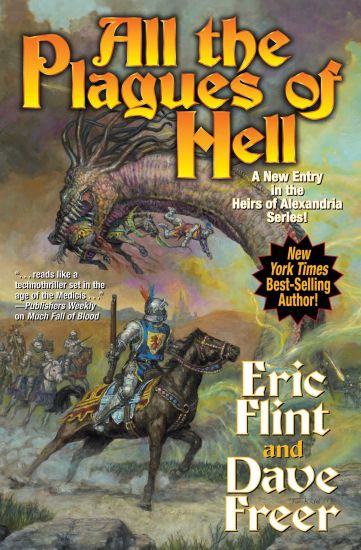
Orkise is loose. The snake-god of plague has been awakened by Lucia del Maino, the bastard daughter of the recently overthrown duke of Milan, Phillipo Visconti. With the venomous magic of Orkise at her command, Lucia plots to marry and then murder the usurper who now rules Milan, the condottiere Carlo Sforza—known to friend and foe alike as the Wolf the North. Other trouble is brewing as well. Sforza has his own bastard, Benito Valdosta, who is returning to Venice after having conquered the Byzantine Empire. Benito has a score to settle with his father, and he will have the help of his half-brother Marco, who is the embodiment of ancient Etruria’s mighty Winged Lion of St. Mark. Adding further to Sforza’s predicament, yet another power has entered the fray. The terrifying sorcerer Count Mindaug has decided to settle in Milan. Will he ally with Sforza, or oppose him? Either will bring trouble, for if Mindaug aids the usurper he will arouse the fury of the Holy Roman Empire and the Knights of the Holy Trinity. Both of those great forces have sworn to destroy Mindaug and anyone who shelters him. On his side, Sforza has only the skill and cunning of his physician, Francisco Turner—who is on good terms with the Valdosta brothers and may be able to neutralize Venetian hostility. But even if he can, will that be enough to save the Wolf of the North? For out there in the countryside of northern Italy, Orkise is uncoiling all the plagues of hell. About All the Plagues of Hell: “. . . a compelling tale of political, military, and magical conflict . . .”—Booklist About Eric Flint: “Another engaging alternate history from a master of the genre.”—Booklist “. . . an old-style police-procedural mystery, set in 17th century Germany. . . . The threads . . . spin together . . . to weave an addictively entertaining story. . . . A strong addition to a fun series.”—Daily News of Galveston County “This alternate history series is . . . a landmark. . .”—Booklist “[Eric] Flint's 1632 universe seems to be inspiring a whole new crop of gifted alternate historians.”—Booklist “. . . reads like a technothriller set in the age of the Medicis. . .”—Publishers Weekly About Dave Freer: “Dave Freer always delivers compelling, fast-moving and addictive fantasy adventures.”—Garth Nix, New York Times best-selling author of The Keys to the Kingdom series "Dave Freer's stories are always well-plotted, fast-paced and—most of all—a lot of fun to read."—Eric Flint, New York Times best-selling creator of the Ring of Fire series About A Mankind Witch, by Dave Freer: “Good characterization, ripsnorting action and an ingenious plot make this a feast . . .” —Publishers Weekly (Starred Review)
Orkise is loose. The snake-god of plague has been awakened by Lucia del Maino, the bastard daughter of the recently overthrown duke of Milan, Phillipo Visconti. With the venomous magic of Orkise at her command, Lucia plots to marry and then murder the usurper who now rules Milan, the condottiere Carlo Sforza—known to friend and foe alike as the Wolf the North. Other trouble is brewing as well. Sforza has his own bastard, Benito Valdosta, who is returning to Venice after having conquered the Byzantine empire. Benito has a score to settle with his father, and he will have the help of his half-brother Marco, who is the embodiment of ancient Etruria’s mighty Winged Lion of St. Mark. Adding further to Sforza’s predicament, yet another power has entered the fray. The terrifying sorcerer Count Mindaug has decided to settle in Milan. Will he ally with Sforza, or oppose him? Either will bring trouble, for if Mindaug aids the usurper he will arouse the fury of the Holy Roman Empire and the Knights of the Holy Trinity. Both of those great forces have sworn to destroy Mindaug and anyone who shelters him. On his side, Sforza has only the skill and cunning of his physician, Francisco Turner—who is on good terms with the Valdosta brothers and may be able to neutralize Venetian hostility. But even if he can, will that be enough to save the Wolf of the North? For out there in the countryside of northern Italy, Orkise is uncoiling all the plagues of hell. About Eric Flint: “Another engaging alternate history from a master of the genre.”—Booklist “. . . an old-style police-procedural mystery, set in 17th century Germany. . . . the threads . . . spin together . . . to weave an addictively entertaining story. . . . a strong addition to a fun series.”—Daily News of Galveston County “This alternate history series is … a landmark…”—Booklist “[Eric] Flint's 1632 universe seems to be inspiring a whole new crop of gifted alternate historians.”—Booklist “…reads like a technothriller set in the age of the Medicis…”—Publishers Weekly About Dave Freer: “Dave Freer always delivers compelling, fast-moving and addictive fantasy adventures.”–Garth Nix, New York Times best-selling author of The Keys to the Kingdom series "Dave Freer's stories are always well-plotted, fast-paced and—most of all—a lot of fun to read."—Eric Flint, New York Times best-selling creator of the Ring of Fire series About A Mankind Witch, by Dave Freer: “Good characterization, ripsnorting action and an ingenious plot make this a feast. . .” —Publishers Weekly (Starred Review)
RING OF FIRE SERIES ENTRY FROM THE LATE ERIC FLINT AND BEST-SELLING AUTHOR WALTER HUNT: The King is dead: Long Live the King. But which one? Gaston sits on the throne in Paris, but the dead king's infant son has powerful forces on his side, ready to place him where he belongs. Who will prevail? Tensions build in France following the ascension of Gaston to the throne of his murdered brother, but there are factions supporting the claim of King Louis' surviving infant son. As France moves toward civil war, other parties, both visible and invisible, maneuver to take advantage of the increased tension. Who will survive to reign over France--King Gaston, the exiled child and his regents, or the King of Spain?
When astronomer Stephanie Bronson uncovers a massive alien vessel named Fenrir racing toward the Sun, she must lead a desperate mission to rescue its crew before a catastrophic failure dooms them both to fiery destruction. It was just a dot of light . . . . . . a dot of light that appeared out of nowhere. Stephanie Bronson thought she might have found a distant supernova. Instead, what she'd found was something more than a thousand miles across, moving towards the Sun at almost a third the speed of light from the constellation of Lupus, the Wolf. Even more frightening, the object--called Fenrir, after the Norse Wolf of the World's End--was slowing down. It was not a comet or even a rogue planet. It was an alien vessel. And despite the increasingly detailed and insistent messages of greeting from Earth, it showed no sign of responding. As the world braced itself for the arrival of the immense, frighteningly silent alien visitor, Stephanie held hope that they still might communicate with Fenrir--until something happened that no one had imagined: Fenrir flared and its drive died, leaving the huge ship careening out of control to a fiery death inside the orbit of Venus. There was--just possibly--a chance for Earth to act--to rescue the now-shipwrecked "Fens." But even Stephanie--or those trying to stop her and the rescue ship Carpathia--could not imagine that not merely the fate of the aliens, but that of Earth itself, would be decided by Fenrir.
Tensions build in France following the ascension of Gaston to the throne of his murdered brother, but there are factions supporting the claim of King Louis’ surviving infant son. As France moves toward civil war, other parties, both visible and invisible, maneuver to take advantage of the increased tension. Who will survive to reign over France—King Gaston, the exiled child and his regents, or the King of Spain?
Michael and Melanie Anderle are hauling a tanker full of oil with their Peterbilt eighteen-wheeler when they’re struck by a temporal irregularity that sends them, the truck, and their daughter back in time a thousand years. The bubble that transports them also grabs a chemist and her two young children, along with half a convenience store in the middle of the United States. They just want to make a decent life for themselves in this new world of the past, with their Peterbilt and its oil providing a means of transportation, a generator, and shelter. But not all the locals are willing to live and let live, and when the area shamans decide that this community of temporally displaced persons is a threat to their power, the Anderles find out what it’s like to take a Peterbilt to war.
Eric Flint's 1632 & Beyond Special Issue #2
Eric Flint; Iver P Cooper; Edith Wild
Flint's Shards
2024
pokkari
This is a reissue of the second half of A 1632 Christmas, . The first half is Special Issue 1 from November 2024. Jackie Britton Lopatin's "Grantville's Secret Santa" tells how Grantville changed one woman's once-bleak future to fulfillment. In Chuck Thompson's "The Gift," Inez Wiley convinces her down-time friends not to leave her. Mark Huston's "At Christmas Time" follows a simple letter and its impact. Sarah Hay's "No Proper Carol" follows a search for hard to find up-time music. Edith Wild's "A Christmas Stollen" tells more of Amalia's story. Leaving Grantville, John Deakin's tale "At the Schickelmans'" follows their first Christmas celebration in the New World. In "Santa's Lapp" by George Haberberger, a man tells his people what he learned of their future up-time. "Natala" by Iver Cooper sees a Christmas play in Califonia. "One Night Only" by Michael Lockwood tells of a special performance at the Magdeburg Opera House. "Sad Spectacles" by Eric Flint and Lucille Robbins shows how new ideas can blow up even the most entrenched paths. The final tale addresses one of the key questions of modern Christmas: Is Die Hard a Christmas movie? Spoiler: yes, it is.
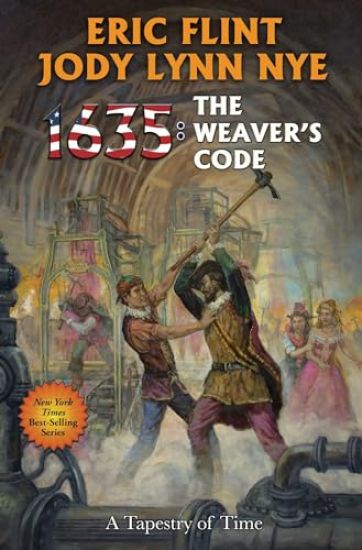
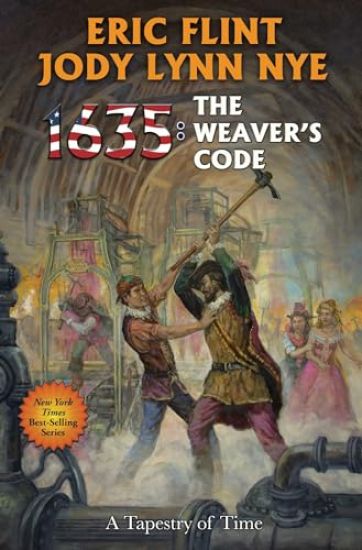
A young gentlewoman, Margaret de Beauchamp, finds her fate twisted into the lives of the up-timers when she meets the Americans imprisoned in the Tower of London. In exchange for her help, Rita Simpson and Harry Lefferts give her a huge sum of money to keep her family’s manor and its woolen trade from falling into the hands of the crown and its unscrupulous minister, Lord Cork. But Margaret’s troubles are not at an end. Her family’s fortunes are in a downward spiral. Her trip to Grantville brings unexpected dangers and a possible up-time solution. Inspired by books in the Grantville library, Margaret has an idea to restore her family’s fortunes with an innovation never before seen in fabric design. With the help of Aaron Craig, an up-timer programmer using aqualators, water-powered computers, they teach her father’s craftsmen to create a combination machine loom that can produce a new type of woolen cloth. The ornate and perfect patterns quickly trend among the nobility. However, the Master Weavers of the county’s Weaver’s Guild aren’t happy about being overshadowed by the changes to the status quo, and take their grievance to Lord Cork, who is still looking for the people who helped the Americans escape from the Tower. Cork isn’t interested in squabbles between mere tradesmen, but he is very interested in taking over the new calculating machine that is fueling the upsurge in the de Beauchamp fortunes. He sends agents ordered to stop at nothing to secure it for his own ends. Margaret has to protect her new business, and prevent anyone from discovering that up-timers are in the country to assist her, but she still has to deal with an uprising at home.
The United Sovereign States of Russia struggles to set in place the traditions and legal precedents that will let it turn into a constitutional monarchy with freedom and opportunity for all its citizens. At the same time, they’re trying to balance the power of the states and the federal government. And the USSR is fighting a civil war with Muscovite Russia, defending the new state of Kazakh from invasion by the Zunghars, building a tech base and an economy that will allow its money to be accepted in western Europe, establishing a more solid claim to Siberia, and, in general, keeping the wheels of civilization from coming off and dumping Russia back into the Time of Troubles. Or, possibly even worse, reinstalling the sort of repressive oligarchy that they just got rid of.
Michael and Melanie Anderle are hauling a tanker full of oil with their Peterbilt eighteen-wheeler when they’re struck by a temporal irregularity that sends them, the truck, and their daughter back in time a thousand years. The bubble that transports them also grabs a chemist and her two young children, along with half a convenience store in the middle of the United States. They just want to make a decent life for themselves in this new world of the past, with their Peterbilt and its oil providing a means of transportation, a generator, and shelter. But not all the locals are willing to live and let live, and when the area shamans decide that this community of temporally displaced persons is a threat to their power, the Anderles find out what it’s like to take a Peterbilt to war.
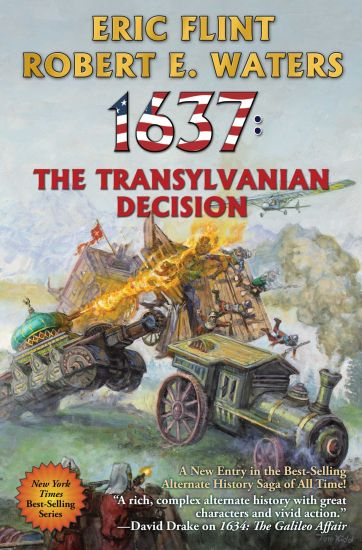
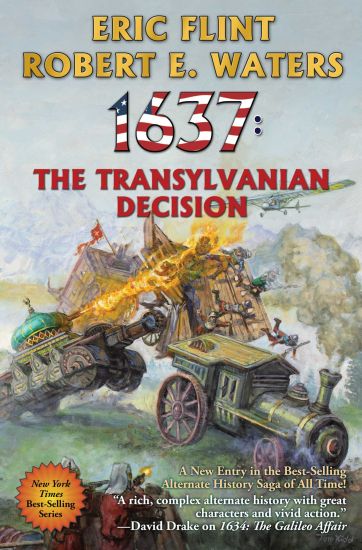
Up-timer Morris Roth and his Grand Army of the Sunrise stand at a crossroads. Military success against the Polish-Lithuanian magnates has all but guaranteed a continued push east into Ruthenian lands. There, Roth hopes to further his Anaconda Project so that tens of thousands of Jews are not slaughtered in what’s to become known as the Chmielnicki Pogrom of 1648. An envoy from Transylvania arrives with a promising offer from its prince, who wishes to form an alliance with Bohemia, but the land shrouded in the fog of the Carpathian Mountains—and known only to most up-timers as the playground of Count Dracula—is a vassal state of the Ottoman Empire. Such an alliance would surely draw the ire of Sultan Murad IV. The United States of Europe agrees to assist the Bohemian forces, and sends in the Silesian Guard, under the command of Brigadier Jeff Higgins. They also send in Gretchen Richter to organize and lead the political struggle. Transylvania is thrown into political, social, and religious turmoil as battle lines are drawn. Whatever happens and whoever wins the fight, one thing is certain: the history of Eastern Europe will change radically. In fact, it already has. About 1636: Calabar's War: “. . . dives into the story of . . . Calabar, a Brazilian military adviser [who] juggles helping [the Dutch] in their fight against the Spanish with rescuing his family, who have been sold into slavery.”—Publishers Weekly About 1635: A Parcel of Rogues: “The 20th volume in this popular, fast-paced alternative history series follows close on the heels of the events in The Baltic War, picking up with the protagonists in London, including sharpshooter Julie Sims. This time the 20th-century transplants are determined to prevent the rise of Oliver Cromwell and even have the support of King Charles.”—Library Journal About 1634: The Galileo Affair: “A rich, complex alternate history with great characters and vivid action. A great read and an excellent book.”—David Drake “Gripping . . . depicted with power!”—Publishers Weekly About Eric Flint's Ring of Fire series: “This alternate history series is . . . a landmark . . .”—Booklist “Flint’s 1632 universe seems to be inspiring a whole new crop of gifted alternate historians.”—Booklist “ . . . reads like a techno-thriller set in the age of the Medicis . . . ”—Publishers Weekly
Europe, 1632. It is a time of upheaval and great change. But none so great as when an unexplained temporal and spatial phenomenon known as the Ring of Fire transports the blue collar town of Grantville, West Virginia, smack-dab in the middle of the Thirty Years War. When the dust settles, it becomes clear that the town of Grantville isn't going anywhere, and the can-do Americans of the twenty-first century begin altering the course of history forever. It is now five years later, and the effects of the Ring of Fire reach from the Old World to the New. But the course of exploration and colonization will look much different than it did in our time line. The French bought the English possessions in North America way back in 1633, but have never done much with the uncivilized backwater. Until the new king of France, Gaston I, decides that it's time to seize the territory and establish French control over it. Here then, a new braided novel edited by Ring of Fire series creator Eric Flint, chronicling the exploits of the citizens of Grantville, their allies, and their enemies, as they venture forth onto a new continent. About 1637: No Peace Beyond the Line: “The action is non-stop. The authors skillfully blend battle, intrigue, politics, and everyday life in a remade seventeenth century to yield an exciting story. Both those familiar with the series (and this sequel’s predecessor) and those reading “No Peace Beyond the Line” as a first exposure to an addictive series will find it satisfying reading.”—Ricochet.com About 1635: A Parcel of Rogues: “The 20th volume in this popular, fast-paced alternative history series follows close on the heels of the events in The Baltic War, picking up with the protagonists in London, including sharpshooter Julie Sims. This time the 20th-century transplants are determined to prevent the rise of Oliver Cromwell and even have the support of King Charles.”—Library Journal About 1634: The Galileo Affair: “A rich, complex alternate history with great characters and vivid action. A great read and an excellent book.”—David Drake “Gripping . . . depicted with power!”—Publishers Weekly About Eric Flint's Ring of Fire series: “This alternate history series is . . . a landmark.”—Booklist “[Eric] Flint's 1632 universe seems to be inspiring a whole new crop of gifted alternate historians.”—Booklist “ . . . reads like a technothriller set in the age of the Medicis . . .”—Publishers Weekly
Up-timer Morris Roth and his Grand Army of the Sunrise stand at a crossroads. Military success against the Polish-Lithuanian magnates has all but guaranteed a continued push east into Ruthenian lands. There, Roth hopes to further his Anaconda Project so that tens of thousands of Jews are not slaughtered in what’s to become known as the Chmielnicki Pogrom of 1648. An envoy from Transylvania arrives with a promising offer from its prince, who wishes to form an alliance with Bohemia, but the land shrouded in the fog of the Carpathian mountains and known only to most up-timers as the playground of Count Dracula is a vassal state of the Ottoman Empire. Such an alliance would surely draw the ire of Sultan Murad IV. The United States of Europe agrees to assist the Bohemian forces, and sends in the Silesian Guard, under the command of Brigadier Jeff Higgins. They also send in Gretchen Richter to organize and lead the political struggle. Transylvania is thrown into political, social, and religious turmoil as battle lines are drawn. Whatever happens and whoever wins the fight, one thing is certain: the history of Eastern Europe will change radically. In fact, it already has. About 1636: Calabar's War: “. . . dives into the story of . . . Calabar, a Brazilian military adviser [who] juggles helping [the Dutch] in their fight against the Spanish with rescuing his family, who have been sold into slavery.”—Publishers Weekly About 1635: A Parcel of Rogues: “The 20th volume in this popular, fast-paced alternative history series follows close on the heels of the events in The Baltic War, picking up with the protagonists in London, including sharpshooter Julie Sims. This time the 20th-century transplants are determined to prevent the rise of Oliver Cromwell and even have the support of King Charles.”—Library Journal About 1634: The Galileo Affair: “A rich, complex alternate history with great characters and vivid action. A great read and an excellent book.”—David Drake “Gripping . . . depicted with power!”—Publishers Weekly About Eric Flint's Ring of Fire series: “This alternate history series is . . . a landmark . . .”—Booklist “[Eric] Flint's 1632 universe seems to be inspiring a whole new crop of gifted alternate historians.”—Booklist “ . . . reads like a technothriller set in the age of the Medicis . . . ”—Publishers Weekly
The relocation of the southern Indian tribes to Oklahoma engineered by Sam Houston following the War of 1812 also swept up many black inhabitants of North America. Many of the states in the USA—free as well as slaveholding—have passed laws ordering the expulsion of black freedmen. Having nowhere else to go, they joined the migration of the southern Indian tribes and settled in Arkansas. What results by 1824 is a hybrid nation of Indians, black people, and a number of white settlers as well. The situation is intolerable for the slaveholding states, which find a champion in Speaker of the House Henry Clay, whose longstanding ambition to become President of the United States looks to be coming to fruition. But Sam Houston and his friends and allies —the freedman Charles Ball, a former gunner for the US Navy and now a general in the Arkansas army, and the Irish revolutionary Patrick Driscol — are building a powerful army of their own in Arkansas. The crisis is brought to a head by the election of 1824. The war that follows will be a bloody crisis of conscience, politics, economics, and military action, drawing in players from as far away as England. And for such men as outgoing president James Monroe, Secretary of State John Quincy Adams, charismatic war hero Andrew Jackson, and the violent abolitionist John Brown, it is a time to change history itself. About 1635: A Parcel of Rogues: “The 20th volume in this popular, fast-paced alternative history series follows close on the heels of the events in The Baltic War, picking up with the protagonists in London, including sharpshooter Julie Sims. This time the 20th-century transplants are determined to prevent the rise of Oliver Cromwell and even have the support of King Charles.”—Library Journal About 1634: The Galileo Affair: “A rich, complex alternate history with great characters and vivid action. A great read and an excellent book.”—David Drake “Gripping . . . depicted with power!”—Publishers Weekly About Eric Flint's Ring of Fire series: “This alternate history series is . . . a landmark.”—Booklist “[Eric] Flint's 1632 universe seems to be inspiring a whole new crop of gifted alternate historians.”—Booklist “ . . . reads like a technothriller set in the age of the Medicis . . .”—Publishers Weekly
The emperor is dead; long live the emperors! The assassinated Shah Jahan lies entombed beside his beloved wife in the Taj Mahal, while their progeny drag the Mughal Empire into a three-sided struggle over the succession to the Peacock Throne. The diplomatic and trade mission from the United States of Europe is openly siding with Princess Jahanara and her brother Dara Shikoh. The mission, made up largely of Americans transplanted in time by the Ring of Fire, is providing the siblings with technical assistance as they prepare to fight their rivals for the throne, Aurangzeb and Shah Shuja. Meanwhile, the Afghan adventurer Salim Gadh Yilmaz, confidant of two emperors—Shah Jahan and now his son Dara Shikoh—has been elevated to the position of general. He has great challenges to face, not the least of which is resisting the fierce and forbidden mutual attraction between himself and Princess Jahanara. As the conflict deepens, the junior members of the mission are sent east to buy opium needed by the USE’s doctors. Their guide, merchant Jadu Das, has an agenda of his own, one entrusted to him by Jahanara: seek out her great uncle, Asaf Khan, and promise whatever is needed to bring his army over to Dara’s side. The USE’s mission was sent to India in search of goods needed in Europe. But now they find that straightforward task has become enmeshed in a great civil war — for control of The Peacock Throne. About 1635: A Parcel of Rogues: "The 20th volume in this popular, fast-paced alternative history series follows close on the heels of the events in The Baltic War, picking up with the protagonists in London, including sharpshooter Julie Sims. This time the 20th-century transplants are determined to prevent the rise of Oliver Cromwell and even have the support of King Charles."—Library Journal About 1634: The Galileo Affair: "A rich, complex alternate history with great characters and vivid action. A great read and an excellent book."—David Drake "Gripping . . . depicted with power!"—Publishers Weekly About Eric Flint's Ring of Fire series: “This alternate history series is . . . a landmark . . .”—Booklist “[Eric] Flint's 1632 universe seems to be inspiring a whole new crop of gifted alternate historians.”—Booklist “ . . . reads like a technothriller set in the age of the Medicis . . . ”—Publishers Weekly