Kirjojen hintavertailu. Mukana 12 390 323 kirjaa ja 12 kauppaa.

Kirjailija

Eric G. Flamholtz

Kirjat ja teokset yhdessä paikassa: 7 kirjaa, julkaisuja vuosilta 1996-2016, suosituimpien joukossa Human Resource Accounting. Vertaile teosten hintoja ja tarkista saatavuus suomalaisista kirjakaupoista.

7 kirjaa

Kirjojen julkaisuhaarukka 1996-2016.

Human Resource Accounting

Human Resource Accounting

Eric G. Flamholtz

Springer
1999
sidottu
************ The United States is currently undergoing a fundamental transfonnation from an industrial toaseIVice-based economy. ! This transfonnation, which began around the eOO ofWorld WarII, has led to changes in the composition of the labor force, affecting the various sectors in which people are employed and also the types and levels ofskills that are indemand. At present ours is rapidly becoming a mowledge, or infonnation based economy, requiring "high-teclmology services" from people who are highly. trained and educated as well as experienced in their fields. Engineers, computer programmers, software developers, medical technicians, lawyers, and university professors all qualify as high-tech selVice personnel Thus, the economy is increasingly composed ofwhite collar, teclutical, professionalpersonnel GrowingRecognition oftheImportanceofHuman Assets Whereas physical capital was of utmost importance in the economy of the past, the distinctive feature of the emerging economy is an increasing emphasis on human and intellectual capital-the knowledge, skills, and experience ofpeople. Given the growing importance of human capital and intellectual property as detenninants of economic success at both the macroeconomic and enterprise levels, it should also be clear that the nature ofinvestments made by firms needs to shift to reflect the new economic realities. Specifically, if human caPital is a key detenninant of organizational success, then investmentsintraininganddevelopmentofpeoplealso become critical.
Changing the Game

Changing the Game

Eric G. Flamholtz; Yvonne Randle

Oxford University Press Inc
1998
sidottu
The authors of this book argue that firms succeed or fail in their industries according to the degree that they are able to change what they do to meet changing market decisions. The authors present a framework for managing the process of organizational transformation, and the tools that are necessary to manage that change. This book is intended for managers and academics.
Building Family Business Champions

Building Family Business Champions

Eric G. Flamholtz; Yvonne Randle

Stanford University Press
2016
sidottu
Building Family Business Champions provides a theoretically sound and practical framework for understanding the challenges that family businesses face. Drawing on three decades of consulting with more than 250 companies, their own experience running a family-owned firm, and sound research, Eric G. Flamholtz and Yvonne Randle explain that the success of these companies hinges upon the dual management of family functionality and the company's infrastructure. They present a set of managerial tools for planning, structuring the business, measuring performance, and managing culture. After laying this groundwork, they attend to issues that uniquely pertain to these companies, such as succession and the challenges of familial dysfunction. Finally, the book offers a set of short self-assessments that can be used in any family business. Richly illustrated with stories of companies at various stages of growth from around the globe, this book provides a comprehensive guide for building businesses that thrive from generation to generation.
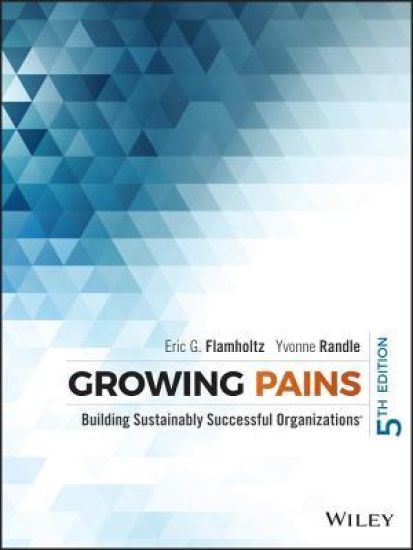
Growing Pains

Growing Pains

Eric G. Flamholtz; Yvonne Randle

John Wiley Sons Inc
2016
sidottu
An insightful and practical toolkit for managing organizational growth Growing Pains is the definitive guide to the life cycle of an organization, and the optimization strategies that make the organization stronger. Whether growth is rapid, slow, or not occurring at all, this book provides a host of solid tools and recommendations for putting everything in order. Now in its fifth edition, this invaluable guide has been fully updated to reflect the current economic climate, and includes new case studies and chapters discussing nonprofit life cycle tools, leadership challenges and the "leadership molecule", and real-world applications of the frameworks presented. The latest empirical research is presented in the context of these ideas, including new data on strategic organizational development. Mini-cases that illustrate growth management issues have been added throughout, with additional coverage of international entrepreneurship and companies that provide a frame of reference for the perspective being developed. Growing pains are normal, and a valuable indicator of organizational health, but they indicate the need for new systems, processes, and structure to support the organization's size. This book provides a practical framework for managing the process, applicable to organizations of all sizes. Understand the key stages of growth and the challenges of eachMeasure your organization's growing pains and developmentDeploy new tools that facilitate positive organizational developmentMake the necessary transitions required to ensure sustainable success Some companies, even after brilliant beginnings, lose their way as growth throws them for a loop. Growing Pains identifies the underlying factors that promote long term success, and gives you a framework for successfully managing the transitions of growth.
Human Resource Accounting

Human Resource Accounting

Eric G. Flamholtz

Springer-Verlag New York Inc.
2012
nidottu
************ The United States is currently undergoing a fundamental transfonnation from an industrial toaseIVice-based economy. ! This transfonnation, which began around the eOO ofWorld WarII, has led to changes in the composition of the labor force, affecting the various sectors in which people are employed and also the types and levels ofskills that are indemand. At present ours is rapidly becoming a mowledge, or infonnation based economy, requiring "high-teclmology services" from people who are highly. trained and educated as well as experienced in their fields. Engineers, computer programmers, software developers, medical technicians, lawyers, and university professors all qualify as high-tech selVice personnel Thus, the economy is increasingly composed ofwhite collar, teclutical, professionalpersonnel GrowingRecognition oftheImportanceofHuman Assets Whereas physical capital was of utmost importance in the economy of the past, the distinctive feature of the emerging economy is an increasing emphasis on human and intellectual capital-the knowledge, skills, and experience ofpeople. Given the growing importance of human capital and intellectual property as detenninants of economic success at both the macroeconomic and enterprise levels, it should also be clear that the nature ofinvestments made by firms needs to shift to reflect the new economic realities. Specifically, if human caPital is a key detenninant of organizational success, then investmentsintraininganddevelopmentofpeoplealso become critical.
Effective Management Control

Effective Management Control

Eric G. Flamholtz

Springer-Verlag New York Inc.
2011
nidottu
Effective Management Control deals with a critical but relatively neglected and misunderstood aspect of organizational effectiveness: the process of controlling the behavior of people in organizations. The issue of organizational control and the design of an optimal control system is essential for the long term effectiveness of an organization: too little control can lead to confusion and chaos; conversely, too great a degree of control can result in the erosion of innovation and entrepreneurship. This monograph presents a conceptual framework for approaching these issues, and examines the role accounting can play in a successful control system. The author works towards an understanding of the nature, role, elements and functioning of organizational control and control systems in organizations. The book posits and discusses the features of a core control system and its component parts, including: planning, measurement and feedback, evaluation and reward sub-systems. It also discusses the ways in which a core control system operates within a larger organizational structure and culture. The theory is illustrated through its application to a particular case study.
Effective Management Control

Effective Management Control

Eric G. Flamholtz

Springer
1996
sidottu
Effective Management Control deals with a critical but relatively neglected and misunderstood aspect of organizational effectiveness: the process of controlling the behavior of people in organizations. The issue of organizational control and the design of an optimal control system is essential for the long term effectiveness of an organization: too little control can lead to confusion and chaos; conversely, too great a degree of control can result in the erosion of innovation and entrepreneurship. This monograph presents a conceptual framework for approaching these issues, and examines the role accounting can play in a successful control system. The author works towards an understanding of the nature, role, elements and functioning of organizational control and control systems in organizations. The book posits and discusses the features of a core control system and its component parts, including: planning, measurement and feedback, evaluation and reward sub-systems. It also discusses the ways in which a core control system operates within a larger organizational structure and culture. The theory is illustrated through its application to a particular case study.