Kirjojen hintavertailu. Mukana 12 657 676 kirjaa ja 12 kauppaa.

Kirjailija

Eric Hammel

Kirjat ja teokset yhdessä paikassa: 6 kirjaa, julkaisuja vuosilta 2018-2024, suosituimpien joukossa Two Flags Over Iwo Jima. Vertaile teosten hintoja ja tarkista saatavuus suomalaisista kirjakaupoista.

6 kirjaa

Kirjojen julkaisuhaarukka 2018-2024.

The Cactus Air Force

The Cactus Air Force

Eric Hammel; Thomas McKelvey Cleaver; Richard P. Hallion

BLOOMSBURY PUBLISHING PLC
2024
nidottu
Using diary entries, interviews and first-hand accounts, this vivid narrative brings to life the struggle in the air over the island of Guadalcanal between August 20 and November 15, 1942.The battle of Guadalcanal was the first offensive operation undertaken by the US and its allies in the Pacific War. The three months of air battles between August 20, 1942, when the first Marine air unit arrived on the island, and November 15, when the last enemy attempt to retake the island was defeated, were perhaps the most important of the Pacific War. “Cactus,” the code name for the island, became a sinkhole for Japanese air and naval power, as they experienced losses that could never be made good. For 40 years, the late Eric Hammel interviewed more than 150 American participants in the air campaign at Guadalcanal, none of whom are still alive. These interviews are the most comprehensive first-person accounts of the battle assembled by any historian. More importantly, they involved the junior officers and enlisted men whose stories and memories were not part of the official history, and thus provide a unique insight. In The Cactus Air Force, Pacific War expert Thomas McKelvey Cleaver worked closely with Eric to build on his collection of diary entries, interviews and first-hand accounts to create a vivid narrative of the struggle in the air over the island of Guadalcanal between August 20 and November 15, 1942.
The Forge: The Decline and Rebirth of the American Military
The ForgeThe Decline and Rebirth of the American MilitaryNovember 12, 1918 to December 6, 1941Eric HammelBecause the United States military undertook its first World War II offensive operations in the Pacific within only eight months of Pearl Harbor, most historians and readers of the war's history depict and perceive the quick transition in 1942 from defensive war to offensive war as a miracle. In the miraculous narrative Americans have written for themselves, the peace-loving and ill-prepared sleeping giant, the United States, is suddenly struck by enemies who use her peace-loving ways against her, while a mere sprinkling of gallant, dedicated soldiers, sailors, and airmen fight overwhelming odds to barely hold the line against an unremitting backdrop of tearful defeats. Meanwhile, U.S. industry suddenly-instantly-becomes a magical "Arsenal of Democracy" that produces uncountable tanks and ships and guns, not to mention trained soldiers, sailors, and airmen in their legions, fleets, and air armadas that will smash the wiliest and most powerful enemies ever before confronted. The appearance of all that materiel, and all those battle-ready young men so soon after the Pearl Harbor attack, looks exactly like a miracle. There was no miracle. Celebrated military historian Eric Hammel's cool appraisal of the facts reveals that America's stunning and overwhelming moral response to German and Japanese aggression in the mid- and late 1930s, a response that eventually brought a huge portion of the globe within its embrace, was far less a miracle than an inexorable force of nature. America was a sleeping giant. But the decision to turn the entire force and will of a hard-working, innovative nation to arming for war was not made in the wake of Pearl Harbor. By Pearl Harbor, an alliance of the American government, American industry, and the American military community was already close to complete preparedness. The real story of America's preparations for World War II had begun in mid-November 1938.The Forge was previously published as How America Saved the World. Reviewed by Book News: "Hammel, a noted military historian and author, analyzes the military build-up in the United States just prior to World War II and notes how this strategy was "deliberate, orderly and integrated." Written for history buffs and general readers, this volume characterizes the U.S. as a "sleeping giant" after the end of World War I as a new shift toward an expanded military-industrial complex was implemented, creating an "Arsenal of Democracy" that would ultimately decide the outcome of World War II. Appendices include a list of the armies, corps, regiments and divisions in the Army and Navy as well as a list of major naval and aircraft hardware. "Reviewed by Bookviews: The Forge] by Eric Hammel tells how preparation for war was the reason that, following the Japanese attack on Pearl Harbor in 1941, the nation was able to transition quickly to an offensive war. This excellent book tells why America was able to transform itself into what FDR called "the arsenal of democracy," fielding armies in both the Asian and European theatres, while providing them with countless tanks and ships and guns. America may have been a sleeping giant when it came to the political events unfolding, but the decision to turn the entire force of American industry toward the task of winning World War II had been made long before the initial attack on the homeland. It had, in fact, begun in 1938 as the war clouds threatened. Those who criticize America's current superpower status would do well to read this book and then wonder if preparing for war isn't the best way to maintain the peace."
Ambush Valley

Ambush Valley

Eric Hammel

Casemate Publishers
2019
nidottu
In the summer of 1967, the Marines in I Corps, South Vietnam’s northernmost military region, were doing everything they could to lighten the pressure on the besieged Con Thien Combat Base.Still fresh after months of relatively light action around Khe Sanh, the 3d Battalion, 26th Marines, was sent to the Con Thien region to secure the combat bases’ endangered main supply route. On 7 September 1967, its first full day in the new area of operations, separate elements of the battalion were attacked by at least two battalions of North Vietnamese infantry, and both were nearly overrun in night-long battles.On 10 September, while advancing to a new sector near Con Thien, the 3d Battalion, 26th Marines, was attacked by at least a full North Vietnamese regiment, the same NVA unit that had attacked it two days earlier. Divided into two separate defensive perimeters, the Marines battled through the afternoon and evening against repeated assaults by waves of NVA regulars intent upon achieving a major victory. In a battle described as 'Custer’s Last Stand—With Air Support', the Americans prevailed by the narrowest of margins.Ambush Valley is an unforgettable account of bravery and survival under impossible conditions. It is told entirely in the words of the men who faced the ordeal together – an unprecedented mosaic of action and emotion woven into an incredibly clear and vivid combat narrative by one of today’s most effective military historians. Ambush Valley achieves a new standard for oral history. It is a war story not to be missed.
Two Flags Over Iwo Jima

Two Flags Over Iwo Jima

Eric Hammel

Casemate Publishers
2018
sidottu
The saga of the flags on Iwo Jima has fascinated America for decades. Hammel himself grew up in the company of WWII veterans and has always been intrigued by ‘The Photo’ of the flag, which became a powerful symbol of patriotism and national pride. But the story of how the flag got there, and even the identity of the soldiers in the photo, has been muddied by history. Eric Hammel here sets the record straight, viewing complex events through the lens of the story of the infantry company in which all the flag raisers served. Joe Rosenthal’s “Raising the Flag on Iwo Jima” photo is one of the best-known images of US war history. The photo captures the moment that the first American flag flew over the core of Imperial Japanese territory on the top of Mount Suribachi. The focus of this book lies on the 28th Marine Regiment’s self-contained battle in February 1945 for Mount Suribachi, the 556-foot-high volcano on Iwo Jima. It was here that this one regiment defeated more than 1500 heavily armed Japanese combatants who were determined to hold the highest vantage point on the island. Two Flags over Iwo Jima reveals the all-but-forgotten first-flag raising, and the aftermath of the popularization campaign undertaken by the post-WWII Marine Corps and national press. Hammel attempts to untangle the various battles which led up to the first and second flag raisings, as well as following the men of the 28th Marine Regiment in the events which took place after. Not only is the full story behind one of the most iconic photographs ever taken revealed, but also the real heroism and stories of the men behind this most fervent expression of American patriotism.
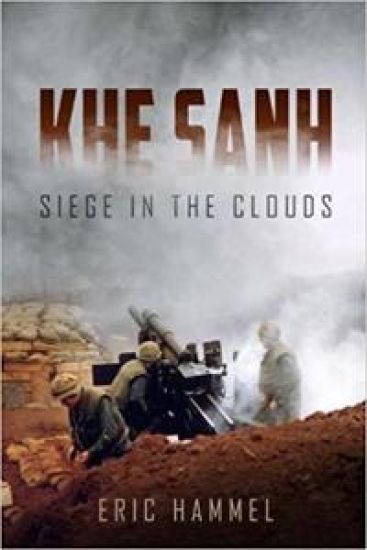
Khe Sanh

Khe Sanh

Eric Hammel

Casemate Publishers
2018
nidottu
In late 1967 as part of the Tet offensive, U.S. commanders hoped to lure the North Vietnamese Army into exposing large numbers of soldiers to their overwhelming air power. But in January 1968, a U.S. Marine Corps force found themselves surrounded by the enemy in their hilltop base at Khe Sanh. The siege lasted for nearly three months and caught the attention of the world; for many it came to epitomise the conflict. Eric Hammel’s classic account is a vivid oral history, using the words of American fighting men caught up in the gruelling, deadly seventy-seven-day ordeal create a harrowing tapestry of tragedy and triumph. As two North Vietnamese Army divisions move to surround them, the vastly outnumbered U.S. Marines rush to strengthen their defenses at the isolated base and several nearby hilltop positions. The Communist forces repeatedly attack, are repeatedly repelled, and then dig in to take the American base by siege–the makings of a classic, modern “set-piece” strategy in which the defenders become bait to tie the attackers to fixed positions in which they can be pummelled and pulverized by American artillery and air support. The gripping–and moving–narrative flows from the masterfully woven threads provided by nearly a hundred men who gallantly endured the wrenching all-out struggle to hold the combat base and its vulnerable outlying positions. Re-issued in the fiftieth anniversary year of the siege, with an updated photo section and maps, this is a ground-breaking and influential history of this crucial landmark battle.
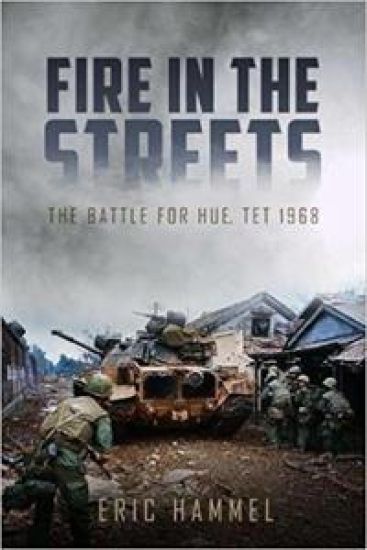
Fire in the Streets

Fire in the Streets

Eric Hammel

Casemate Publishers
2018
nidottu
The Tet Offensive of January 1968 was the most important military campaign of the Vietnam War. The ancient capital city of Hue, once considered the jewel of Indochina’s cities, was a key objective of a surprise Communist offensive launched on Vietnam’s most important holiday. But when the North Vietnamese launched their massive invasion of the city, instead of the general civilian uprising and easy victory they had hoped for, they faced a devastating battle of attrition with enormous casualties on both sides. In the end, the battle for Hue was an unambiguous military and political victory for South Vietnam and the United States. In Fire in the Streets, the dramatic narrative of the battle unfolds on an hour-by-hour, day-by-day basis. The focus is on the U.S. and South Vietnamese soldiers and Marines–from the top commanders down to the frontline infantrymen–and on the men and women who supported them. With access to rare documents from both North and South Vietnam and hundreds of hours of interviews, Eric Hammel, a renowned military historian, expertly draws on first-hand accounts from the battle participants in this engrossing mixture of action and commentary. In addition, Hammel examines the tremendous strain the surprise attack put on the South Vietnamese-U.S. alliance, the shocking brutality of the Communist “liberators,” and the lessons gained by U.S. Marines forced to wage battle in a city–a task for which they were utterly unprepared and which remains highly relevant today. Re-issued in the fiftieth anniversary year of the battle, with an updated photo section and maps this is the only complete and authoritative account of this crucial landmark battle.