Kirjojen hintavertailu. Mukana 12 595 353 kirjaa ja 12 kauppaa.

Kirjailija

Eric Heginbotham

Kirjat ja teokset yhdessä paikassa: 9 kirjaa, julkaisuja vuosilta 2008-2017, suosituimpien joukossa Shaking the Heavens and Splitting the Earth. Vertaile teosten hintoja ja tarkista saatavuus suomalaisista kirjakaupoista.

9 kirjaa

Kirjojen julkaisuhaarukka 2008-2017.

The Creation of the Pla Strategic Support Force and Its Implications for Chinese Military Space Operations
This report explores the missions and organization of China's military space enterprise, focusing on the People's Liberation Army (PLA) Strategic Support Force (SSF), created in 2015 to develop and employ most of the PLA's space capabilities. Its main function appears to be launch and operation of satellites to provide C4ISR capabilities critical to strategic deterrence, fighting informatized wars, and countering U.S. military intervention.
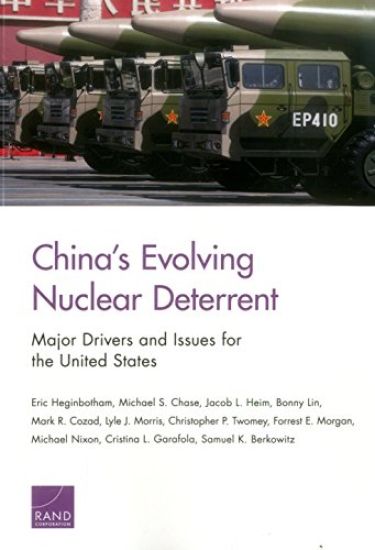
China's Evolving Nuclear Deterrent

China's Evolving Nuclear Deterrent

Eric Heginbotham; Michael S. Chase; Jacob L. Heim; Bonny Lin; Mark R. Cozad; Lyle J. Morris; Christopher P. Twomey; Forrest E. Morgan; Michael Nixon; Cristina L. Garafola; Samuel K. Berkowitz

RAND
2017
pokkari
China's approach to nuclear deterrence has been broadly consistent since its first test in 1964, but it has recently accelerated nuclear force modernization. China's strategic environment is likely to grow more complex, and nuclear constituencies are gaining a larger bureaucratic voice. Beijing is unlikely to change official nuclear policies but will probably increase emphasis on nuclear deterrence and may adjust the definition of key concepts.
The U.S.-China Military Scorecard

The U.S.-China Military Scorecard

Eric Heginbotham; Michael Nixon; Forrest E. Morgan; Jacob L. Heim; Jeff Hagen; Sheng Li; Jeffrey Engstrom; Martin C. Libicki; Paul DeLuca; David A. Shlapak; David R. Frelinger; Burgess Laird; Kyle Brady; Lyle J. Morris

RAND
2015
pokkari
A RAND study analyzed Chinese and U.S. military capabilities in two scenarios (Taiwan and the Spratly Islands) from 1996 to 2017, finding that trends in most, but not all, areas run strongly against the United States. While U.S. aggregate power remains greater than China s, distance and geography affect outcomes. China is capable of challenging U.S. military dominance on its immediate periphery and its reach is likely to grow in the years ahead."
The U.S. Army in Asia, 2030-2040

The U.S. Army in Asia, 2030-2040

Terrence K. Kelly; James Dobbins; David A. Shlapak; David C. Gompert; Eric Heginbotham; Peter Chalk; Lloyd Thrall

RAND
2015
pokkari
Looking to the 2030 2040 time frame, U.S. policy and military strategy will need to strike a balance among maintaining a cooperative relationship with China, deterring Chinese aggression in regional disputes, and preparing for the possibility that China could become more assertive. The U.S. Army will have an important role to play in preparing for these developments and for protecting and furthering U.S. interests in the region."
Shaking the Heavens and Splitting the Earth

Shaking the Heavens and Splitting the Earth

Roger Cliff; John C.H. Fei; Jeff Hagen; Elizabeth Hague; Eric Heginbotham; John Stillion

RAND
2011
pokkari
Less than a decade ago, China's air force was an antiquated service equipped almost exclusively with weapons based on 1950s-era Soviet designs and operated by personnel with questionable training according to outdated employment concepts. This monograph analyzes published Chinese and Western sources about current and future capabilities and employment concepts of the People's Liberation Army Air Force (PLAAF). It describes how those capabilities and concepts might be realized in a conflict over Taiwan, assesses the implications of China implementing them, and provides recommendations about actions that should be taken in response.
Chinese and Indian Strategic Behavior

Chinese and Indian Strategic Behavior

George J. Gilboy; Eric Heginbotham

Cambridge University Press
2012
sidottu
This book offers an empirical comparison of Chinese and Indian international strategic behavior. It is the first study of its kind, filling an important gap in the literature on rising Indian and Chinese power and American interests in Asia. The book creates a framework for the systematic and objective assessment of Chinese and Indian strategic behavior in four areas: (1) strategic culture; (2) foreign policy and use of force; (3) military modernization (including defense spending, military doctrine and force modernization); and (4) economic strategies (including international trade and energy competition). The utility of democratic peace theory in predicting Chinese and Indian behavior is also examined. The findings challenge many assumptions underpinning Western expectations of China and India.
Chinese and Indian Strategic Behavior

Chinese and Indian Strategic Behavior

George J. Gilboy; Eric Heginbotham

Cambridge University Press
2012
pokkari
This book offers an empirical comparison of Chinese and Indian international strategic behavior. It is the first study of its kind, filling an important gap in the literature on rising Indian and Chinese power and American interests in Asia. The book creates a framework for the systematic and objective assessment of Chinese and Indian strategic behavior in four areas: (1) strategic culture; (2) foreign policy and use of force; (3) military modernization (including defense spending, military doctrine and force modernization); and (4) economic strategies (including international trade and energy competition). The utility of democratic peace theory in predicting Chinese and Indian behavior is also examined. The findings challenge many assumptions underpinning Western expectations of China and India.
Pacific Currents

Pacific Currents

Evan S Medeiros; Keith Crane; Eric Heginbotham; Norman D Levin; Julia F Lowell

RAND
2008
pokkari
China's importance in the Asia-Pacific has been on the rise, raising concerns about competition the United States. The authors examined the reactions of six U.S. allies and partners to China's rise. All six see China as an economic opportunity. They want it to be engaged productively in regional affairs, but without becoming dominant. They want the United States to remain deeply engaged in the region.