Kirjojen hintavertailu. Mukana 12 595 353 kirjaa ja 12 kauppaa.

Kirjailija

Eric Kandel

Kirjat ja teokset yhdessä paikassa: 8 kirjaa, julkaisuja vuosilta 2007-2024, suosituimpien joukossa Principles of Neural Science, Sixth Edition. Vertaile teosten hintoja ja tarkista saatavuus suomalaisista kirjakaupoista.

8 kirjaa

Kirjojen julkaisuhaarukka 2007-2024.

Principles of Neural Science, Sixth Edition

Principles of Neural Science, Sixth Edition

Eric Kandel; John D. Koester; Sarah H. Mack; Steven Siegelbaum

McGraw-Hill Education
2021
nidottu
The gold standard of neuroscience texts-updated with hundreds of brand-new images and fully revised content in every chapterA Doody's Core Titles for 2024 & 2023! For more than 40 years, Principles of Neural Science has helped readers understand the link between the human brain and behavior. As the renowned text has shown, all behavior is an expression of neural activity and the future of both clinical neurology and psychiatry is dependent on the progress of neural science. Fully updated, this sixth edition of the landmark reference reflects the latest research, clinical perspectives, and advances in the field. It offers an unparalleled perspective on the the current state and future of neural science. This new edition features:Unmatched coverage of how the nerves, brain, and mind functionNEW chapters on: - The Computational Bases of Neural Circuits that Mediate Behavior - Brain-Machine Interfaces - Decision-Making and ConsciousnessNEW section on the neuroscientific principles underlying the disorders of the nervous systemExpanded coverage of the different forms of human memoryHighly detailed chapters on stroke, Parkinson’s disease, and multiple sclerosis2,200 images, including 300 new color illustrations, diagrams, radiology studies, and PET scansPrinciples of Neural Science, Sixth Edition benefits from a cohesive organization, beginning with an insightful overview of the interrelationships between the brain, nervous system, genes, and behavior. The text is divided into nine sections: Part I: Overall Perspective provides an overview of the broad themes of neural science, including the basic anatomical organization of the nervous system and the genetic bases of nervous system function and behavior.Part II: Cell and Molecular Biology of Cells of the Nervous System examines the basic properties of nerve cells, including the generation and conduction of propagated signaling. Part III: Synaptic Transmission focuses on the electrophysiological and molecular mechanism of synaptic transmission with chapters on neuronal excitability, neurotransmitters, and transmitter release. Part IV: Perception discusses the various aspects of sensory perception, including how information from the primary organs of sensation is transmitted to and processed by the central nervous system. Part V: Movement considers the neural mechanisms underlying movement and examines a new treatment that addresses how the basal ganglia regulate the selection of motor actions and instantiate reinforcement learning. Part VI: The Biology of Emotion, Motivation and Homeostasis examines the neural mechanisms by which subcortical areas mediate homeostatic control mechanisms, emotions, and motivation. Part VII: Development and the Emergence of Behavior looks at the nervous system from early embryonic differentiation to the formation and elimination of synapses. Part VIII: Learning, Memory, Language and Cognition expands on the previous section, examining the cellular mechanisms of implicit and explicit memory storage, as well as decision-making and consciousness. Part IX: explores the neural mechanisms underlying diseases and disorders of the nervous system, including autism spectrum disorder, epilepsy, schizophrenia, and anxiety.

The first 10 years

The first 10 years

Anders Hammarlund; Devin E. Naar; Amos Elon; Adam Gopnik; Eddy Portnoy; Jody Rosen; Stefanie Halpern; Eric Kandel; Christian Witt-Dörring; Fredric Bedoire; Allan Janik; Steven Beller; Per Svensson

Judisk Kultur i Sverige
2024
sidottu
The First Ten Years är en ambitiös sammanställning av de många uppmärksammade symposier, konferenser, konserter, litterära samtal, teatergästspel, samtal, läsningar, utställningar, böcker och mycket mera som kulturinstitutionen Judisk Kultur i Sverige har initierat och genomfört under de första tio åren. Boken innehåller texter från de internationella symposier som genomförts kring "Jewish Cities", som Berlin, New York, Wien och Thessaloniki. Därtill kommer en generös sammanställning av bilder från alla möten under åren, de många internationella gästerna som kommit till Sverige. Dessa inkluderar världsledande musiker, kompositörer och dirigenter. Nobelprisförfattare, framstående intellektuella och filmskapare. Därtill komiker, skådespelare, sångare, poeter och artister.Boken är redigerad av Lizzie Oved Scheja och Daniel Pedersen.Bland författarna återfinns Steven Beller, Allan Janik, Fredric Bedoire, Christian Witt-Dörring, Eric Kandel, Stefanie Halpern, Jody Rosen, Eddy Portnoy, Annie Polland, Daniel Soyer, David Denby, Adam Gopnik, Letty Cottin Pogrebin, Sandee Brawarsky, Tony Michels, Jackie Jakubowski, Amos Elon, Graeme Gilloch, Jay Howard Geller, Devin E. Naar and Anders Hammarlund Med texter av Hugo von Hofmannsthal, Moses Mendelssohn, Walter Benjamin, Ernst Bloch, Franz Hessel, Siegfrid Kracauer och Else Lasker-Schüler.Boken är rikligt illustrerad med hundratals färgfotografier.
The Age of Insight

The Age of Insight

Eric Kandel

Random House Inc
2012
sidottu
This is a rough cut edition. A brilliant book by Nobel Prize winner Eric R. Kandel, "The Age of Insight" takes us to Vienna 1900, where leaders in science, medicine, and art began a revolution that changed forever how we think about the human mind--our conscious and unconscious thoughts and emotions--and how mind and brain relate to art. At the turn of the century, Vienna was the cultural capital of Europe. Artists and scientists met in glittering salons, where they freely exchanged ideas that led to revolutionary breakthroughs in psychology, brain science, literature, and art. Kandel takes us into the world of Vienna to trace, in rich and rewarding detail, the ideas and advances made then, and their enduring influence today. The Vienna School of Medicine led the way with its realization that truth lies hidden beneath the surface. That principle infused Viennese culture and strongly influenced the other pioneers of Vienna 1900. Sigmund Freud shocked the world with his insights into how our everyday unconscious aggressive and erotic desires are repressed and disguised in symbols, dreams, and behavior. Arthur Schnitzler revealed women's unconscious sexuality in his novels through his innovative use of the interior monologue. Gustav Klimt, Oscar Kokoschka, and Egon Schiele created startlingly evocative and honest portraits that expressed unconscious lust, desire, anxiety, and the fear of death. Kandel tells the story of how these pioneers--Freud, Schnitzler, Klimt, Kokoschka, and Schiele--inspired by the Vienna School of Medicine, in turn influenced the founders of the Vienna School of Art History to ask pivotal questions such as What does the viewer bring to a work of art? How does the beholder respond to it? These questions prompted new and ongoing discoveries in psychology and brain biology, leading to revelations about how we see and perceive, how we think and feel, and how we respond to and create works of art. Kandel, one of the leading scientific thinkers of our time, places these five innovators in the context of today's cutting-edge science and gives us a new understanding of the modernist art of Klimt, Kokoschka, and Schiele, as well as the school of thought of Freud and Schnitzler. Reinvigorating the intellectual enquiry that began in Vienna 1900, "The Age of Insight" is a wonderfully written, superbly researched, and beautifully illustrated book that also provides a foundation for future work in neuroscience and the humanities. It is an extraordinary book from an international leader in neuroscience and intellectual history.
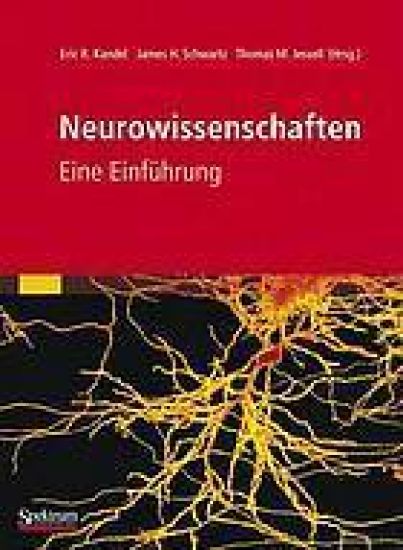
Neurowissenschaften

Neurowissenschaften

Eric Kandel; James Schwartz; Thomas Jessell

Spektrum Akademischer Verlag (Germany)
2012
nidottu
Dieses umfassende Lehrbuch für Studenten und Dozenten der Neurobiologie sowie an der Hirnforschung Interessierter aus Medizin und Psychologie ist die erste integrierende Darstellung der modernen Neurowissenschaften. Zahlreiche Disziplinen versuchen gemeinsam, menschliches Denken und Verhalten sowie deren Störungen auf biologische Strukturen und Vorgänge bzw. ihre Veränderung zurückzuführen. Der 'Kandel/Schwartz/Jessell' setzt nur (Oberstufen-)Schulwissen voraus und entwickelt aus der umfassenden Präsentation der molekularen und zellulären Grundeinheiten und -funktionen des Nervensystems geschickt das Verständnis von Wahrnehmungsprozessen, der Bewegungssteuerung und schließlich der höhreren geistigen Hirnleistungen wie Sprache, Lernen und Gedächtnis.Um das von Studierenden nachgefragte Buch auch weiterhin lieferbar halten zu können, wurde es schwarzweiß gedruckt.
Auf der Suche nach dem Gedächtnis
Wir sind das, woran wir uns erinnern Eric Kandel, der bedeutendste Gedächtnisforscher unserer Zeit, erinnert sich an sein Leben. Als Kind floh er 1939 vor den Nazis aus Wien nach New York. Mit großem erzählerischen Schwung schildert Kandel, wie ihn seine persönliche Suche nach der Erinnerung dazu brachte, sich erst der Geschichte, dann der Psychoanalyse und schließlich der neurobiologischen Forschung zuzuwenden, um eine neue Wissenschaft des menschlichen Denkens und Fühlens zu begründen. Zwei Tage nach Eric Kandels neuntem Geburtstag bricht die Gewalt in sein Leben ein. Die Wohnung der Kandels wird von den Nazis geplündert, die jüdische Familie muss fliehen. Gemeinsam mit seinem Bruder trifft er 1939 in New York ein, erst Monate später gelingt es den Eltern nachzukommen. Aus dem Versuch zu begreifen, was ihm geschehen ist, erwächst bei Kandel eine Faszination für die Vergangenheit, für das Erinnern und Vergessen. Das führt ihn zunächst zum Studium der Geschichte und Literatur. Doch das Wien, das ihn nicht loslässt, die Stadt Schnitzlers und Musils, ist auch die Sigmund Freuds. Bei seiner Auseinandersetzung mit der Psychoanalyse stößt Kandel jedoch rasch an die Grenzen dieses Fachs. Er wendet sich daher der biologischen Forschung zu. Es geht ihm um die wissenschaftliche Erklärung dessen, was Freud über psychische Prozesse, das Bewusste und das Unbewusste gesagt hat. Indem Kandel sein Leben Revue passieren lässt und seine Entwicklung als Forscher erzählt, beschreibt er, wie sich die moderne, neurobiologisch fundierte Wissenschaft des menschlichen Geistes entwickelt hat. Eine Autobiographie auf höchstem literarischem Niveau, geschrieben von einem analytischen Meisterdenker und getragen von großer politischer und menschlicher Weitsicht. Die Gedächtnisforschung ist eine Schlüsseldisziplin des 21. Jahrhunderts. "'Auf der Suche nach dem Gedächtnis' ist nicht bloß die Autobiographie eines Hirnforschers, es ist auch die Autobiographie einer Wissenschaft. Die Entwicklung der letzten 70 Jahre Hirnforschung werden so gut erzählt, wie es im biographischen Genre nur sein kann: zupackend, leidenschaftlich, mit Insiderinformationen, sorgfältig im Detail (...) ein faszinierender Einblick in eine bewundernswürdige Lebensleistung." Süddeutsche Zeitung "Kandels auch stilistisch mitreißend vorgetragenen Erinnerungen bewegen deshalb so sehr, weil sie die eigene Historie im Guten wie im Schlechten unauflösbar in der Zeitgeschichte verorten. Alles fügt sich zu einer großen Erzählung im Medium des Gedächtnisses." Literarische Welt "Kandel beschreibt hundert Jahre Gehirnforschung als intellektuellen Krimi. So kritisierbar es ist, wenn geisteswissenschaftliche Theoreme in der Kategoriensprache der Naturwissenschaft abgehandelt werden (...), so fragwürdig sind auch die Abwehrhaltungen oder Ignoranz gegen die Erkenntnisse der Neurowissenschaften. Gegen beide intellektuellen Pathologien hilft die Beschäftigung mit dem Gegenstand. Eric Kandels Erinnerungen an die Entstehungsgeschichte der Biologie des Geistes ist dafür eine hervorragende Handreichung." Tagezeitung
In Search of Memory: The Emergence of a New Science of Mind / À la recherche de la mémoire: Une nouvelle théorie de l'esprit
Memory is the key to our mental life. If we are what we are, it is mainly because of what we have leaned and what we remember.Whether reassuring or obsessive, vivid or vague, our memories constitute a sort of journey through time. How does the brain create memories? A few decades ago, the notion that memory and other aspects of the human mied could be explained by biology and molecular interaction was unimaginable. Since then, the biological exploration of the mied has become not just a possibility but also a reality. A major contributor to this revolution, Eric Kandel charts its history and shows how psychology, neuroscience and molecular biology have converged to create a new science of mied. Through its profound insights into perception, thought, emotions, recollection, as well as schizophrenia, depression, and age-related memory loss, this new science is pointing the way to more effective healing.In recounting his quest to understand memory, Kandel describes his career; he shows how the young man with a fascination for history and psychoanalysis became one of the scientists who revealed the cellular and molecular processes of memory, for which he was awarded the Nobel Prize.?In Search of Memory is a scintillating mix of memoir, history of science, and fundamental biology without peer. It shows compellingly what first-rate science is and how it is created.?E. O. Wilson ?Written with talent and grace, this extraordinary book by one of the greatest scientists of the mied alive will be read with delight by general readers as well as by students and scholars.? Elie Wiesel ?An extraordinary picture of this last incredible half-century of neuroscience.?Oliver Sacks Eric Kandel was awarded the Nobel Prize in physiology or medicine in 2000. He is University Professor at Columbia University, director of the Kavli Institute for Brain Sciences, and a senior investigator at the Howard Hughes Medical Institute. He was born in Vienna and has lived in the United States since 1939.