Kirjojen hintavertailu. Mukana 12 657 676 kirjaa ja 12 kauppaa.

Kirjailija

Eric Moulines

Kirjat ja teokset yhdessä paikassa: 4 kirjaa, julkaisuja vuosilta 2005-2019, suosituimpien joukossa Markov Chains. Vertaile teosten hintoja ja tarkista saatavuus suomalaisista kirjakaupoista.

4 kirjaa

Kirjojen julkaisuhaarukka 2005-2019.

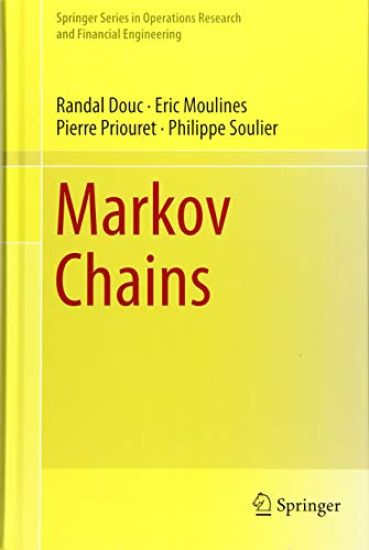
Markov Chains

Markov Chains

Randal Douc; Eric Moulines; Pierre Priouret; Philippe Soulier

Springer International Publishing AG
2019
sidottu
This book covers the classical theory of Markov chains on general state-spaces as well as many recent developments. The theoretical results are illustrated by simple examples, many of which are taken from Markov Chain Monte Carlo methods. The book is self-contained, while all the results are carefully and concisely proven. Bibliographical notes are added at the end of each chapter to provide an overview of the literature. Part I lays the foundations of the theory of Markov chain on general states-space. Part II covers the basic theory of irreducible Markov chains on general states-space, relying heavily on regeneration techniques. These two parts can serve as a text on general state-space applied Markov chain theory. Although the choice of topics is quite different from what is usually covered, where most of the emphasis is put on countable state space, a graduate student should be able to read almost all these developments without any mathematical background deeperthan that needed to study countable state space (very little measure theory is required). Part III covers advanced topics on the theory of irreducible Markov chains. The emphasis is on geometric and subgeometric convergence rates and also on computable bounds. Some results appeared for a first time in a book and others are original. Part IV are selected topics on Markov chains, covering mostly hot recent developments.
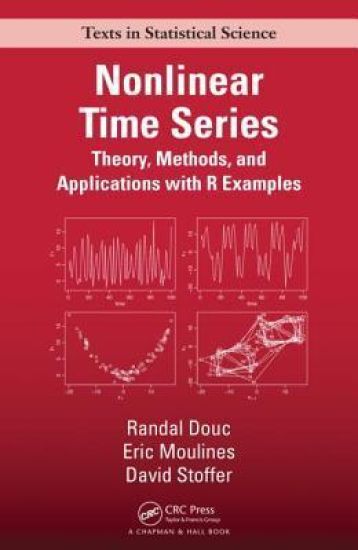
Nonlinear Time Series

Nonlinear Time Series

Randal Douc; Eric Moulines; David Stoffer

CRC Press Inc
2014
sidottu
Designed for researchers and students, Nonlinear Times Series: Theory, Methods and Applications with R Examples familiarizes readers with the principles behind nonlinear time series models—without overwhelming them with difficult mathematical developments. By focusing on basic principles and theory, the authors give readers the background required to craft their own stochastic models, numerical methods, and software. They will also be able to assess the advantages and disadvantages of different approaches, and thus be able to choose the right methods for their purposes.The first part can be seen as a crash course on "classical" time series, with a special emphasis on linear state space models and detailed coverage of random coefficient autoregressions, both ARCH and GARCH models. The second part introduces Markov chains, discussing stability, the existence of a stationary distribution, ergodicity, limit theorems, and statistical inference. The book concludes with a self-contained account on nonlinear state space and sequential Monte Carlo methods. An elementary introduction to nonlinear state space modeling and sequential Monte Carlo, this section touches on current topics, from the theory of statistical inference to advanced computational methods. The book can be used as a support to an advanced course on these methods, or an introduction to this field before studying more specialized texts. Several chapters highlight recent developments such as explicit rate of convergence of Markov chains and sequential Monte Carlo techniques. And while the chapters are organized in a logical progression, the three parts can be studied independently. Statistics is not a spectator sport, so the book contains more than 200 exercises to challenge readers. These problems strengthen intellectual muscles strained by the introduction of new theory and go on to extend the theory in significant ways. The book helps readers hone their skills in nonlinear time series analysis and their applications.
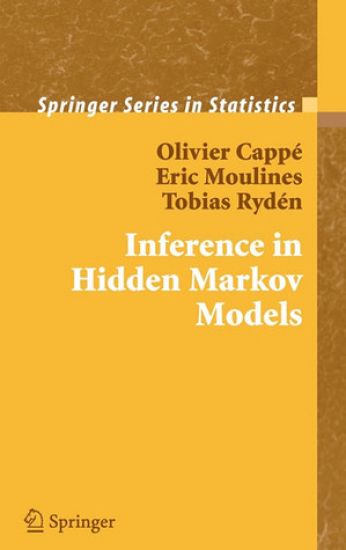
Inference in Hidden Markov Models

Inference in Hidden Markov Models

Olivier Cappé; Eric Moulines; Tobias Ryden

Springer-Verlag New York Inc.
2010
nidottu
Hidden Markov models have become a widely used class of statistical models with applications in diverse areas such as communications engineering, bioinformatics, finance and many more. This book is a comprehensive treatment of inference for hidden Markov models, including both algorithms and statistical theory. Topics range from filtering and smoothing of the hidden Markov chain to parameter estimation, Bayesian methods and estimation of the number of states. In a unified way the book covers both models with finite state spaces, which allow for exact algorithms for filtering, estimation etc. and models with continuous state spaces (also called state-space models) requiring approximate simulation-based algorithms that are also described in detail. Simulation in hidden Markov models is addressed in five different chapters that cover both Markov chain Monte Carlo and sequential Monte Carlo approaches. Many examples illustrate the algorithms and theory. The book also carefully treats Gaussian linear state-space models and their extensions and it contains a chapter on general Markov chain theory and probabilistic aspects of hidden Markov models. This volume will suit anybody with an interest in inference for stochastic processes, and it will be useful for researchers and practitioners in areas such as statistics, signal processing, communications engineering, control theory, econometrics, finance and more. The algorithmic parts of the book do not require an advanced mathematical background, while the more theoretical parts require knowledge of probability theory at the measure-theoretical level. From the reviews: "By providing an overall survey of results obtained so far in a very readable manner, and also presenting some new ideas, this well-written book will appeal to academic researchers in the field of HMMs, with PhD students working on related topics included. It will also appeal to practitioners and researchers from other fields by guiding them through the computational steps needed for making inference HMMs and/or by providing them with the relevant underlying statistical theory. In the reviewer's opinion this book will shortly become a reference work in its field." MathSciNet "This monograph is a valuable resource. It provides a good literature review, an excellent account of the state of the art research on the necessary theory and algorithms, and ample illustrations of numerous applications of HMM. It goes much beyond the earlier resources on HMM...I anticipate this work to serve well many Technometrics readers in the coming years." Haikady N. Nagaraja for Technometrics, November 2006
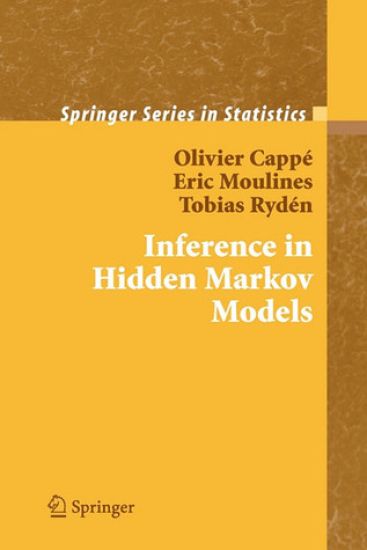
Inference in Hidden Markov Models

Inference in Hidden Markov Models

Olivier Cappé; Eric Moulines; Tobias Ryden

Springer-Verlag New York Inc.
2005
sidottu
Hidden Markov models have become a widely used class of statistical models with applications in diverse areas such as communications engineering, bioinformatics, finance and many more. This book is a comprehensive treatment of inference for hidden Markov models, including both algorithms and statistical theory. Topics range from filtering and smoothing of the hidden Markov chain to parameter estimation, Bayesian methods and estimation of the number of states. In a unified way the book covers both models with finite state spaces, which allow for exact algorithms for filtering, estimation etc. and models with continuous state spaces (also called state-space models) requiring approximate simulation-based algorithms that are also described in detail. Simulation in hidden Markov models is addressed in five different chapters that cover both Markov chain Monte Carlo and sequential Monte Carlo approaches. Many examples illustrate the algorithms and theory. The book also carefully treats Gaussian linear state-space models and their extensions and it contains a chapter on general Markov chain theory and probabilistic aspects of hidden Markov models. This volume will suit anybody with an interest in inference for stochastic processes, and it will be useful for researchers and practitioners in areas such as statistics, signal processing, communications engineering, control theory, econometrics, finance and more. The algorithmic parts of the book do not require an advanced mathematical background, while the more theoretical parts require knowledge of probability theory at the measure-theoretical level. From the reviews: "By providing an overall survey of results obtained so far in a very readable manner, and also presenting some new ideas, this well-written book will appeal to academic researchers in the field of HMMs, with PhD students working on related topics included. It will also appeal to practitioners and researchers from other fields by guiding them through the computational steps needed for making inference HMMs and/or by providing them with the relevant underlying statistical theory. In the reviewer's opinion this book will shortly become a reference work in its field." MathSciNet "This monograph is a valuable resource. It provides a good literature review, an excellent account of the state of the art research on the necessary theory and algorithms, and ample illustrations of numerous applications of HMM. It goes much beyond the earlier resources on HMM...I anticipate this work to serve well many Technometrics readers in the coming years." Haikady N. Nagaraja for Technometrics, November 2006