Kirjojen hintavertailu. Mukana 12 657 676 kirjaa ja 12 kauppaa.
Kirjailija
Eric Peltz
Kirjat ja teokset yhdessä paikassa: 9 kirjaa, julkaisuja vuosilta 2002-2014, suosituimpien joukossa Withdrawing from Iraq. Vertaile teosten hintoja ja tarkista saatavuus suomalaisista kirjakaupoista.
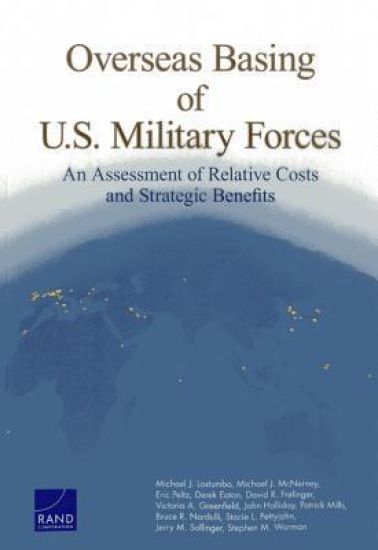
Michael J. Lostumbo; Michael J. McNerney; Eric Peltz; Derek Eaton; David R. Frelinger; Victoria A. Greenfield; John Halliday; Patrick Mills; Bruce R. Nardulli; Jerry M. Sollinger; Stephen M. Worman
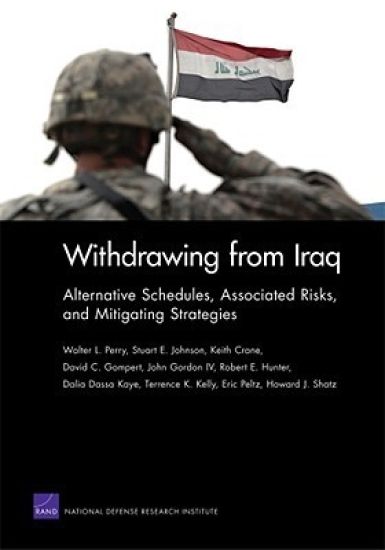
Walter L. Perry; Stuart E. Johnson; Keith Crane; David C. Gompert; John Gordon; Robert E. Hunter; Dalia Dassa Kaye; Terrence K. Kelly; Eric Peltz; Howard J. Shatz
Since 2007, security has improved dramatically in Iraq. The U.S. and Iraqi governments - and most Iraqis - want to see both the U.S. presence there reduced and the Iraqi government and security forces assuming a greater role in providing for public security. The challenge is to effect this drawdown while preserving security and stability in the country and in the region. In response to tasking from the U.S. Congress, RAND researchers conducted an independent study to examine drawdown schedules, risks, and mitigating strategies. They identified logistical constraints on moving equipment out of the country, assessed trends in insurgent activity and the ability of Iraqi security forces to counter it, and examined the implications for the size of the residual U.S. force and for security in Iraq and the region. This book presents alternative drawdown schedules - one consistent with the Obama administration's stated intentions and two others, one somewhat slower and another faster - that are responsive to these factors.It also recommends steps that the United States can take to alleviate anticipated constraints, overcome likely resistance, and reduce the potential risks associated with a drawdown. For more than 60 years, decisionmakers in the public and private sectors have turned to the RAND Corporation for objective analysis and effective solutions that address the challenges facing the nation and the world.
Examines Department of Defense depot-level reparable (DLR) supply chain management to identify the most common reasons for apparent inventory excess and customer support shortfalls and assess how DLR supply chain management could be improved to enhance customer support and reduce costs.
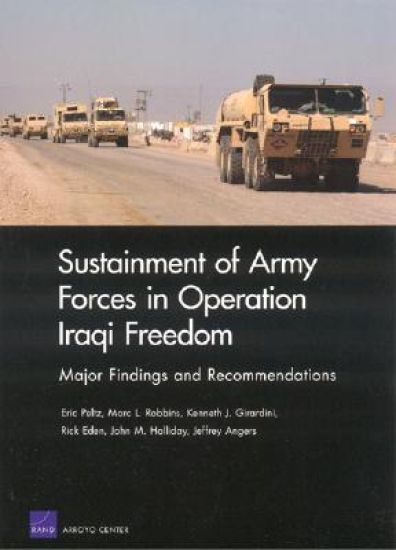
This book describes how well the Department of Defense logistics system supported Army forces in Operation Iraqi Freedom, documents the major reasons for shortfalls in performance, provides recommendations for improvement, and points to questions raised with respect to the design of future forces.
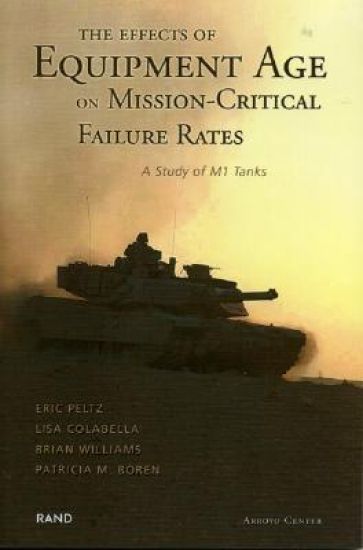
Assesses the relationship between tank age and the mission-critical failure rate for the Army's M1 Abrams tank. Budget limits have brought about extensions in the service lives of many Army weapon systems. In the widespread belief that the increases in fleet age will create readiness and cost problems, the Army is executing recapitalization programs to rebuild or upgrade selected weapon systems to retain combat capabilities and hold down maintenance costs. This research assesses the effects of age on mission-critical failure rates for M1 Abrams tanks.
Even before the new Army vision took shape and the Army began its transformation efforts, the nonlinear operational concepts now associated with the Objective Force were emerging. This work covers research to identify how the army should define equipment sustainment requirements for new systems.
Using a case study based on the Army's Stryker Brigade Combat team, the authors explore how the Army might improve its ability to contribute to prompt global power projection, that is, strategically responsive early-entry forces for time-critical events.
Defines metrics to evaluate the Army's process for returning and repairing reparable spare parts. Value recovery, in the form of the return and repair of reparable spare parts, involves sizable investments of time and inventory. This monograph describes metrics developed to evaluate the Army's retrograde processes. Baseline repair times were found to be long: over a month for items repaired below depot and returned to stock. The authors suggest ways to speed up the movement of parts through the system to minimize the size of the parts inventory.
The Equipment Downtime Analyzer is a tool designed to help the Army optimize its equipment sustainment processes and enhance the companion processes that head off equipment failure before it happens. The new Army Vision, with its emphasis on rapid force deployment and immediate employment capabilities, demands robust equipment and streamlined logistics processes that maximize the ability of soldiers to keep equipment ready to fight. Achieving this goal calls for dramatic progress in the Army's ability to keep equipment ready-a synergistic combination of improving the logistics system and equipment reliability. To do this, the Army needs metrics that fully potytsy its equipment readiness capabilities, both in the motor pool and during missions, to identify critical preparation and operating shortfalls. These metrics should directly connect the underlying logistics processes and equipment reliability to equipment readiness results so that the Army can target its resources effectively.This document presents a general framework for measuring equipment readiness and linking it to process performance, and it introduces a prototype initiative based upon this framework, the Equipment Downtime Analyzer (EDA). The EDA leverages advances in information technology to better utilize data collected by existing Army information systems. It provides an integrated set of metrics that tie equipment sustainment and reliability to equipment readiness. The authors illustrate potential applications for the EDA and describe its power to provide more complete and effective information for managing equipment readiness. They also discuss EDA implementation and some of the ways that the Army might enhance it through increased data integration, thereby improving its ability to help the Army understand equipment readiness. To keep its equipment ready to fight, the Army needs metrics that fully portray its condition both in the motor pool and during missions. These metrics should connect underlying logistics processes and equipment reliability to equipment readiness results so that the Army can target its resources effectively.The Equipment Downtime Analyzer provides an integrated set of metrics that tie equipment sustainment and reliability to equipment readiness.