Kirjojen hintavertailu. Mukana 12 390 323 kirjaa ja 12 kauppaa.

Kirjailija

Eric R. Wolf

Kirjat ja teokset yhdessä paikassa: 6 kirjaa, julkaisuja vuosilta 1999-2012, suosituimpien joukossa Envisioning Power. Vertaile teosten hintoja ja tarkista saatavuus suomalaisista kirjakaupoista.

6 kirjaa

Kirjojen julkaisuhaarukka 1999-2012.

Europe and the People Without History

Europe and the People Without History

Eric R. Wolf; Thomas Hylland Eriksen

University of California Press
2010
pokkari
Offering insight and equal consideration into the societies of the "civilized" and "uncivilized" world, "Europe and the People Without History" deftly explores the historical trajectory of so-called modern globalization. In this foundational text about the development of the global political economy, Eric R. Wolf challenges the long-held anthropological notion that non-European cultures and people were isolated and static entities before the advent of European colonialism and imperialism. Ironically referred to as "the People Without History" by Wolf, these societies before active colonization possessed perpetually changing, reactionary cultures and were indeed just as intertwined into the processes of the pre-Columbian global economic system as their European counterparts. Utilizing Marxian concepts and a vivid consideration for the importance of history, Wolf judiciously traces the effects and conditions in Europe and the rest of the "known" world, beginning in 1400 AD, that allowed capitalism to emerge as the dominant ideology of the modern era.
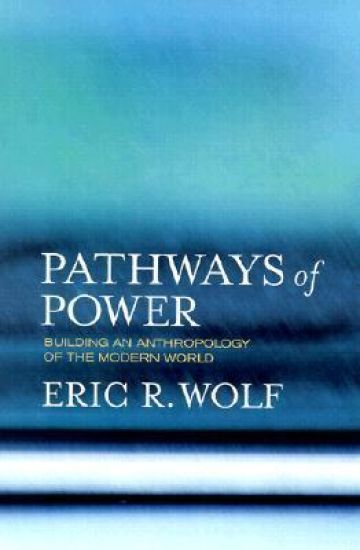
Pathways of Power

Pathways of Power

Eric R. Wolf; Aram Yengoyan

University of California Press
2001
pokkari
This collection of twenty-eight essays by renowned anthropologist Eric R. Wolf is a legacy of some of his most original work, with an insightful foreword by Aram Yengoyan. Of the essays, six have never been published and two have not appeared in English until now. Shortly before his death, Wolf prepared introductions to each section and individual pieces, as well as an intellectual autobiography that introduces the collection as a whole. Sydel Silverman, who completed the editing of the book, says in her preface, "He wanted this selection of his writings over the past half-century to serve as part of the history of how anthropology brought the study of complex societies and world systems into its purview."
The Hidden Frontier

The Hidden Frontier

John W. Cole; Eric R. Wolf

University of California Press
1999
pokkari
This award-winning classic in the study of ethnicity, identity, and nation-building has a new introduction (on which Eric Wolf collaborated near the end of his life) that shows the continuing validity of the book's innovative approach to ethnography, ecology, culture, and politics. The authors investigated two Alpine villages--the German-speaking community of St. Felix and Romance-speaking Tret--only a mile apart in the same mountain valley.
History, Power, Ideology

History, Power, Ideology

Donald L. Donham; Eric R. Wolf

University of California Press
1999
pokkari
Is Marxism a reflection of the conceptual system it fights against, rather than a truly comprehensive approach to human history? Drawing on recent work in anthropology, history, and philosophy, Donald Donham confronts this problem in analyzing a radically different social order: the former Maale kingdom of southern Ethiopia. "Every once in a while there appears a book that ...opens up new ways of inquiring into the ways of the world. Donald Donham has written such a book. The style is quiet and judicious, but the effect is stunning...In putting inherited partisan approaches to the test of explaining the realities of Maale society and culture, Donham enriches anthropology and imparts new vigor to the analytical Marxian traditions. "History, Power, Ideology" embodies a major accomplishment". (From the Foreword).
Envisioning Power

Envisioning Power

Eric R. Wolf

University of California Press
1999
pokkari
With the originality and energy that have marked his earlier works, Eric Wolf now explores the historical relationship of ideas, power, and culture. Responding to anthropology's long reliance on a concept of culture that takes little account of power, Wolf argues that power is crucial in shaping the circumstances of cultural production. Responding to social-science notions of ideology that incorporate power but disregard the ways ideas respond to cultural promptings, he demonstrates how power and ideas connect through the medium of culture. Wolf advances his argument by examining three very different societies, each remarkable for its flamboyant ideological expressions: the Kwakiutl Indians of the Northwest Pacific Coast, the Aztecs of pre-Hispanic Mexico, and National Socialist Germany. Tracing the history of each case, he shows how these societies faced tensions posed by ecological, social, political, or psychological crises, prompting ideological responses that drew on distinctive, historically rooted cultural understandings. In each case study, Wolf analyzes how the regnant ideology intertwines with power around the pivotal relationships that govern social labor. Anyone interested in the history of anthropology or in how the social sciences make comparisons will want to join Wolf in Envisioning Power.