Kirjojen hintavertailu. Mukana 12 595 353 kirjaa ja 12 kauppaa.

Kirjailija

Eric S. Nelson

Kirjat ja teokset yhdessä paikassa: 10 kirjaa, julkaisuja vuosilta 2016-2025, suosituimpien joukossa Daoism and Environmental Philosophy. Vertaile teosten hintoja ja tarkista saatavuus suomalaisista kirjakaupoista.

Mukana myös kirjoitusasut: Eric S Nelson

10 kirjaa

Kirjojen julkaisuhaarukka 2016-2025.

Heidegger and Dao

Heidegger and Dao

Eric S. Nelson

BLOOMSBURY PUBLISHING PLC
2025
nidottu
In this innovative contribution, Eric S. Nelson offers a contextualized and systematic exploration of the Chinese sources and German language interpretations that shaped Heidegger's engagement with Daoism and his thinking of the thing, nothingness, and the freedom of releasement (Gelassenheit). Encompassing forgotten and recently published historical sources, including Heidegger's Daoist and Buddhist-related reflections in his lectures and notebooks, Nelson presents a critical intercultural reinterpretation of Heidegger's philosophical journey. Nelson analyzes the intersections and differences between the Daodejing, the Zhuangzi, and Heidegger's philosophy and the linguistic and conceptual shifts in Heidegger's thinking that correlate with his encounters and interactions with Daoist, Buddhist, and East Asian texts and interlocutors. He thereby traces hints for encountering things and environments anew, models for intercultural hermeneutics, and ways of reimagining the thing, nothingness, and freedom with and beyond Heidegger's thought. This work elucidates the thing, the mystery, and freedom in Heidegger and Daoism in Part I and Heidegger's thinking of nothingness, emptiness, and the clearing in relation to Daoist and Buddhist philosophy in Part II. In each part, Nelson unfolds a fresh perspective for thinking further with Heidegger and East Asian philosophies in relation to the contemporary existential and environmental situation for the sake of nourishing life amidst damaged life.
Heidegger and Dao

Heidegger and Dao

Eric S. Nelson

BLOOMSBURY PUBLISHING PLC
2023
sidottu
In this innovative contribution, Eric S. Nelson offers a contextualized and systematic exploration of the Chinese sources and German language interpretations that shaped Heidegger's engagement with Daoism and his thinking of the thing, nothingness, and the freedom of releasement (Gelassenheit). Encompassing forgotten and recently published historical sources, including Heidegger's Daoist and Buddhist-related reflections in his lectures and notebooks, Nelson presents a critical intercultural reinterpretation of Heidegger's philosophical journey. Nelson analyzes the intersections and differences between the Daodejing, the Zhuangzi, and Heidegger's philosophy and the linguistic and conceptual shifts in Heidegger's thinking that correlate with his encounters and interactions with Daoist, Buddhist, and East Asian texts and interlocutors. He thereby traces hints for encountering things and environments anew, models for intercultural hermeneutics, and ways of reimagining the thing, nothingness, and freedom with and beyond Heidegger's thought. This work elucidates the thing, the mystery, and freedom in Heidegger and Daoism in Part I and Heidegger's thinking of nothingness, emptiness, and the clearing in relation to Daoist and Buddhist philosophy in Part II. In each part, Nelson unfolds a fresh perspective for thinking further with Heidegger and East Asian philosophies in relation to the contemporary existential and environmental situation for the sake of nourishing life amidst damaged life.
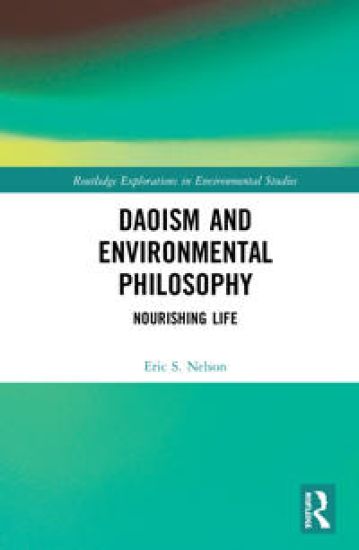
Daoism and Environmental Philosophy

Daoism and Environmental Philosophy

Eric S. Nelson

TAYLOR FRANCIS LTD
2022
nidottu
Daoism and Environmental Philosophy explores ethics and the philosophy of nature in the Daodejing, the Zhuangzi, and related texts to elucidate their potential significance in our contemporary environmental crisis. This book traces early Daoist depictions of practices of embodied emptying and forgetting and communicative strategies of undoing the fixations of words, things, and the embodied self. These are aspects of an ethics of embracing plainness and simplicity, nourishing the asymmetrically differentiated yet shared elemental body of life of the myriad things, and being responsively attuned in encountering and responding to things. These critical and transformative dimensions of early Daoism provide exemplary models and insights for cultivating a more expansive ecological ethos, environmental culture of nature, and progressive political ecology.This work will be of interest to students and scholars interested in philosophy, environmental ethics and philosophy, religious studies, and intellectual history.
Levinas, Adorno, and the Ethics of the Material Other

Levinas, Adorno, and the Ethics of the Material Other

Eric S. Nelson

State University of New York Press
2021
pokkari
A provocative examination of the consequences of Levinas's and Adorno's thought for contemporary ethics and political philosophy.This book sets up a dialogue between Emmanuel Levinas and Theodor W. Adorno, using their thought to address contemporary environmental and social-political situations. Eric S. Nelson explores the "non-identity thinking" of Adorno and the "ethics of the Other" of Levinas with regard to three areas of concern: the ethical position of nature and "inhuman" material others such as environments and animals; the bonds and tensions between ethics and religion and the formation of the self through the dynamic of violence and liberation expressed in religious discourses; and the problematic uses and limitations of liberal and republican discourses of equality, liberty, tolerance, and their presupposition of the private individual self and autonomous subject. Thinking with and beyond Levinas and Adorno, this work examines the possibility of an anarchic hospitality and solidarity between material others and sensuous embodied life.
Levinas, Adorno, and the Ethics of the Material Other

Levinas, Adorno, and the Ethics of the Material Other

Eric S. Nelson

State University of New York Press
2020
sidottu
A provocative examination of the consequences of Levinas's and Adorno's thought for contemporary ethics and political philosophy.This book sets up a dialogue between Emmanuel Levinas and Theodor W. Adorno, using their thought to address contemporary environmental and social-political situations. Eric S. Nelson explores the "non-identity thinking" of Adorno and the "ethics of the Other" of Levinas with regard to three areas of concern: the ethical position of nature and "inhuman" material others such as environments and animals; the bonds and tensions between ethics and religion and the formation of the self through the dynamic of violence and liberation expressed in religious discourses; and the problematic uses and limitations of liberal and republican discourses of equality, liberty, tolerance, and their presupposition of the private individual self and autonomous subject. Thinking with and beyond Levinas and Adorno, this work examines the possibility of an anarchic hospitality and solidarity between material others and sensuous embodied life.
Daoism and Environmental Philosophy

Daoism and Environmental Philosophy

Eric S. Nelson

Routledge
2020
sidottu
Daoism and Environmental Philosophy explores ethics and the philosophy of nature in the Daodejing, the Zhuangzi, and related texts to elucidate their potential significance in our contemporary environmental crisis. This book traces early Daoist depictions of practices of embodied emptying and forgetting and communicative strategies of undoing the fixations of words, things, and the embodied self. These are aspects of an ethics of embracing plainness and simplicity, nourishing the asymmetrically differentiated yet shared elemental body of life of the myriad things, and being responsively attuned in encountering and responding to things. These critical and transformative dimensions of early Daoism provide exemplary models and insights for cultivating a more expansive ecological ethos, environmental culture of nature, and progressive political ecology.This work will be of interest to students and scholars interested in philosophy, environmental ethics and philosophy, religious studies, and intellectual history.
Grammar Advantage

Grammar Advantage

Eric S Nelson; George Yule

A3d Impressions
2019
pokkari
Grammar Advantage is a course text and self-study tool for advanced learners of English as a second language (C-TOEFL score of at least 190 or equivalent). Clear examples and explanations are followed by varied and abundant exercises. Topics that are important in academic contexts are highlighted: sentence structure, transitions, and sentence flow, verb tenses, active and passive voice, gerunds and infinitives, reporting and noun clauses, relative clauses, adverbials, and conditionals. Coverage of basic rules and finer points of usage help students understand not just basic grammar but how individual words are used (lexical grammar). Easily referenced subsections and sections on errors to avoid enable teachers to guide students to edit their work. The text includes four appendices (Tense Overview, Basic Punctuation for Joining Clauses, Transition Expressions Word by Word, and Principles of Sentence Flow), a glossary of grammar terms, an index and, on request, answer keys.
Chinese and Buddhist Philosophy in Early Twentieth-Century German Thought
Presenting a comprehensive portrayal of the reading of Chinese and Buddhist philosophy in early twentieth-century German thought, Chinese and Buddhist Philosophy in Early Twentieth-Century German Thought examines the implications of these readings for contemporary issues in comparative and intercultural philosophy.Through a series of case studies from the late 19th-century and early 20th-century, Eric Nelson focuses on the reception and uses of Confucianism, Daoism, and Buddhism in German philosophy, covering figures as diverse as Buber, Heidegger, and Misch. He argues that the growing intertextuality between traditions cannot be appropriately interpreted through notions of exclusive identities, closed horizons, or unitary traditions. Providing an account of the context, motivations, and hermeneutical strategies of early twentieth-century European thinkers’ interpretation of Asian philosophy, Nelson also throws new light on the question of the relation between Heidegger and Asian philosophy. Reflecting the growing interest in the possibility of intercultural and global philosophy, Chinese and Buddhist Philosophy in Early Twentieth-Century German Thought opens up the possibility of a more inclusive intercultural conception of philosophy.
Chinese and Buddhist Philosophy in Early Twentieth-Century German Thought
Presenting a comprehensive portrayal of the reading of Chinese and Buddhist philosophy in early twentieth-century German thought, Chinese and Buddhist Philosophy in Early Twentieth-Century German Thought examines the implications of these readings for contemporary issues in comparative and intercultural philosophy.Through a series of case studies from the late 19th-century and early 20th-century, Eric Nelson focuses on the reception and uses of Confucianism, Daoism, and Buddhism in German philosophy, covering figures as diverse as Buber, Heidegger, and Misch. He argues that the growing intertextuality between traditions cannot be appropriately interpreted through notions of exclusive identities, closed horizons, or unitary traditions. Providing an account of the context, motivations, and hermeneutical strategies of early twentieth-century European thinkers’ interpretation of Asian philosophy, Nelson also throws new light on the question of the relation between Heidegger and Asian philosophy. Reflecting the growing interest in the possibility of intercultural and global philosophy, Chinese and Buddhist Philosophy in Early Twentieth-Century German Thought opens up the possibility of a more inclusive intercultural conception of philosophy.