Kirjojen hintavertailu. Mukana 12 595 353 kirjaa ja 12 kauppaa.

Kirjailija

Eric Tucker

Kirjat ja teokset yhdessä paikassa: 12 kirjaa, julkaisuja vuosilta 1990-2023, suosituimpien joukossa Working Disasters. Vertaile teosten hintoja ja tarkista saatavuus suomalaisista kirjakaupoista.

12 kirjaa

Kirjojen julkaisuhaarukka 1990-2023.

English Shepherd Training Guide English Shepherd Training Includes
This training guide is a truly unique and informative book which is full of reliable and time tested information - written for the admirers and owners of this wonderful breed. Easy-to-read and in-depth in its nature - you will thoroughly enjoy your experience with this training guide. A wealth of reliable methods and procedures, alongside detailed advice for current or soon-to-be-owners is contained within. Contributed to by a series of specialist dog trainers, this book is certainly a must have addition to your collection.
Working Disasters

Working Disasters

Eric Tucker

Routledge
2016
nidottu
Every day, workers are injured, made ill, or killed on the job. Most often, workers experience these harms individually and in isolation. Particular occurrences rarely attract much public attention beyond, perhaps, a small paragraph in the local newspaper. Instead, these events are normalized. This membrane of normalcy, however, is ruptured from time to time, especially after a disaster. This edited collection draws together original case studies written by leading researchers in Australia, Canada, Great Britain, Sweden, and the United States that examine the politics of working disasters. The essays address two fundamental questions: what gets recognized as a work disaster? And how does the state respond to one? In some instances, it seems self-evident that a disaster has occurred. For example, when a mine explodes killing tens or hundreds of workers simultaneously, the media and politicians recognize that this is not just a personal tragedy for the families of the victims, and that more troubling questions need to be asked about how this could happen. In other circumstances, however, the process that determines what gets recognized as a disaster is much more complicated. "Working Disasters" addresses the politics of recognition in case studies of the long-haul trucking industry, repetitive strain injuries, and lung disease in miners. Once it has recognized that a working disaster has occurred, the state typically goes beyond its routine responses to the daily toll of work-related deaths and injuries. Inquiries may be initiated to review the adequacy of regulatory systems and laws may be amended. Sometimes disasters produce meaningful change, but often they do not. In this text, the politics of response is considered in studies of a factory fire, the loss of an offshore oilrig, lung disease among miners, a mine explosion, and the prosecution of health and safety offences. This book will be of use to occupational health and safety activists and professionals; academics and upper-year students in: industrial relations, labour studies, labour history, law, political science, and sociology.
Working Disasters

Working Disasters

Eric Tucker

Baywood Publishing Company Inc
2006
sidottu
Every day, workers are injured, made ill, or killed on the job. Most often, workers experience these harms individually and in isolation. Particular occurrences rarely attract much public attention beyond, perhaps, a small paragraph in the local newspaper. Instead, these events are normalized. This membrane of normalcy, however, is ruptured from time to time, especially after a disaster. This edited collection draws together original case studies written by leading researchers in Australia, Canada, Great Britain, Sweden, and the United States that examine the politics of working disasters. The essays address two fundamental questions: what gets recognized as a work disaster? And how does the state respond to one? In some instances, it seems self-evident that a disaster has occurred. For example, when a mine explodes killing tens or hundreds of workers simultaneously, the media and politicians recognize that this is not just a personal tragedy for the families of the victims, and that more troubling questions need to be asked about how this could happen. In other circumstances, however, the process that determines what gets recognized as a disaster is much more complicated. "Working Disasters" addresses the politics of recognition in case studies of the long-haul trucking industry, repetitive strain injuries, and lung disease in miners. Once it has recognized that a working disaster has occurred, the state typically goes beyond its routine responses to the daily toll of work-related deaths and injuries. Inquiries may be initiated to review the adequacy of regulatory systems and laws may be amended. Sometimes disasters produce meaningful change, but often they do not. In this text, the politics of response is considered in studies of a factory fire, the loss of an offshore oilrig, lung disease among miners, a mine explosion, and the prosecution of health and safety offences. This book will be of use to occupational health and safety activists and professionals; academics and upper-year students in: industrial relations, labour studies, labour history, law, political science, and sociology.
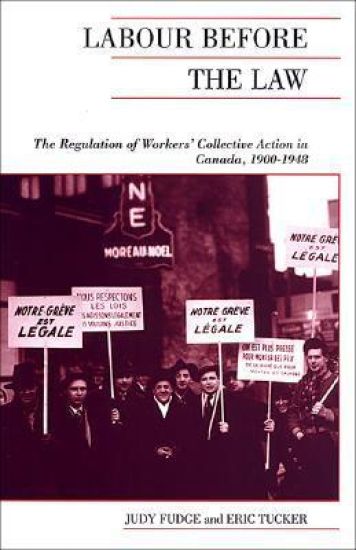
Labour Before the Law

Labour Before the Law

Judy Fudge; Eric Tucker

University of Toronto Press
2001
pokkari
In this groundbreaking study of the relations between workers and the state, Judy Fudge and Eric Tucker examine the legal regulation of workers' collective action from 1900 to 1948. They analyze the strikes, violent confrontations, lockouts, union organizing drives, legislative initiatives, and major judicial decisions that transformed the labour relations regime of liberal voluntarism, which prevailed in the later part of the nineteenth century, into industrial voluntarism, whose centrepiece was Mackenzie King's Industrial Disputes Investigation Act of 1907. This period was marked by coercion and compromise, as workers organized and fought to extend their rights against the profit oriented owners of capital, while the state struggled to define a labour regime that contained industrial conflict. The authors then trace the conflicts that eventually produced the industrial pluralism that Canadians have known in more recent years. By 1948 a detailed set of legal rules and procedures had evolved and achieved a hegemonic status that no prior legal regime had even approached. This regime has become so central to our everyday thinking about labour relations that one might be forgiven for thinking that everything that came earlier was, truly, before the law. But, as Labour Before the Law demonstrates, workers who acted collectively prior to 1948 often found themselves before the law, whether appearing before a magistrate charged with causing a disturbance, facing a superior court judge to oppose an injunction, or in front of a board appointed pursuant to a statutory scheme that was investigating a labour dispute and making recommendations for its resolution. The book is simultaneously a history of law, aspects of the state, trade unions and labouring people, and their interaction within the broad and shifting terrain of political economy. The authors are attentive to regional differences and sectoral divergences, and they attempt to address the fragmentation of class experience.
Labour Before the Law

Labour Before the Law

Judy Fudge; Eric Tucker

Oxford University Press, Canada
2001
pokkari
In this groundbreaking study of the relations between workers and the state, Judy Fudge and Eric Tucker examine the legal regulation of workers' collective action from 1900 to 1948. They analyze the strikes, violent confrontations, lockouts, union organizing drives, legislative initiatives, and major judicial decisions that transformed the labour relations regime of liberal voluntarism, which prevailed in the later part of the nineteenth century, into industrial voluntarism, whose centrepiece was Mackenzie King's Industrial Disputes Investigation Act of 1907. This period was marked by coercion and compromise, as workers organized and fought to extend their rights against the profit oriented owners of capital, while the state struggled to define a labour regime that contained industrial conflict. The authors then trace the conflicts that eventually produced the industrial pluralism that Canadians have known in more recent years. By 1948 a detailed set of legal rules and procedures had evolved and achieved a hegemonic status that no prior legal regime had even approached. This regime has become so central to our everyday thinking about labour relations that one might be forgiven for thinking that everything that came earlier was, truly, before the law. But, as Labour Before the Law demonstrates, workers who acted collectively prior to 1948 often found themselves before the law, whether appearing before a magistrate charged with causing a disturbance, facing a superior court judge to oppose an injunction, or in front of a board appointed pursuant to a statutory scheme that was investigating a labour dispute and making recommendations for its resolution. The book is simultaneously a history of law, aspects of the state, trade unions and labouring people, and their interaction within the broad and shifting terrain of political economy. The authors are attentive to regional differences and sectoral divergences, and they attempt to address the fragmentation of class experience.
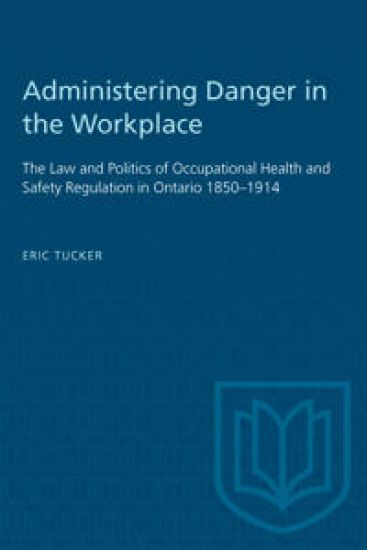
Administering Danger in the Workplace

Administering Danger in the Workplace

Eric Tucker

University of Toronto Press
1990
pokkari
For Ontario workers during the industrial revolution the workplace was often an environment of terrible danger. Injuries and illness from unsafe working conditions were commonplace. Over time these conditions spurred efforts for reform from activists, legislators, and the courts. But change was slow in coming. To understand the impact of industrial revolution on the health and safety of workers generally, and on women and children in particular, tucker uses their testimony before various commissions, newspapers, and reported court cases. Initial efforts to effect change were made through the courts; they were largely unsuccessful. When the judiciary refused to regulate the risk-creating conduct of employers, through either the civil or the criminal law, workers and Victorian reformers found common ground in successfully promoting factory legislation. By prescribing and enforcing minimum standards, a measure of regulatory responsibility for the health of workers generally and women and children in particular was shifted from the market to the state. Class interest and gender ideology played a substantial role in this process. But the legislation’s implementation belied its promise. The government was unwilling to provide adequate enforcement resources and inspectors accepted the conventional wisdom that workers had to adjust to the ‘normal’ hazards of industry, which were reasonable and, therefore, legal. Even when the accident rate began to soar as a result of the ‘second industrial revolution,’ the authorities remained complacent. Tucker says that in industrial capitalist social formation, the nature and degree of hazards to which workers are exposed are determined largely by the employer-worker balance of power. Their respective power resources both shape and are shaped by the ideological, legal, political, and administrative environment in which they are deployed. Throughout the last half of the nineteenth century and up to the First World War, state regulation of occupational health and safety was substantially subordinated to market-driven forces; it still is today.